
Hedge funds turned bullish for the first time after a lapse of more than a year, and fluctuations in the foreign exchange market intensified after Japan and the US raised interest rates to about US$1.6 billion
The Zhitong Finance App learned that according to the latest data from the US Commodity Futures Trading Commission (CFTC), hedge funds have turned bullish on the yen for the first time since July 2025. Just a few weeks ago, the US and Japanese authorities intervened in the market to support the yen, and as the market's expectations for the next policy path changed, leveraged funds began to bet on the yen's further strengthening.
As of the week ending September 15, leveraged funds have completely eliminated their previous net short positions in yen and begun to establish long positions in yen. According to a summary of CFTC data, the media showed that these funds currently hold positions related to the appreciation of the yen of approximately 251 billion yen (about 1.6 billion US dollars).
Judging from the number of contracts, the leveraged fund's yen position changed drastically from a net shortfall of 53,255 contracts to a net increase of 20,069 contracts, indicating a clear reversal in speculative capital's attitude towards the yen. This is also the first time since July 2025 that hedge funds as a whole have turned bullish on the yen.
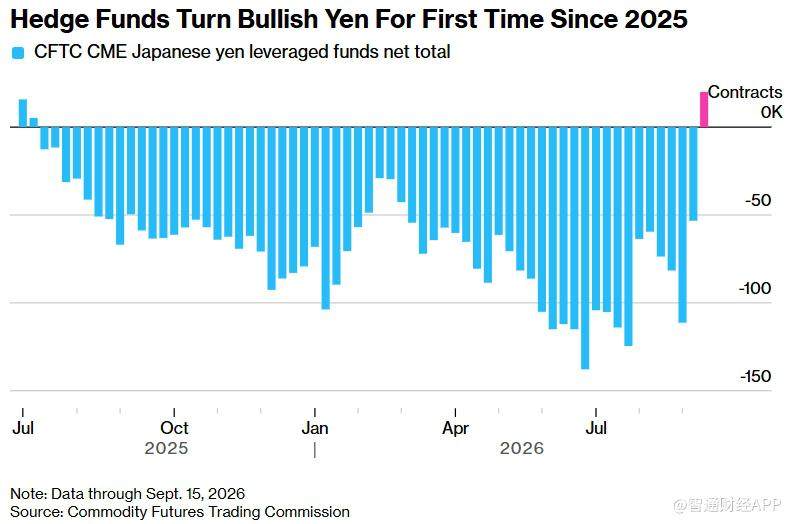
This position change is worth watching because CFTC data shows how investors use derivatives to position the global foreign exchange market with an average daily trading volume of about 9.5 trillion US dollars, which can provide an important reference for observing the exchange rate expectations of hedge funds and asset managers.
As hedge funds are turning bullish on yen, both the Federal Reserve and the Bank of Japan have taken action to raise interest rates this week.
The Federal Reserve raised the federal funds rate target range by 25 basis points to 3.75%-4.00% this week. The Federal Reserve said that US economic activity is still expanding at a steady pace, and inflation is still at a high level. The purpose of this policy adjustment is to push inflation back to the 2% target in a more timely manner.
The Bank of Japan also announced adjustments to the money market operation policy on September 18. The Bank of Japan's official website shows that after policy adjustments, the unsecured overnight lending rate will be maintained at around 1.25%.
However, the Bank of Japan's policy signals did not fully meet the expectations of some market participants. Some investors had hoped that the Bank of Japan would more clearly suggest that interest rates would continue to be raised in the future, putting short-term pressure on funds previously betting on yen appreciation.
On Friday, the yen fell 1.3% against the US dollar, then narrowed its decline. By the end of the New York session, it was trading around 156.80 yen per dollar. In other words, although hedge funds have turned sharply to yen bulls ahead of schedule, the Bank of Japan's subsequent interest rate hike signals have fallen short of expectations from some investors, putting this bet to the test for the time being.
Meanwhile, the continued pressure on the yen has once again drawn the market's attention to the Japanese authorities' intervention in the foreign exchange market. According to reports, the Bank of Japan has asked market participants about the current exchange rate level in the foreign exchange market. This type of inquiry is generally viewed by the market as a potential step before the Japanese authorities may formally intervene in the foreign exchange market.
This trend has received particular attention because just a few weeks ago, the US and Japanese authorities had already taken action to support the yen. In this context, if the yen depreciates rapidly again, traders are bound to pay more attention to whether the Japanese government will re-enter the market.
In addition to leveraged funds, large asset managers have also significantly increased their bets on the appreciation of the yen.
For the week ending September 15, asset management institutions increased the yen's net longings by 54,179 contracts, bringing the overall net long position to 54,821 contracts. This means that different types of institutional funding have recently increased their bullish exposure to the yen.
In contrast, changes in positions in other major currencies are more fragmented.
The leveraged fund increased net short positions in the euro by 4,974 to 51,355; the net long in the British pound decreased by 21,663 to 18,698; and the net long in the Australian dollar increased by 10,920 to 59,299 shares. Meanwhile, net short positions in the Canadian dollar decreased by 15,448 to 41,404, and net long in the Mexican peso increased by 7,946 to 90,125.
In terms of asset management institutions, net longs in the euro fell slightly by 906 to 275,565, net short positions in the British pound fell by 17,119 to 88,959, and net shorts in the Canadian dollar fell sharply by 21,287 to 8,846.
It is worth noting that while yen bulls are increasing rapidly, speculative funds have also previously reduced the level of bullishness against the US dollar. As of September 15, speculative funds, including asset managers and non-commercial traders, are generally bullish on the US dollar to their lowest level since March this year.
However, the subsequent trend of the US dollar clearly contrasted with changes in positions. The US dollar strengthened sharply this week, recording its biggest weekly gain in about three months. This means that some traders who previously reduced their bullish position in the US dollar and turned bullish on the yen may experience a situation where the market trend is opposite in the direction of their positions in the short term.
From a broader perspective, the current CFTC data reflects a clear change in the foreign exchange market. That is, after the yen was suppressed for a long time by the spread between the US and Japan, institutional investors began to pay more attention to the normalization of Japan's monetary policy and the potential support brought about by official foreign exchange market intervention.