
Learn Why The Bull Case For Insulet Stock Could Change Following Fund Exits
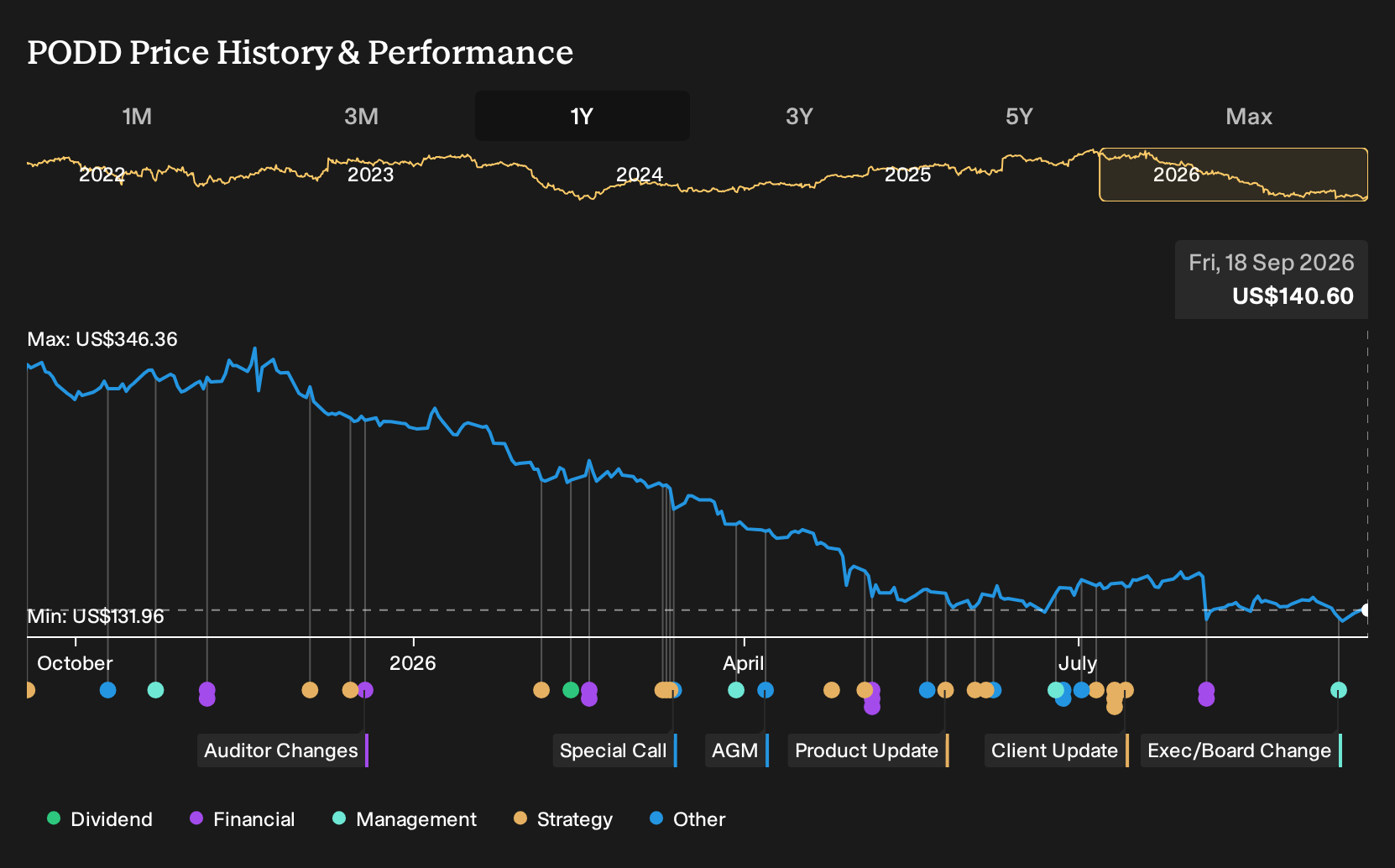
- Insulet disclosed that long-serving directors Timothy J. Scannell and Michael R. Minogue are leaving the board for personal health and political reasons, while key institutional holders such as Baron SMID Cap ETF and Artisan Mid Cap Fund exited positions citing competition and safety questions around the insulin delivery portfolio.
- The combination of board turnover and large fund withdrawals highlights how concentrated product exposure in insulin pumps can quickly translate operational concerns about safety and rivalry into governance and capital allocation scrutiny.
- The next step is to assess how Insulet's investment narrative could be influenced by major fund exits driven by competition and safety reassessment.
Broaden your watchlist beyond Insulet by scanning a curated set of healthcare and medtech names that face similar competitive and safety questions through the 30 resilient stocks with low risk scores.
Insulet Investment Narrative Recap
For you to own Insulet, you need to be comfortable with a focused bet on the Omnipod platform and recurring insulin pump consumables. The short term story still leans on execution in type 1 and type 2 diabetes, international roll out, and keeping Omnipod 5 clinically competitive. Recent director resignations read as limited to governance, so operational impact looks modest near term.
The bigger swing factor right now sits in how Insulet handles questions around competition and product safety while funding capacity and global expansion. That same concentration in one franchise is also the main risk. Large fund exits underline how quickly sentiment can move if confidence in that product engine softens.
The clearest tie in to the current debate is Baron SMID Cap ETF exiting Insulet in Q2 2026 to reassess competitive threats and safety issues around automated insulin delivery. Artisan Mid Cap Fund also stepped away, citing insulin pump rivalry and softer visibility on future growth, which matters for a stock whose value leans heavily on long duration cash flows.
Both moves push investors to focus on two questions. First, how resilient Insulet’s Omnipod ecosystem is against larger medtech and tech rivals in diabetes hardware and software. Second, whether management can use upcoming touchpoints, such as its September 24, 2026 presentation at Bernstein’s Healthcare Forum, to give clearer detail on product safety monitoring, pipeline roadmaps, and capital deployment priorities.
Insulet’s current analyst set up points to revenues of US$4.5b and earnings of US$683.8m by 2029. These figures are built on an assumed 14.1% yearly increase in revenue and an earnings rise of about US$308.5m from US$375.3m today.
Uncover why Insulet's fair value indicates a 22% potential upside to its current price, which could close faster than many investors expect.
Exploring Other Perspectives
Some of the lowest Insulet forecasts lean on a different concern altogether. They focus on slower type 2 diabetes adoption, with bearish analysts modeling revenue of about US$4.1b and earnings of roughly US$682.2m by 2029. That is a more cautious story than consensus. The fresh board exits might push you to revisit both views.
Explore 4 other Insulet fair value estimates, including one that suggests as much as 15% downside from the current price.
The Verdict Is Yours
Don't just follow the ticker. Dig into the data and build a conviction that's truly your own.
- A great starting point for your Insulet research is our analysis highlighting 3 key rewards that could impact your investment decision.
- See our latest analysis for Insulet. The report includes a comprehensive fundamental analysis summarized in a single visual, the Snowflake, making it easy to evaluate Insulet's overall financial health at a glance.
Looking for more investment ideas beyond Insulet?
Once you have framed your own view on Insulet, it can help to compare that thesis against other opportunities that match different risk, income, and quality profiles using the Simply Wall St Screener.
- If you want potential upside with a margin of safety, consider scanning a curated universe of companies that screen well on quality and valuation through the 33 high quality undervalued stocks.
- For investors who care most about balance sheet strength and business resilience, filter for companies with solid financial footing by using the list of solid balance sheet and fundamentals (23 results).
- Income focused readers can zero in on dependable cash returns by checking out the 6 dividend fortresses and seeing which stocks meet their yield and stability preferences.
This article by Simply Wall St is general in nature. We provide commentary based on historical data and analyst forecasts only using an unbiased methodology and our articles are not intended to be financial advice. It does not constitute a recommendation to buy or sell any stock, and does not take account of your objectives, or your financial situation. We aim to bring you long-term focused analysis driven by fundamental data. Note that our analysis may not factor in the latest price-sensitive company announcements or qualitative material. Simply Wall St has no position in any stocks mentioned.
Have feedback on this article? Concerned about the content? Get in touch with us directly. Alternatively, email editorial-team@simplywallst.com