
Meta Stock Could Hit $800 This Year -- And It All Begins on Sept. 23
Citi is betting on a strong few months for Meta Platforms (META). It kept its Buy rating and an $800 price target, and placed the stock on a 90-day upside catalyst watch. The reason is Meta’s Connect event on Sept. 23, where new AI products and hardware are expected. The target implies about 19% upside. Analyst Ronald Josey expects updates on Muse, Meta’s new family of AI models, plus its next-generation models and smart glasses plans. The analyst is confident that Meta’s heavy AI spending will pay off due to faster product rollout and early Muse adoption.
What Investors Should Really Watch at Connect
The hardware will make the headlines as it often does. Connect will be full of eye-catching reveals. New Ray-Ban smart glasses are expected, which Meta calls one of the fastest-growing categories in consumer electronics history. There will be plenty on Muse and the metaverse too. But as I wrote before Meta’s Hatch AI agent launch, the product itself is rarely where the money comes from. Meta earns almost all its revenue from ads, so that is where the real payoff would show up. Zuckerberg himself has said AI is already improving that core business. This is why investors should look past which gadget looks best. What matters is whether Meta can prove its AI work is boosting advertising enough to justify the spending. Capital expenditures are expected to be as high as $145 billion this year, and free cash flow recently collapsed to just $784 million. Those numbers are why investors have remained concerned.
That is why this catalyst watch is bigger than a typical product preview. Instead of focusing on Meta’s hardware, he’s betting Connect gives investors the first real proof the spending is working. Whether that bet pays off or not is exactly what Sept. 23 will reveal.
About Meta Stock
Meta Platforms is a technology company that owns and operates some of the world’s largest social media and messaging platforms. These include Facebook, Instagram, Messenger, and WhatsApp. The company generates most of its revenue from digital advertising across these apps. Meta is also investing heavily in virtual reality, augmented reality, and mixed reality technologies through its Reality Labs division. Founded in 2004. Meta is headquartered in Menlo Park, California.
Over the past year, META has declined almost 13%, underperforming the S&P 500’s ($SPX) gain of approximately 14% during the same period. The primary reason behind the stock’s weakness has been investor concerns over the company’s aggressive artificial intelligence spending. However, year-to-date, META is up 3.52%, still lagging the S&P 500’s 10% gain over the same period, but the numbers have improved.
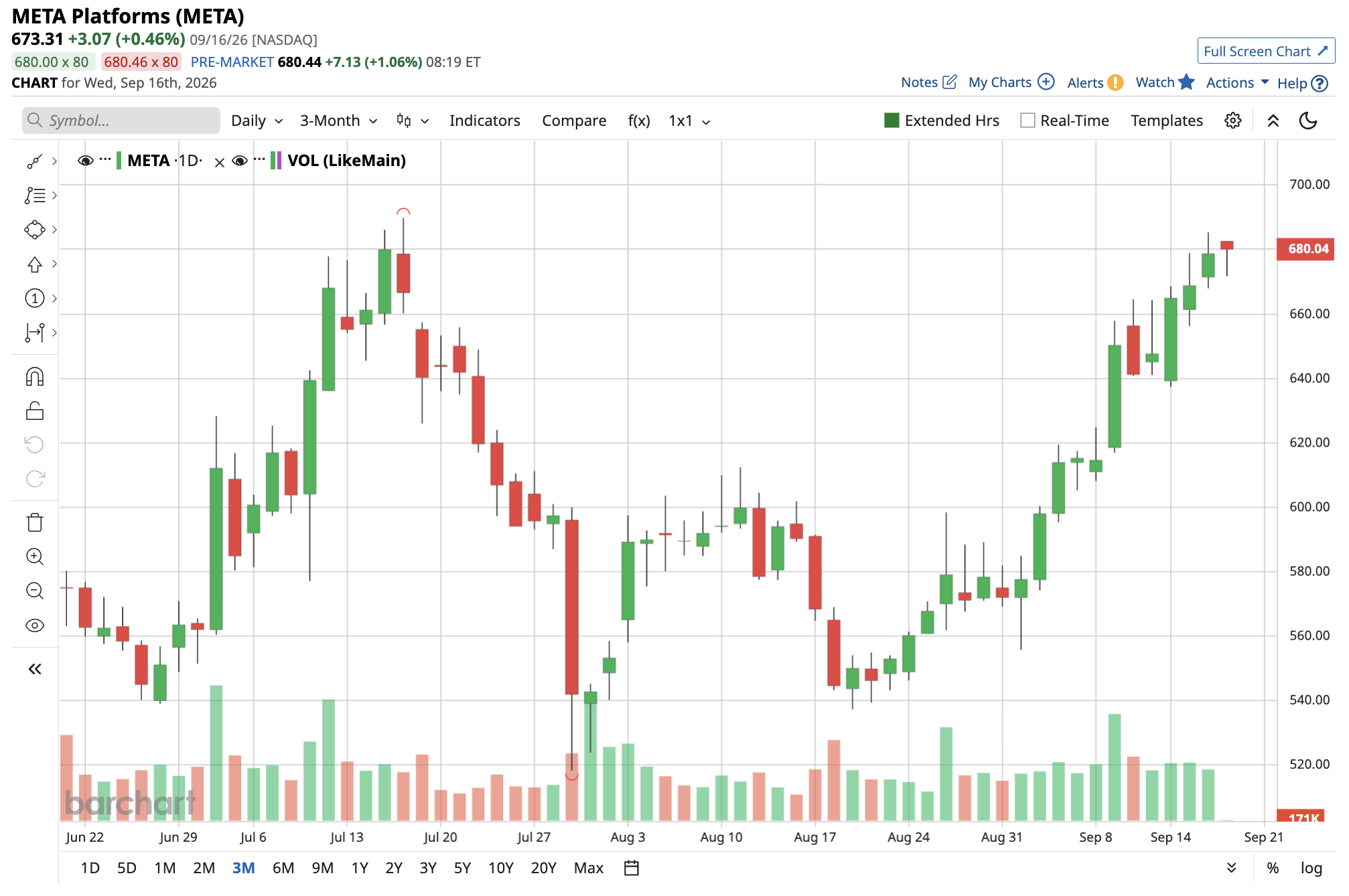
Meta's valuation looks reasonable for a company this size. Unlike most big AI names, the stock isn’t expensive. Its forward P/E of 21.33x sits slightly below its 5-year average, and the price-to-sales ratio is roughly in line with history. So the market isn’t paying up for Meta the way it is for other AI stocks. That matches the concern I raised earlier. Investors are still waiting for proof the spending works, so they haven’t rewarded the stock yet. Analysts expect modest earnings growth of 5% this year as heavy investment weighs on earnings. The earnings are then expected to grow 12-17% through the end of this decade. If Connect provides justification for the spending, a cheap-looking stock could feel like a bargain in hindsight.
Meta's Revenue Momentum Continues as CapEx Outlook Narrows
Meta Platforms reported its second-quarter fiscal 2026 earnings on July 29. It reported revenue of $60.8 billion, up 28% YoY and above the $60.19 billion forecast. Earnings per share came in at $6.18, missing the Wall Street consensus of $7.17. The company incurred total expenses of $42 billion, up 55% YoY. Capital expenditures for the quarter were $31.1 billion, including principal payments on finance leases. This shows that the company is heavily investing in servers, data centers, and network infrastructure. CFO Susan Li reported that the company’s free cash flow stood at $784 million.
Looking forward, META expects third-quarter total revenue to be in the range of $61 billion to $64 billion. The company said foreign exchange would be a roughly 1% headwind to year-over-year growth at current rates. For full-year 2026, the company raised the lower end of its expense outlook to $165 billion to $169 billion, while narrowing its capital expenditure guidance to $130 billion to $145 billion as it continues to build out AI infrastructure. The company also pointed to continued product work in AI models, business agents, recommendation systems, and consumer devices such as glasses.
What Do Analysts Expect for META Stock?
On Sept. 16, Citi's Josey reiterated a Buy rating on META and assigned a price target of $800 on Meta’s upcoming Connect conference being a positive catalyst for the stock. He remains optimistic about the company’s products and believes they will help the company generate more revenue over time.
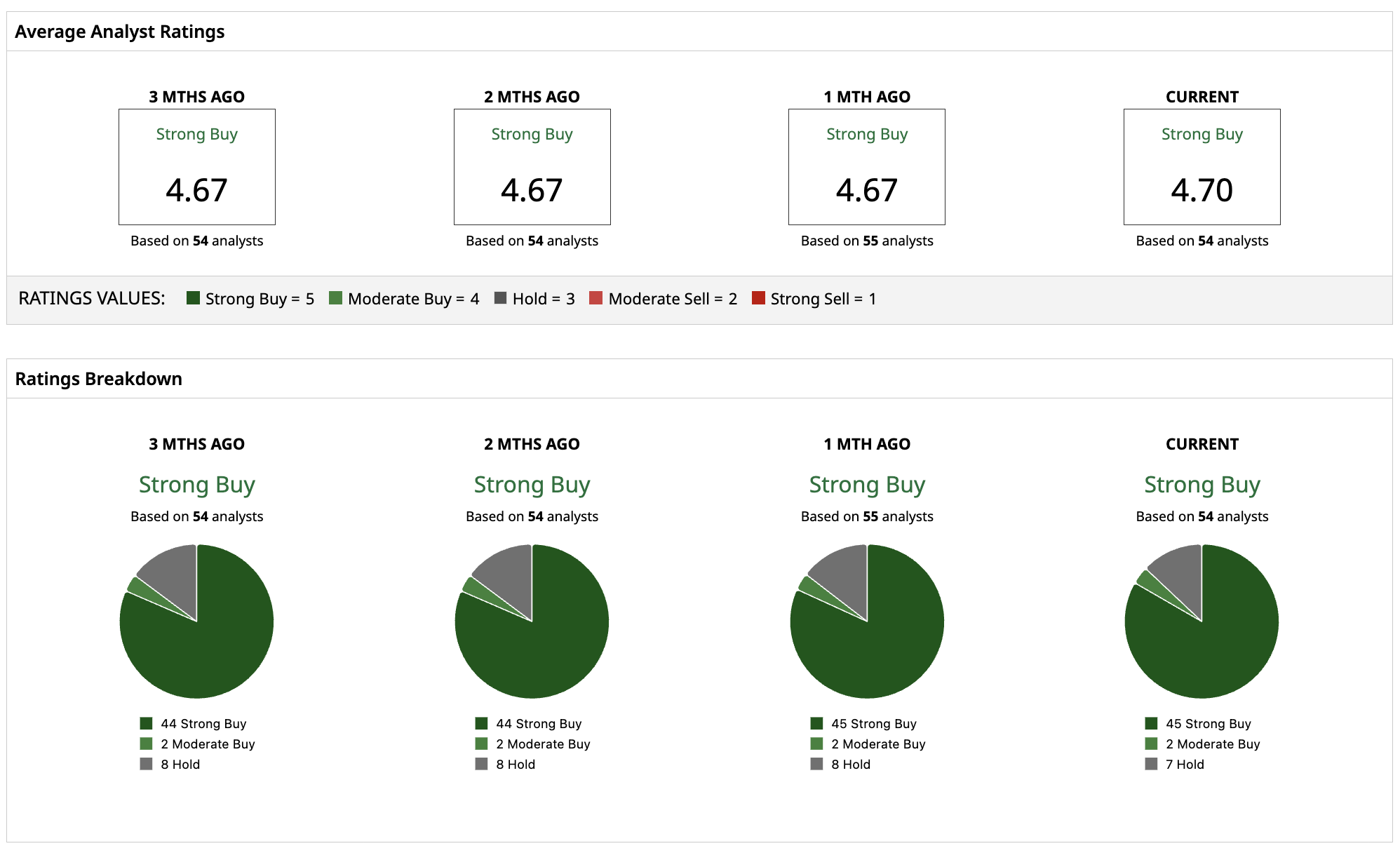
Based on 54 analysts covering the stock, META stock holds a consensus “Strong Buy” rating. Out of those, 45 have a “Strong Buy” rating, two have a “Moderate Buy” rating, seven have a “Hold” rating, and none have a “Sell” rating. This shows that Wall Street is quite optimistic about Meta's future.
On the date of publication, Jabran Kundi did not have (either directly or indirectly) positions in any of the securities mentioned in this article. All information and data in this article is solely for informational purposes. For more information please view the Barchart Disclosure Policy here.