
Building Better Commodity Portfolios – Part 4 Capital Capacity and Staying Power (How Much Can the Portfolio Really Hold?)
Dual Edge Research publishes two powerful newsletters that work great individually — and even better together. The Bull Strangle Newsletter focuses on stocks and options, combining stock ownership with premium-selling strategies to generate consistent income and market-beating returns. The Smart Spreads Newsletter specializes in seasonal commodity futures spreads, offering a diversified approach with low correlation to equities. Together, they deliver a complete investment perspective — one focused on income, the other on diversification — all under one simple subscription.
Introduction
After identifying attractive trades, determining appropriate position sizes, and considering diversification, another question becomes critical:
- How much exposure can the portfolio comfortably support at one time?
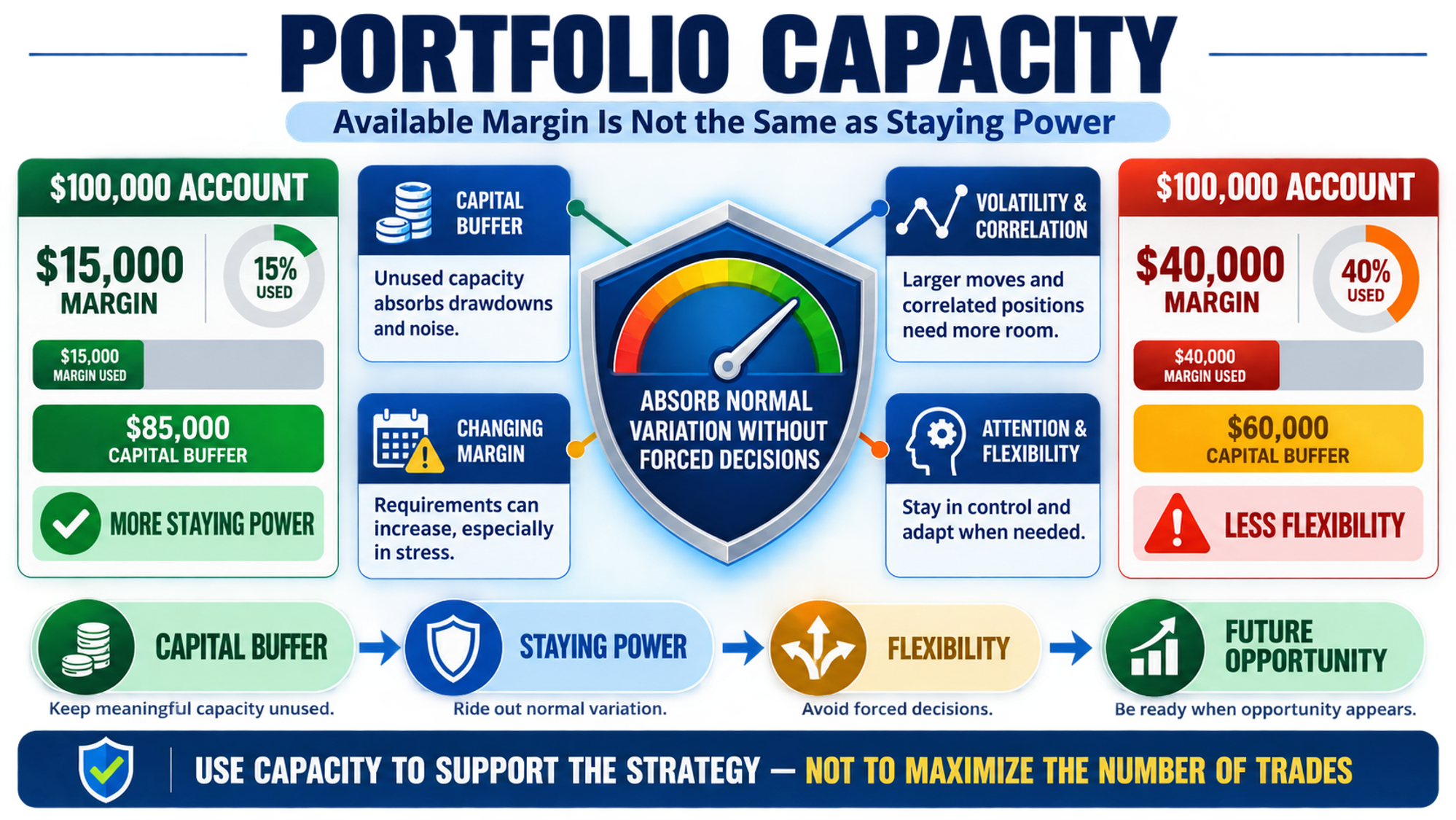
Futures markets make this question particularly important because leverage allows traders to control substantial exposure with relatively little required margin. An account may have enough available margin to establish another position—or several more positions—but that does not necessarily mean it has the capacity to hold them through normal market movement. This distinction is at the heart of portfolio capacity. As I discussed in Trading Commodity Spreads, capacity is not defined by the maximum number of trades that can be placed or even by the amount of available margin. It is better understood as the amount of variation a portfolio can absorb without forcing decisions. Two portfolios can hold identical trades yet have very different staying power depending upon how much of their capital has already been committed.
Capital and Margin Answer Different Questions
Capital and margin are sometimes treated almost interchangeably, but they serve very different purposes. Exchange margin represents the minimum amount required to support a futures position within the clearing system. It is not a recommendation for how much risk to accept. Margin does not tell us how many positions to hold, how much of the account to expose, or what level of drawdown the portfolio can comfortably withstand.
This distinction is especially important with commodity spreads because calendar spreads and other relative-value structures frequently receive reduced margin requirements. The relationship between the legs reduces certain risks from the clearinghouse's perspective, but it does not eliminate trading risk. Spreads can still experience significant adverse movement, temporary widening of relationships, liquidity disruptions, and periods of simultaneous increases in volatility across several related positions. Low margin can therefore create a dangerous illusion: because additional trades can be established, it can appear that additional trades should be established.
Staying Power Is Part of the Strategy
Seasonal commodity spreads require something that can be easy to overlook when analyzing historical results: time. A seasonal tendency does not necessarily begin immediately after a trade is entered, nor does it typically develop in a straight line. A spread may move against the position, remain stagnant, or experience short-term volatility before the historical seasonal tendency can emerge. Capital provides the staying power needed to allow that process to occur.
When capital is stretched too thin, normal drawdowns begin to feel abnormal. Positions require attention sooner than they otherwise would, and decisions can become driven by available capital rather than by the underlying trade structure. With more conservative deployment, temporary fluctuations are easier to absorb, and positions can be managed according to the strategy rather than under short-term financial pressure. This is why staying power should be considered part of portfolio design rather than simply a matter of trader discipline. Patience is much easier when the portfolio has been constructed to allow it.
Margin Utilization Changes the Same Portfolio
Consider a $100,000 account holding a portfolio that requires $15,000 in margin. The remaining capital provides a substantial buffer for normal adverse movement across the positions. Now imagine the same account expanded until required margin reaches $40,000. The individual trades may be every bit as attractive, and none of the selection criteria may have changed. What has changed is the portfolio's ability to absorb variation. At higher utilization, simultaneous drawdowns across several positions can quickly reduce available capital.
A position may need to be reduced or closed not because the seasonal premise has failed, but because the portfolio no longer has sufficient capacity to hold it comfortably. At lower utilization, those same fluctuations can potentially be absorbed without changing the original trade plan. There is no universal margin utilization percentage that applies to every trader or portfolio. The important point is that maximum margin availability should not become a portfolio target. Capacity should be determined by how much normal variation the portfolio can withstand, not by how close it can operate to the broker's limits.
Margin Can Change When the Trades Don't
Another reason margin should not define portfolio capacity is that margin requirements are dynamic. Clearinghouses and brokers can adjust requirements as market volatility, liquidity, and perceived risk change. The portfolio can therefore require materially more margin tomorrow even though no positions have been added and none of the underlying trade structures have changed. That possibility becomes especially important during volatile periods—the very periods when maintaining flexibility may matter most. A portfolio constructed near its maximum margin capacity can lose that flexibility just as markets become more difficult. Maintaining excess capital provides a buffer not only against adverse price movement but also against changes in the capital required to continue holding existing positions.
Capacity Is More Than Financial
Portfolio capacity also extends beyond account equity. Every additional trade consumes some amount of attention and requires monitoring. A portfolio filled with highly volatile or closely related positions can become difficult to manage, even when sufficient capital is available. This is particularly true when several trades begin moving rapidly at the same time.
The objective should not be to fill every available portfolio slot simply because another qualified trade exists. Each additional position consumes capital, attention, and emotional bandwidth. Leaving some capacity unused is therefore not necessarily inefficient. Unused capacity provides flexibility. It allows the portfolio to absorb unexpected movements and preserves the ability to take advantage of new opportunities without having to reduce existing positions first.
Capacity Creates Opportunity
It is easy to think of unused capital as capital that isn't working. I think the better perspective is that unused capacity serves an important function in the portfolio. It allows existing trades to withstand normal variation, protects changing margin requirements, and leaves room for opportunities that have not yet appeared. That last point is especially important for a strategy that continually identifies new seasonal opportunities. Deploying nearly all available capacity today may prevent the portfolio from capitalizing on a particularly attractive trade next week. Maintaining capacity therefore isn't simply defensive. It preserves optionality.
The goal is not to trade as little as possible. It is to deploy sufficient capital to take meaningful advantage of attractive opportunities without creating a portfolio that becomes fragile when several normal adverse movements occur simultaneously.
From Capacity to Portfolio Monitoring
Capital capacity brings the major elements of portfolio construction together. Position size determines individual exposure, diversification and correlation determine how those exposures interact, and volatility influences how quickly risk can develop. Together, these factors determine how much of the portfolio's capacity is being consumed. Maintaining unused capacity provides staying power and preserves flexibility for future opportunities. But portfolio construction does not end when positions are established. Trades move through their seasonal windows, volatility changes, positions exit, and new opportunities appear. A portfolio that was appropriately constructed at entry can look very different several weeks later.
That leads directly to Part 5 — Monitoring the Portfolio. The next step is to continually compare existing positions with new opportunities and decide whether to add a trade, leave capacity unused, or replace an existing position with a more attractive one. Portfolio construction establishes the framework; portfolio monitoring keeps it aligned as opportunities and risks change.
Additional Details
The Bull Strangle Newsletter focuses on stocks and options, combining stock ownership with disciplined option-selling techniques designed to generate consistent income while managing risk.
The Smart Spreads Newsletter focuses on seasonal commodity spreads, a historically proven approach that seeks opportunities across agricultural, energy, metal, and financial futures markets.
Each strategy is designed to stand on its own, but together they provide a diversified approach that can perform across a wide range of market environments. For traders looking to deepen their education, The Bull Strangle Strategy and Trading Commodity Spreads, both available on Amazon.
Visit BullStrangle.com to subscribe for just $1 for the first month.
For a video overview of the Bull Strangle Newsletter
For a video overview of the Smart Spreads Newsletter
Darren Carlat
Dual Edge Research
(214) 636-3133
DualEdgeResearch@gmail.com
Disclaimer
This information is for informational purposes only and should not be considered as investment advice. Past performance is not indicative of future results, and all investments carry inherent risk. Consult with a financial advisor before making any investment decisions.