
How Investors May Respond To Greif (GEF) Mill Closure
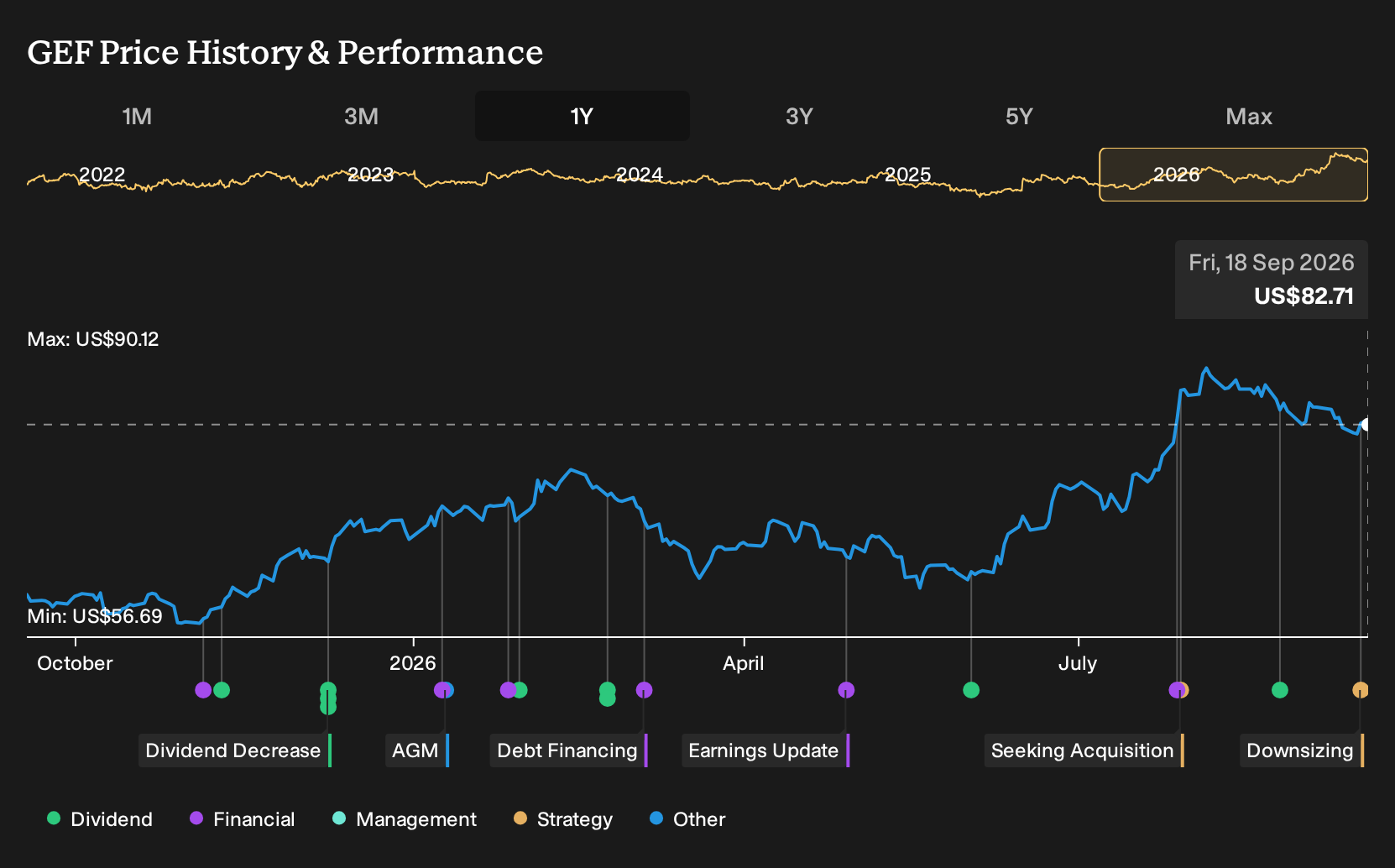
- Greif, Inc. has exited the coated recycled paperboard market after shutting its Sweetwater mill in Austell, Georgia. This removes roughly 120,000 tons of annual capacity and affects around 90 employees, who are receiving severance and career support.
- The Sweetwater closure highlights Greif’s push to concentrate capital on operations with stronger competitive positions and better integration across its North American paperboard network.
- We will now examine how Greif’s decision to close the Sweetwater mill could reshape the existing investment narrative around portfolio focus.
Greif Investment Narrative Recap
Greif appeals to investors who want a packaging business that is pruning weaker assets and concentrating on areas where it already has scale and integration. The Sweetwater mill closure fits that story because it removes a relatively high cost and less connected asset from the network. This looks more like portfolio clean up rather than a change to the core thesis around polymers, metals, and integrated solutions.
The key short term watchpoint is still execution on cost optimization and volume stability in industrial packaging, not the coated recycled paperboard exit itself. The biggest near term risk remains demand softness across industrial end markets, where a sluggish macro backdrop or slower capital spending could weigh on orders, even as Greif fine tunes its footprint.
Recent commentary around Greif centers on asset sales and portfolio shaping, including the earlier divestment of containerboard and timberland operations that were contributing US$218 million of trailing twelve month EBITDA. That move already reduced diversification and increased reliance on more cyclical packaging lines. The Sweetwater step sits in the same pattern of shedding non core or lower fit assets while leaning into chosen segments.
For you, the link between that earlier divestment and this mill shutdown is simple. Both actions concentrate earnings on fewer, more focused activities. This can sharpen execution but also raises exposure if targeted end markets underperform or face regulatory pressure, especially around polymers. The practical question is whether cost savings, network efficiency, and disciplined capital use offset higher concentration risk over time.
Greif Forward Assumptions After Sweetwater
Greif's forecast story on paper is quite specific. Analysts are working off an estimate that revenue expands by 2.6% each year and that earnings move from US$228.6 million today to US$278.3 million by 2029. That implies an earnings increase of about US$49.7 million on their model. For that same year, consensus also lines up around revenue of US$4.7b.
Greif's narrative projects revenue of US$4.7b and earnings of US$278.3 million by 2029. This assumes yearly revenue growth of 2.6% and an earnings increase of about US$49.7 million from US$228.6 million today.
Discover why Greif's fair value suggests a 5% potential upside to its current price, a gap that could narrow quickly.
Exploring Other Perspectives
You might read the Sweetwater exit very differently from the most cautious analysts. They already expected Greif’s revenue to reach about US$4.5b and earnings of roughly US$269.5 million by 2029, with only 1.4% yearly revenue growth. That is a more restrained story, and this new development could push those views to shift again.
Explore 3 other Greif fair value estimates, including one that suggests as much as 45% downside from the current price.
Decide For Yourself
Don't just follow the ticker; dig into the data and build a conviction that's truly your own.
- A great starting point for your Greif research is our analysis highlighting 2 key rewards and 3 important warning signs that could impact your investment decision.
- See our latest analysis for Greif. The report includes a comprehensive fundamental analysis summarized in a single visual, the Snowflake, making it easy to evaluate Greif's overall financial health at a glance.
Looking For More Investment Ideas Beyond Greif?
If the Greif story has you thinking harder about concentration risk, capital discipline, and where to deploy fresh money, it can help to widen the lens and scan a broader set of opportunities that share some of those qualities.
- If resilience and balance sheet strength matter most to you, start by reviewing a curated list of solid balance sheet and fundamentals (23 results) that prioritizes financial sturdiness over flashy headlines.
- If value is your anchor, filter for potential mispriced opportunities by running through a focused 33 high quality undervalued stocks that blends quality signals with discounted pricing.
- If you want fresh ideas away from crowded trades, scan a targeted 16 high quality undiscovered gems that concentrates on under-followed companies with solid underlying fundamentals.
This article by Simply Wall St is general in nature. We provide commentary based on historical data and analyst forecasts only using an unbiased methodology and our articles are not intended to be financial advice. It does not constitute a recommendation to buy or sell any stock, and does not take account of your objectives, or your financial situation. We aim to bring you long-term focused analysis driven by fundamental data. Note that our analysis may not factor in the latest price-sensitive company announcements or qualitative material. Simply Wall St has no position in any stocks mentioned.
Have feedback on this article? Concerned about the content? Get in touch with us directly. Alternatively, email editorial-team@simplywallst.com