
How Investors Are Reacting To Mattel (MAT) New Shows And Licensing Deal
- Mattel announced a new Thomas & Friends animated special, Really Helpful Engines, along with a refreshed Railway Stories series and reimagined global toy line, plus a separate multi-year licensing deal bringing Bluey into Barbie, Hot Wheels, Fisher-Price, Polly Pocket and UNO products.
- The twin push into fresh Thomas content tied directly to a redesigned Easy Connect track system and a broad Bluey licensing rollout deepens Mattel’s use of owned and partner IP across both streaming and shelves, which matters for how consistently its brands can drive demand.
- This development helps clarify how Mattel's IP driven investment narrative is shaped by the Thomas content launch and the broad Bluey licensing push.
Scan how Mattel’s content and licensing push compares with other consumer brands leaning on strong IP by reviewing our hand picked list of 16 high quality undiscovered gems.
Mattel Investment Narrative Recap
For Mattel, the core belief is that an IP heavy model across toys, content and digital can support steadier demand even when individual film releases are uneven. Right now the key near term swing factor is whether core franchises like Barbie, Hot Wheels and Fisher Price can stabilize sell through after a share price reset and softer recent returns.
The biggest risk remains execution on this branded entertainment plan while carrying meaningful debt and dealing with margin pressure. The Thomas and Bluey news helps on the content side but does not meaningfully change near term exposure to input costs, licensing terms or any cooling in adult collector and theatrical tie in demand.
The Thomas & Friends Railway Stories launch looks most relevant. It connects Mattel owned content directly to a redesigned Easy Connect track range that is already on shelves worldwide. That matters for near term catalysts because it ties new streaming exposure on YouTube, Netflix, Amazon Prime and free to air directly to a global toy push.
This move also sits in the middle of a broader IP plan, with Mattel targeting about 50% adjusted gross margin and leaning into digital games and film extensions. The risk is execution, not intent. If the refreshed Thomas world or Easy Connect system fails to resonate, or if marketing spend outweighs sell through, the content pipeline alone will not offset cost and licensing pressures.
What The Current Mattel Forecasts Are Pricing In
Mattel's IP story around Thomas & Friends and Bluey only really matters for investors once it is mapped against the current consensus numbers. Analysts are building their models on a few simple anchors. Revenue is assumed to rise by 4.0% a year over the next three years. Profit margins are expected to ease from 7.8% today to 7.5% in that window.
On earnings, the Street is working off current profit of US$427.4 million and a forecast of US$463.7 million by 2029. That implies an increase of about US$36 million in earnings, with a more cautious end of the range at US$377.8 million. Forecasts also embed an expected 7.0% yearly reduction in share count over the next three years. This matters for per share metrics even if total profit only edges higher.
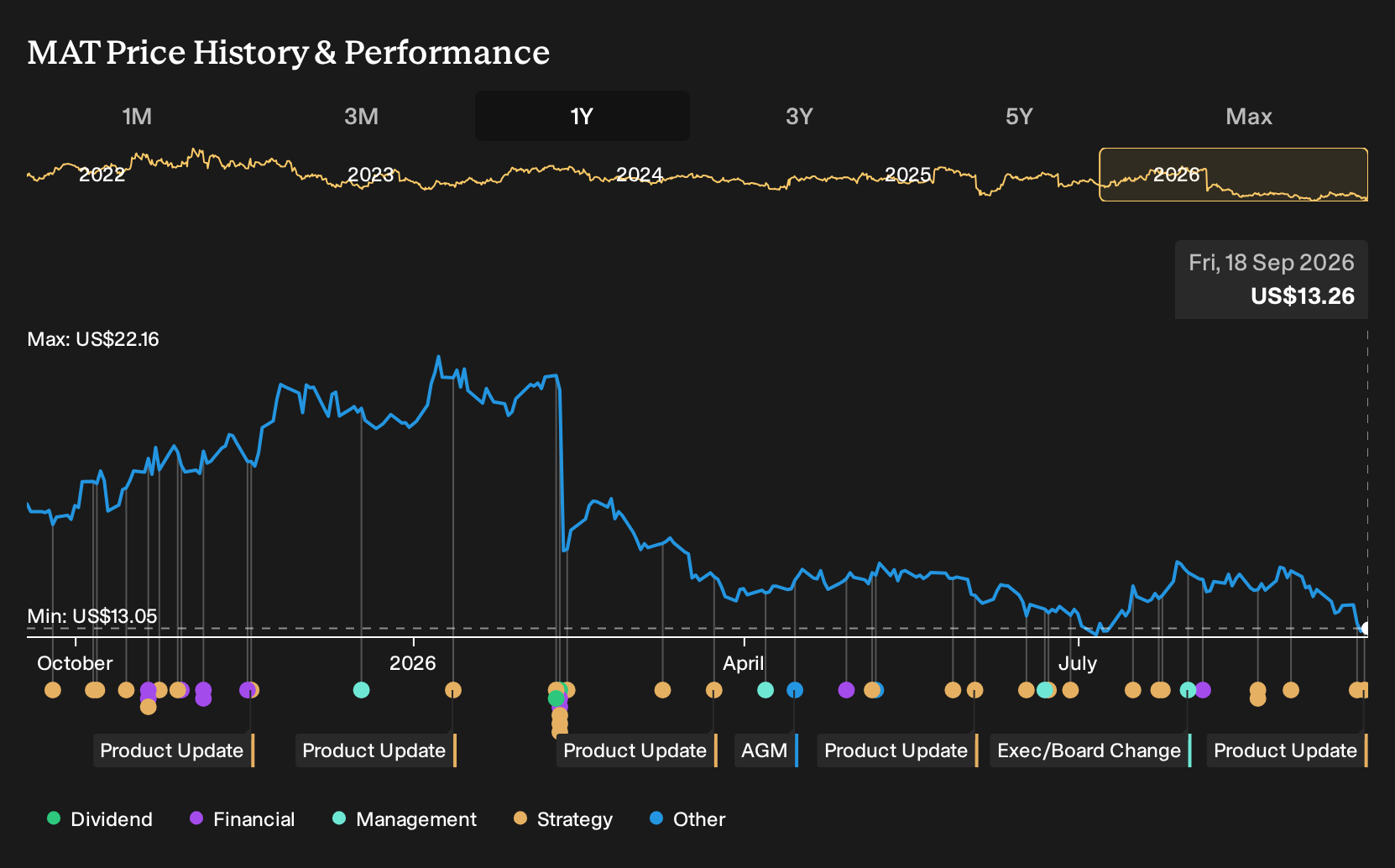
Those assumptions underpin the valuation work. The consensus view ties the Mattel story to projected 2029 revenue of US$6.2b and earnings of US$463.7 million, discounted at around 8.4%. To get to the US$18.23 price target from a current share price of US$13.81, investors would need to be comfortable with a P/E of 11.5x on those 2029 earnings. That multiple sits below the 22.7x P/E quoted for the wider US Leisure space in the same report.
Mattel's narrative projects US$6.2b revenue and US$463.7 million earnings by 2029. This rests on 4.0% yearly revenue growth and about US$36 million earnings increase from US$427.4 million today.
Uncover why Mattel's fair value indicates a 37% potential upside to its current price that may not last much longer.
Exploring Other Perspectives
Some of the most optimistic analysts were already leaning hard into a different catalyst before this Thomas & Friends and Bluey push. They focused on Mattel’s global and digital expansion, building forecasts around revenue of about US$6.4b and earnings of roughly US$503.7 million by 2029. Those projections came from before this news, so you may want to recheck how your own view lines up as opinions evolve.
Explore 3 other Mattel fair value estimates, including one that suggests as much as 199% upside from the current price!
Decide For Yourself
Don't just follow the ticker. Dig into the data and build a conviction that's truly your own.
- A great starting point for your Mattel research is our analysis highlighting 2 key rewards and 3 important warning signs that could impact your investment decision.
- See our latest analysis for Mattel. The report includes a comprehensive fundamental analysis summarized in a single visual, the Snowflake, making it easy to evaluate Mattel's overall financial health at a glance.
Looking For More Investment Ideas Beyond Mattel?
If the Mattel story has sharpened how you think about brands, cash flows and risk, it can be useful to stress test that framework against a wider set of companies using the Simply Wall St Screener.
- For investors who care most about valuation support and quality fundamentals, consider reviewing a broader pool of opportunities through 33 high quality undervalued stocks that fit those criteria.
- If capital preservation and steadier business profiles are higher on your list, scan companies with more resilient characteristics using our 30 resilient stocks with low risk scores to see what else lines up with your risk tolerance.
- When balance sheet strength is a priority, widen your watchlist by filtering for financially robust businesses via the list of solid balance sheet and fundamentals (23 results) and compare how they stack up against Mattel.
This article by Simply Wall St is general in nature. We provide commentary based on historical data and analyst forecasts only using an unbiased methodology and our articles are not intended to be financial advice. It does not constitute a recommendation to buy or sell any stock, and does not take account of your objectives, or your financial situation. We aim to bring you long-term focused analysis driven by fundamental data. Note that our analysis may not factor in the latest price-sensitive company announcements or qualitative material. Simply Wall St has no position in any stocks mentioned.
Have feedback on this article? Concerned about the content? Get in touch with us directly. Alternatively, email editorial-team@simplywallst.com