
Has Intuit (INTU) Fallen Far Enough To Be A Bargain?
Intuit has seen a sharp reset in sentiment over the past year, and the size of that share price slide now puts fresh focus on what investors are really paying for its earnings. With the business leaning heavily on its tax, accounting and personal finance platforms, the live question is whether the current valuation still lines up with the profits those franchises generate.
- Over the past year the stock has fallen 55.4%, which puts recent price action and earnings power under much closer scrutiny.
- Management has highlighted plans for an AI driven financial platform and an end to end consumer offering, which can feed directly into expectations for future profitability and the timing of cash generation.
- The analysts covering Intuit have run their own numbers. See what analysts think Intuit's shares could be worth.
The issue now is whether Intuit's recent share price level is adequately supported by the earnings the company is producing today.
If you want a broader watchlist while you assess whether Intuit's earnings justify today's price, a focused screen of 33 high quality undervalued stocks is a useful second starting point.
Does Intuit Look Undervalued on Earnings?
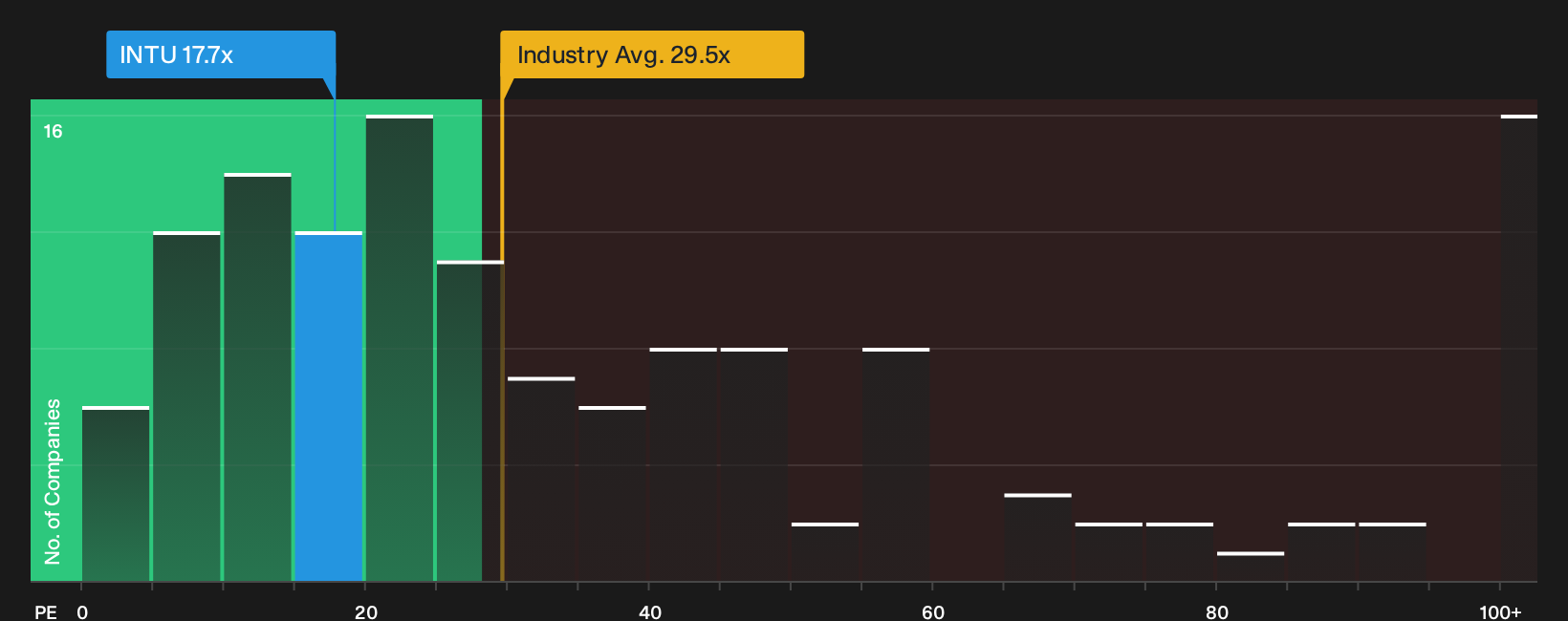
The P/E ratio suits Intuit because earnings are the main anchor for how investors are judging its mature software franchises today. Right now the stock trades on roughly 17.7x earnings. That compares with about 29.5x for the broader Software industry and a peer group closer to 44.0x, so the market is pricing Intuit’s profits at a lower multiple than many comparable platforms.
The implied fair P/E for Intuit, based on a model that blends its growth profile, profitability, size and risk, sits above the current 17.7x level. This points to the shares screening as undervalued on this metric. Because management recently reaffirmed longer term guidance at its Investor Day, the discount in the P/E ratio comes against a backdrop where the company is still leaning into its AI driven financial platform ambitions. For investors weighing up the tax and accounting engine against those ambitions, this gap in multiples is the key question to probe further. Explore the numbers behind Intuit's P/E valuation.
The Intuit Narrative: What Would Justify Today's Price?
Simply Wall St Narratives for Intuit pick up where the P/E puzzle leaves off and explain which paths for growth, margins and earnings would need to play out for the stock to be worth materially more or less than today’s price, all set out on the Community page. Instead of a single ratio or model output, Narratives describe the future that number relies on so you can watch whether the real business continues to match that story over time.
Community writers looking at Intuit see the same high quality franchise, yet one group thinks the reset has created a clear value gap while the other views expectations as still demanding.
Bull case: 46% undervalued
"Once a small business puts its financial life into QuickBooks, switching to a competitor is genuinely painful and that stickiness is the foundation..."
Discover why this Narrative puts Intuit at 46% undervalued.
Bear case: roughly fairly valued
"Although Intuit is seeing early traction with its AI driven expert platform and virtual AI agents, the heavy reliance on continued AI adoption raises the risk that execution missteps could limit the uplift to revenue growth and pressure earnings..."
Explore why this Narrative puts Intuit at roughly fairly valued.
Intuit's valuation still hinges on one unresolved question
Numbers only tell part of the story for Intuit, because the people steering the business and the way they are rewarded can quietly shape every decision that follows. See who runs Intuit and how they are paid.
This article by Simply Wall St is general in nature. We provide commentary based on historical data and analyst forecasts only using an unbiased methodology and our articles are not intended to be financial advice. It does not constitute a recommendation to buy or sell any stock, and does not take account of your objectives, or your financial situation. We aim to bring you long-term focused analysis driven by fundamental data. Note that our analysis may not factor in the latest price-sensitive company announcements or qualitative material. Simply Wall St has no position in any stocks mentioned.
Have feedback on this article? Concerned about the content? Get in touch with us directly. Alternatively, email editorial-team@simplywallst.com