
Did Engine Upgrade Validation Just Shift RTX's (RTX) Investment Narrative?
- RTX reported a series of recent moves, including a leadership change at Pratt & Whitney, progress on the F135 Engine Core Upgrade, and fresh capital going into Polish manufacturing, alongside a new defense laser partnership and missile supply chain support.
- The mix of engine upgrade validation, expanded production capacity in Europe, and RTX’s role across key missile programs may influence how dependable its long-cycle defense and aerospace cash flows appear to investors.
- The focus now turns to what this RTX news cluster may indicate for the broader investment narrative, particularly its expanding engine capacity.
Scan RTX's latest engine, missile and directed energy moves in the context of a broader defense watchlist by focusing on 30 resilient stocks with low risk scores that may offer steadier exposure to similar themes.
RTX Investment Narrative Recap
To own RTX, you need to be comfortable with a complex, capital intensive aerospace and defense platform that depends on reliable engine performance, long term defense budgets and steady aftermarket work. The most important near term swing factor remains execution at Pratt & Whitney, especially on engine reliability and cost control, with this week’s news not materially changing that focus.
The biggest near term risk still sits in potential engine related overruns and any spillover into warranty, retrofit or MRO pressure, alongside tariff and fixed cost exposure. Leadership continuity through Shane Eddy’s advisory role slightly reduces transition risk, but the real test is operational delivery, not organizational structure.
The Pratt & Whitney F135 Engine Core Upgrade milestone is the clearest operational tie in to this leadership change. Validation of the ECU design keeps RTX aligned with a key defense program and supports the idea that the engine portfolio can evolve through upgrades rather than constant clean sheet risk.
For catalysts, ECU progress interacts directly with the incoming Pratt & Whitney president’s track record on F135 delivery and sustainment. Effective execution on this upgrade and the broader F-35 support footprint could help RTX manage aftermarket profitability and soften some of the margin and warranty risk associated with the engine business.
RTX Forecasts, Earnings Path and Valuation Setup
RTX's current analyst framework leans heavily on a steady operational clean up at Pratt & Whitney and disciplined capital spending across the rest of the portfolio. The numbers behind that story are specific. Analysts are assuming RTX's revenue will grow by 6.1% a year over the next 3 years, with profit margins moving from 8.3% today to 9.7% by 2029. Earnings are expected to reach US$10.9b by 2029, compared with US$7.7b today, which implies an increase of about US$3.2b under the consensus view.
RTX's narrative projects US$111.8b revenue and US$10.9b earnings by 2029. This requires 6.1% yearly revenue growth and an earnings increase of about US$3.2b from US$7.7b.
Those forecasts also rest on a specific valuation bridge. To line up with the consensus price target, analysts use a future P/E of 37.2x on those 2029 earnings, compared with 38.8x today for RTX and the broader US Aerospace & Defense peer group cited in the report. The implied earnings power and lower multiple both need to show up at the same time for that model to work, which puts more pressure on execution in the engine and missile franchises where most of the heavy lifting on margins is expected to come from.
Revenue forecasts of US$111.8b and earnings of US$10.9b for 2029 also assume only modest share count creep, with analysts baking in 0.69% yearly growth in shares outstanding over the next 3 years. That share issuance assumption affects earnings per share, so any shift in buybacks, equity compensation or acquisition funding could change the earnings per share outcome even if absolute profit in dollars remains the same. For investors tracking RTX, it helps to separate the story into two parts. First, can the business produce the US$10.9b earnings figure. Second, how many shares will those earnings need to be spread across.
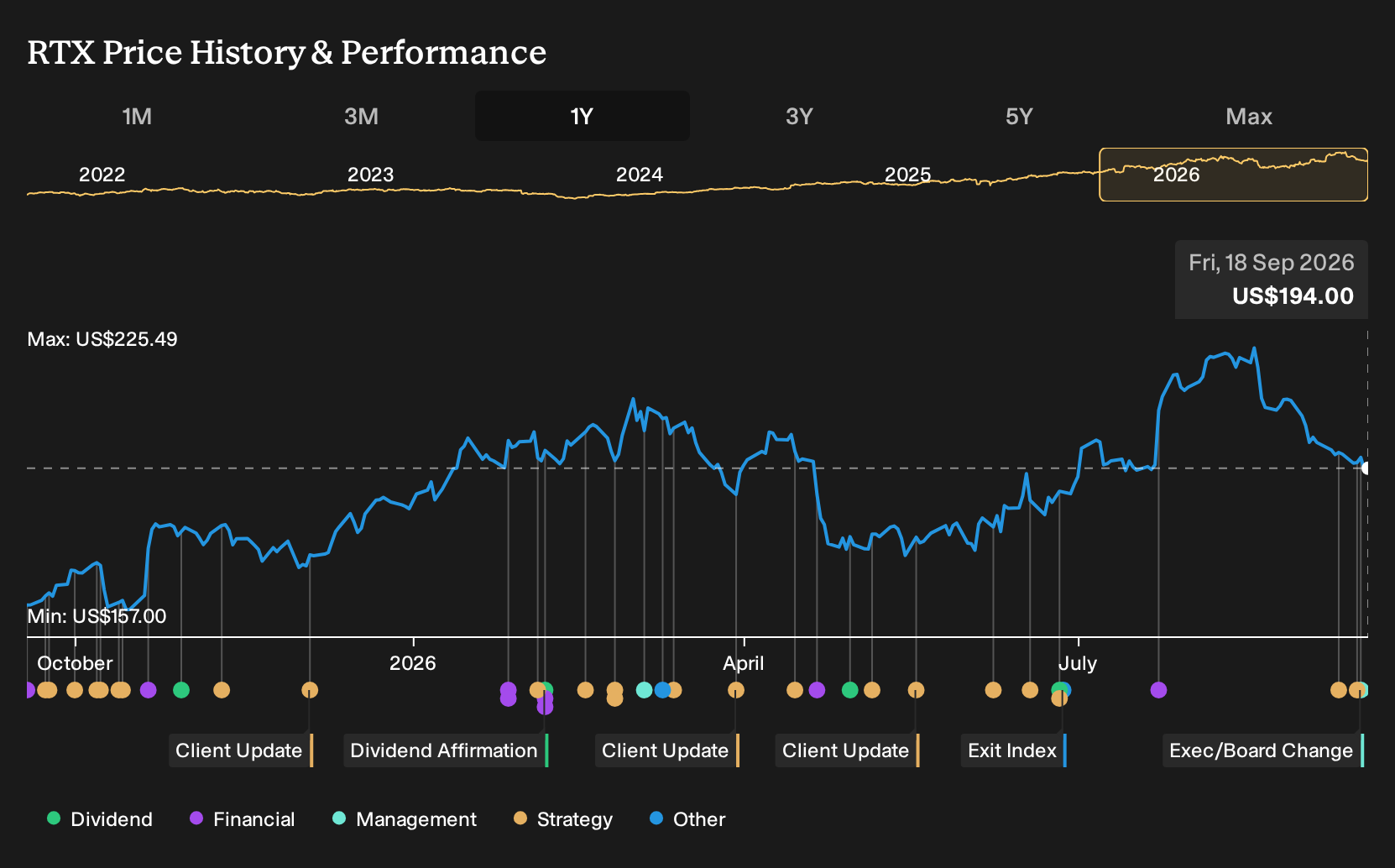
Uncover why RTX's fair value indicates a 20% potential upside to its current price, which could narrow quickly.
Exploring Other Perspectives
Three fair value estimates from the Simply Wall St Community cluster tightly between about US$232.27 and US$237.09 per RTX share, which shows how closely some private investors are thinking. Your own view might shift once you weigh tariff and engine reliability risks against ECU progress, missile demand and directed energy optionality.
Explore 2 other RTX fair value estimates, including one that suggests there may be as much as 22% upside from the current price.
Form Your Own Verdict
Don't just follow the ticker. Dig into the data and build a conviction that's truly your own.
- A great starting point for your RTX research is our analysis highlighting 4 key rewards and 3 important warning signs that could impact your investment decision.
- See our latest analysis for RTX. The report includes a comprehensive fundamental analysis summarized in a single visual, the Snowflake, making it easy to evaluate RTX's overall financial health at a glance.
Looking For More Ideas Beyond RTX?
If RTX has sharpened your focus on quality, defense exposed businesses, it can help to compare it with a wider field of opportunities using the Simply Wall St Screener.
- For investors who want resilient balance sheets and fewer surprises, start with a list of solid balance sheet and fundamentals (23 results) that shares RTX's emphasis on financial strength.
- If value is your priority, compare RTX with a 33 high quality undervalued stocks that combines stronger fundamentals with more modest expectations.
- Income focused portfolios can round out RTX exposure by adding a 6 dividend fortresses that aims to pair higher yields with business stability.
This article by Simply Wall St is general in nature. We provide commentary based on historical data and analyst forecasts only using an unbiased methodology and our articles are not intended to be financial advice. It does not constitute a recommendation to buy or sell any stock, and does not take account of your objectives, or your financial situation. We aim to bring you long-term focused analysis driven by fundamental data. Note that our analysis may not factor in the latest price-sensitive company announcements or qualitative material. Simply Wall St has no position in any stocks mentioned.
Have feedback on this article? Concerned about the content? Get in touch with us directly. Alternatively, email editorial-team@simplywallst.com