
Will Class Action Lawsuit Change Avis Budget Group (CAR) Narrative
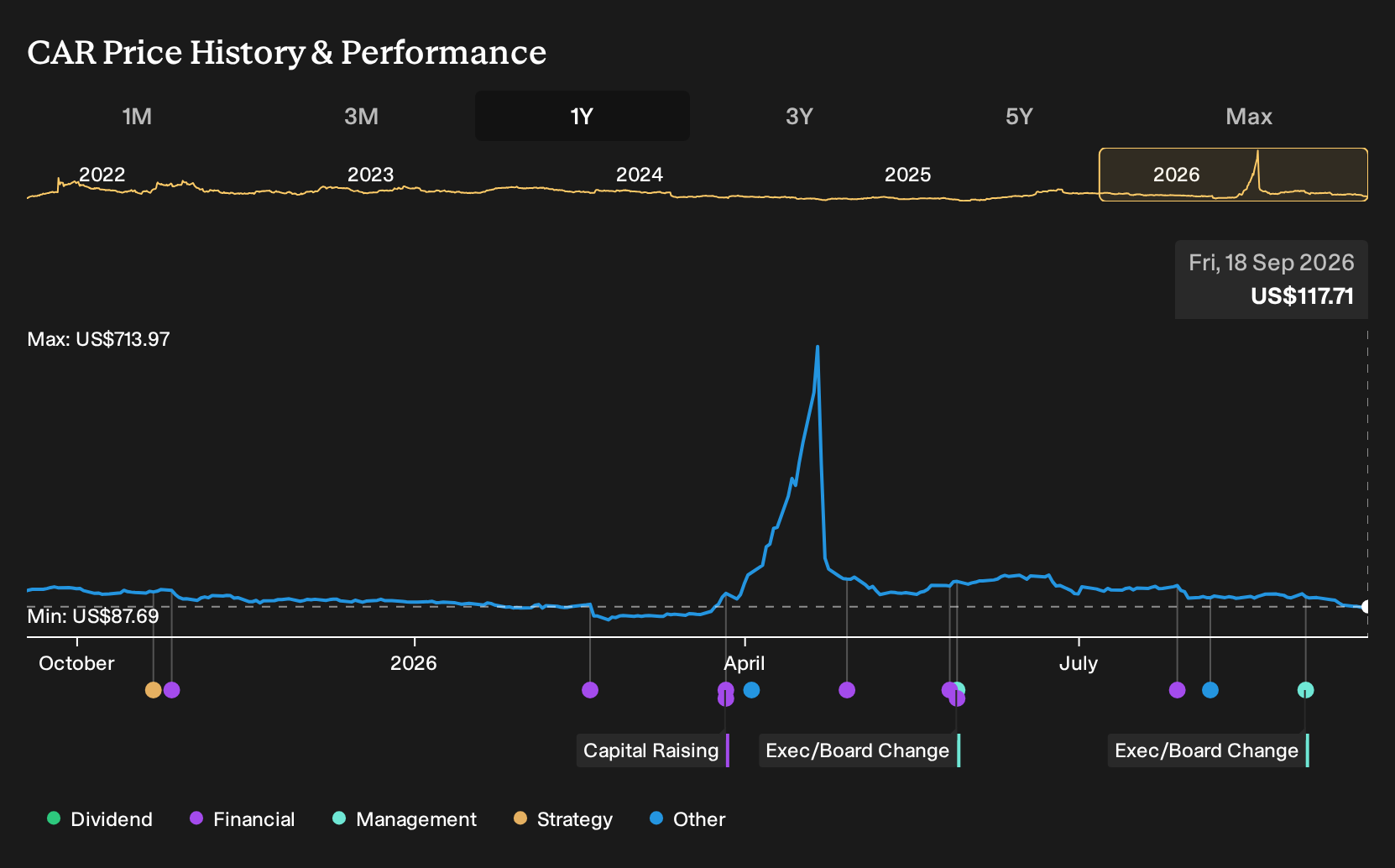
- Avis Budget Group recently faced investor attention after ClaimsFiler highlighted an upcoming deadline for lead plaintiff applications in a securities class action that covers purchases between February 20, 2025 and April 21, 2026, following allegations of undisclosed material information and manipulated trading activity involving large shareholder Pentwater.
- The lawsuit points directly at disclosure controls and how Avis Budget Group manages large shareholder dynamics, raising fresh questions about governance, risk oversight, and the resilience of its longer term mobility and premiumization plans.
- We will now examine how Avis Budget Group's investment narrative could be reshaped by the class action allegations around disclosure and market activity.
Avis Budget Group Investment Narrative Recap
To stay in Avis Budget Group, an investor needs to believe the rental and mobility model can turn current losses into sustainable profits as premium offerings, tech upgrades and partnerships like Waymo gain traction. The class action and Pentwater questions sit alongside that, but the bigger swing factor is still how efficiently vehicles are priced and utilized across regions.
In the near term, the biggest operational catalyst is execution on premiumization and digital systems that could support better yields on a roughly US$11.7b revenue base. The primary risk is that net income remains weak, with interest expenses not well covered, while legal scrutiny around disclosure and trading distracts management attention or tightens oversight around capital allocation.
The upcoming Morgan Stanley Laguna Conference on 15 September 2026 gives Avis Budget Group a public forum to address many of these themes head on. Investors can listen for detail on how management frames premium offerings like Avis First, the health of corporate and leisure demand, and how autonomous and EV partnerships fit into long term fleet planning.
This presentation also matters because the firm is currently loss making with interest costs flagged as a pressure point, while the share price has fallen roughly 25% over the past year. Clear commentary on cash generation, balance sheet priorities, and any guardrails they describe around large shareholders and governance will help you judge whether the litigation noise touches the core business thesis or mostly sits in the background.
Avis Budget Group's current analyst storyline points to revenue of US$12.2b and earnings of US$613.3m by 2029. That path assumes yearly top line growth of 1.5% and a swing in profit of about US$1.25b from the current earnings loss of US$636.0m.
Uncover why Avis Budget Group's fair value indicates a 10% potential upside to its current price that may not last much longer.
Exploring Other Perspectives
One alternative view focuses on rising capital needs rather than premiumization. Before the lawsuit headlines, the most cautious analysts were already assuming heavier spending would squeeze Avis Budget Group’s profitability, with revenue around US$12.4b and earnings of roughly US$432.0m by 2029. You now have a live example of how sharply investor opinions can diverge, so use this lawsuit and the upcoming Laguna conference as prompts to compare several narratives, not just the consensus story you hear first.
Explore 2 other Avis Budget Group fair value estimates, including one that suggests it could be worth just $128.57.
Reach Your Own Conclusion
Disagree with existing narratives? Extraordinary investment returns rarely come from following the herd, so go with your instincts.
- A great starting point for your Avis Budget Group research is our analysis highlighting 3 key rewards and 2 important warning signs that could impact your investment decision.
- See our latest analysis for Avis Budget Group. The report includes a comprehensive fundamental analysis summarized in a single visual, the Snowflake, making it easy to evaluate Avis Budget Group's overall financial health at a glance.
Looking For More Investment Ideas Beyond Avis Budget Group?
If the Avis Budget Group story has sharpened your focus on risk, cash flow and governance, it can help to line it up against other companies facing very different conditions. Use the Simply Wall St Screener to build that wider watchlist and pressure test your thesis against a broader set of opportunities.
- If you want potential upside with less balance sheet strain, scan a list of solid balance sheet and fundamentals (23 results) that can handle stress without constant refinancing worries.
- For investors hunting for quality at a discount, sort through 35 high quality undervalued stocks that combine fundamentals with pricing that may not fully reflect them yet.
- When stability and reliability matter most, focus on income ideas by reviewing 7 dividend fortresses that prioritize returning cash to shareholders.
This article by Simply Wall St is general in nature. We provide commentary based on historical data and analyst forecasts only using an unbiased methodology and our articles are not intended to be financial advice. It does not constitute a recommendation to buy or sell any stock, and does not take account of your objectives, or your financial situation. We aim to bring you long-term focused analysis driven by fundamental data. Note that our analysis may not factor in the latest price-sensitive company announcements or qualitative material. Simply Wall St has no position in any stocks mentioned.
Have feedback on this article? Concerned about the content? Get in touch with us directly. Alternatively, email editorial-team@simplywallst.com