
What Nuvation Bio (NUVB)'s Updated Cancer Drug Label Means For Shareholders
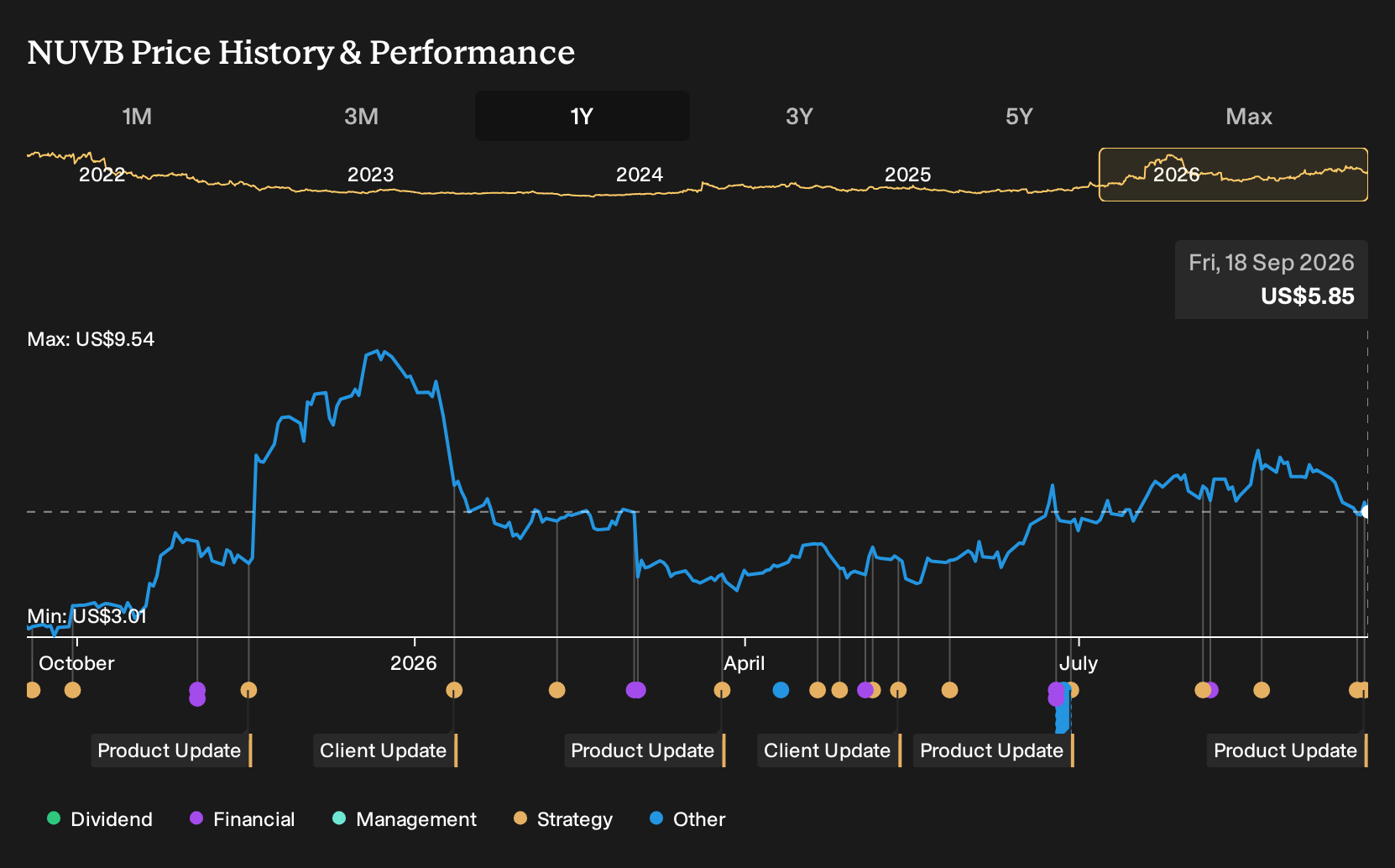
- Nuvation Bio reported that the FDA approved a supplemental NDA for IBTROZI, updating the U.S. label to include long term TRUST data with a median duration of response of 49.7 months in TKI naive ROS1+ NSCLC and no new safety signals.
- The new subgroup analyses from the TRUST program suggest IBTROZI’s activity is consistent across prior chemotherapy exposure and different ROS1 fusion partners, which indicates how broadly the therapy could be used within this already narrow lung cancer population.
- We will now examine how Nuvation Bio's investment narrative could be influenced by IBTROZI's updated long term efficacy and safety profile.
Nuvation Bio Investment Narrative Recap
To own Nuvation Bio, you need to believe IBTROZI can anchor a focused oncology franchise while the pipeline matures. The updated U.S. label, now showing a 49.7 month median duration of response with no new safety signals, reinforces the commercial story around a single key product. In the near term, the main swing factor remains how quickly IBTROZI use broadens within ROS1+ NSCLC globally.
The biggest risk is concentration. Earnings potential is heavily tied to sustained IBTROZI uptake while safusidenib and other assets are still years from pivotal readouts. Any competitive ROS1 agent, pricing pressure, or slower than expected reimbursement progress in markets like China, Japan, or Europe could weigh on that path and keep Nuvation Bio more dependent on a single therapy.
The most relevant announcement to focus on here is the FDA approval of the supplemental NDA that updates IBTROZI’s U.S. label with long term TRUST data. That decision formalizes the 49.7 month median duration of response in TKI naive ROS1+ NSCLC and confirms no new safety findings with extended follow up, giving prescribers and payers a clearer view of durability and tolerability.
For catalysts, that label change comes on top of the TRUST program and global filings already in motion. It supports the case for continued IBTROZI adoption, while longer term value still hinges on execution in adjuvant NSCLC studies and the lengthy safusidenib program. The operational question for investors is how effectively Nuvation Bio converts this stronger data package into broader real world use before new ROS1 competitors emerge.
Nuvation Bio's current analyst narrative points to forecast revenue of US$469.0 million and earnings of US$10.6 million by 2029. That scenario assumes revenue growth of 40.3% per year and an earnings swing of about US$160 million from a loss of US$149.8 million today to the projected profit level.
Uncover why Nuvation Bio's fair value indicates a 124% potential upside to its current price that could narrow quickly.
Exploring Other Perspectives
One alternate angle focuses less on IBTROZI’s new TRUST data and more on how slowly RNA testing might expand the ROS1+ pool for Nuvation Bio. The most bearish analysts were penciling in about US$391.5 million of 2029 revenue and saw earnings potentially as low as a US$186.8 million loss. That is a very different story from consensus. Use this label update as a prompt to compare both sets of numbers and decide which narrative you find more reasonable.
Explore 3 other Nuvation Bio fair value estimates, including one that suggests it could be worth just $13.10!
Form Your Own Verdict
Disagree with existing narratives? Extraordinary investment returns rarely come from following the herd, so go with your instincts.
- A great starting point for your Nuvation Bio research is our analysis highlighting 2 key rewards that could impact your investment decision.
- See our latest analysis for Nuvation Bio. The report includes a comprehensive fundamental analysis summarized in a single visual, the Snowflake, making it easy to evaluate Nuvation Bio's overall financial health at a glance.
Looking For More Investment Ideas Beyond Nuvation Bio?
Once you have a view on Nuvation Bio, it can help to line it up against a broader watchlist so you are not relying on a single story.
- For investors who want potential mispricing with quality behind it, start with a focused set of 35 high quality undervalued stocks that already clear high bars on fundamentals.
- If capital preservation and steadier profiles matter more to you than aggressive upside, scan through a curated group of 30 resilient stocks with low risk scores that screen well on resilience.
- When you want durable balance sheets and cleaner accounts backing the equity story, build a comparison list from the list of solid balance sheet and fundamentals (23 results).
This article by Simply Wall St is general in nature. We provide commentary based on historical data and analyst forecasts only using an unbiased methodology and our articles are not intended to be financial advice. It does not constitute a recommendation to buy or sell any stock, and does not take account of your objectives, or your financial situation. We aim to bring you long-term focused analysis driven by fundamental data. Note that our analysis may not factor in the latest price-sensitive company announcements or qualitative material. Simply Wall St has no position in any stocks mentioned.
Have feedback on this article? Concerned about the content? Get in touch with us directly. Alternatively, email editorial-team@simplywallst.com