
Dear Meta Platforms Stock Fans, Mark Your Calendars for Sept. 23
Facebook parent Meta Platforms (META) is picking up serious momentum, and this time, the excitement has little to do with social media. Artificial intelligence (AI) is taking center stage, and Meta may have another major catalyst waiting in the wings. After months of investor concerns over soaring AI spending and whether those massive investments would translate into meaningful returns, Meta is finally making moves that could help shift the narrative.
The company officially launched Muse this month, an autonomous personal AI assistant powered by the Muse Spark 1.3 foundation model and developed by Meta Superintelligence Labs (MSL), marking a major AI announcement that caught Wall Street’s attention. And now, another potential catalyst could be just around the corner. Citi analyst Ronald Josey has highlighted an upside catalyst to watch ahead of Meta’s Connect event on Sept. 23, where he expects updates on the company’s artificial intelligence products and broader product strategy.
Josey maintained a “Buy” rating and an $800 price target, implying roughly an 18.8% return from the stock’s last close. He expects updates on Muse, next-generation AI models, and Meta’s glasses strategy, citing an accelerating product cadence and early Muse adoption as factors supporting his view of potential returns from Meta’s AI investments. With analysts pointing to next week’s developers conference as a potential source of fresh enthusiasm for the stock, here’s a closer look at Meta.
About Meta Stock
Meta Platforms is no longer simply the company behind Facebook and Instagram. With billions of users across Facebook, Instagram, WhatsApp, Messenger, and Threads, the tech giant has built one of the most deeply embedded digital ecosystems globally. Founded by Mark Zuckerberg in February 2004 as Facebook and headquartered in Menlo Park, Calif., Meta has since expanded into AI assistants, Quest headsets, and AI-powered smart glasses.
Now, the company is looking to turn that enormous reach into a powerful AI advantage. Rather than building a completely separate destination for users, Meta is bringing artificial intelligence into the platforms people already use every day. Meta AI is available across WhatsApp, Instagram, Facebook, and Messenger, helping users answer questions, create content, search for information, receive recommendations, and manage everyday tasks without leaving the app.
But Meta’s ambitions go well beyond adding AI features to social media. Last week, the company unveiled its AI personal agent app, internally code-named Hatch, marking another major step in its AI push. Powered by the Muse Spark family of foundation models, the app drew immediate attention from Wall Street and helped send Meta shares soaring nearly 6.6% on Sept. 9. Meta AI chief Alexandr Wang has been introducing the Muse Spark models at a breakneck pace since April, highlighting the company’s accelerating AI development.
According to Meta, the app allows users to delegate digital chores to AI-powered assistants, including booking appointments, filling out electronic forms, and monitoring home security camera feeds. The idea is to make AI more practical and approachable rather than intimidating. Wang said Meta designed Muse so that it “feels very approachable and friendly and explainable, and it doesn’t feel too complicated.” The personal agent will be available through a free tier, as well as monthly subscription plans priced at $20 or $100, depending on usage.
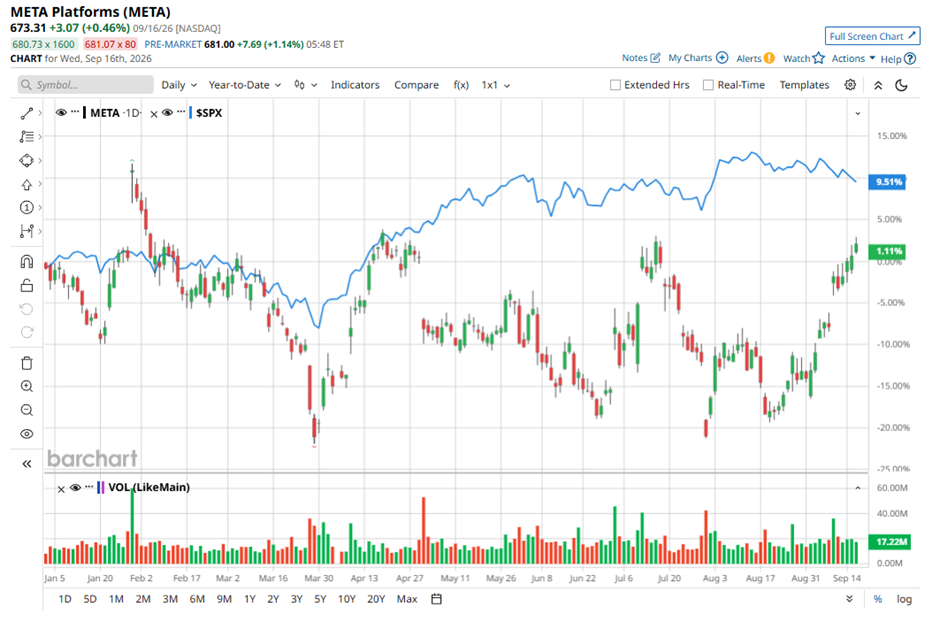
That AI push is now showing up in Meta’s stock performance. With a market capitalization of about $1.72 trillion, Meta’s stock has risen 14.2% over the past month and 12.2% over the past three months, outperforming the broader market during both periods. In fact, the company, which was in negative territory in 2026 not long ago amid concerns over its massive AI spending, is now showing a 2% gain year-to-date. That still trails the broader S&P 500 Index ($SPX) , which has gained about 10.3% year-to-date.
A Closer Look at Meta’s Q2 Earnings Report
Meta Platforms’ fiscal 2026 second-quarter results delivered a mixed bag for investors. The company reported earnings on July 29, and while revenue comfortably beat Wall Street expectations, soaring costs and massive AI-related investments weighed on profitability, sending the stock down 8% in the following trading session. In the second quarter, Meta generated $60.80 billion in revenue, up 28% year-over-year (YOY) and ahead of Wall Street’s $60.21 billion forecast.
The strong top-line performance was largely powered by continued demand for digital advertising across Meta’s Family of Apps. The company’s enormous user base also kept growing, with Family daily active people (DAP) averaging 3.60 billion in June, up 3% YOY. Meanwhile, ad impressions delivered across the Family of Apps jumped 14%, while the average price per ad rose 12% from a year earlier, highlighting the continued strength of Meta’s advertising engine.
However, the picture changed sharply further down the income statement. Total costs and expenses surged 55% YOY to $42.03 billion, putting significant pressure on profitability. The increase was partly driven by $2.4 billion in legal proceeding charges and $1.18 billion in severance costs tied to workforce layoffs. As a result, Meta’s operating margin plunged to 31% from 43% in the year-ago quarter. EPS also came under pressure, landing at $6.18, down 13% from $7.14 in Q2 2025 and below analysts’ $7.10 consensus estimate.
Another major pressure point was Meta’s massive AI and infrastructure spending. Capital expenditures surged to $31.08 billion during the quarter as the company continued pouring money into AI infrastructure and servers. And while operating cash flow remained strong at $31.86 billion, the heavy investment spending left Meta with just $784 million in free cash flow, a dramatic drop from $8.55 billion in the year-ago quarter.
Despite the sharp decline in FCF, Meta ended June with a substantial liquidity cushion. Cash, cash equivalents, and marketable securities totaled $90.26 billion. Looking ahead, Meta expects third-quarter 2026 revenue of $61 billion to $64 billion. The company also raised the lower end of its full-year expense outlook to account for the $2.4 billion in legal proceeding charges recognized in the second quarter.
Meta now expects full-year 2026 total expenses of $165 billion to $169 billion. At the same time, the company is preparing for an enormous AI infrastructure bill. Meta now expects 2026 capital expenditures, including principal payments on finance leases, to reach $130 billion to $145 billion, narrowing the range from its previous outlook of $125 billion to $145 billion.
How Do Analysts View Meta Stock?
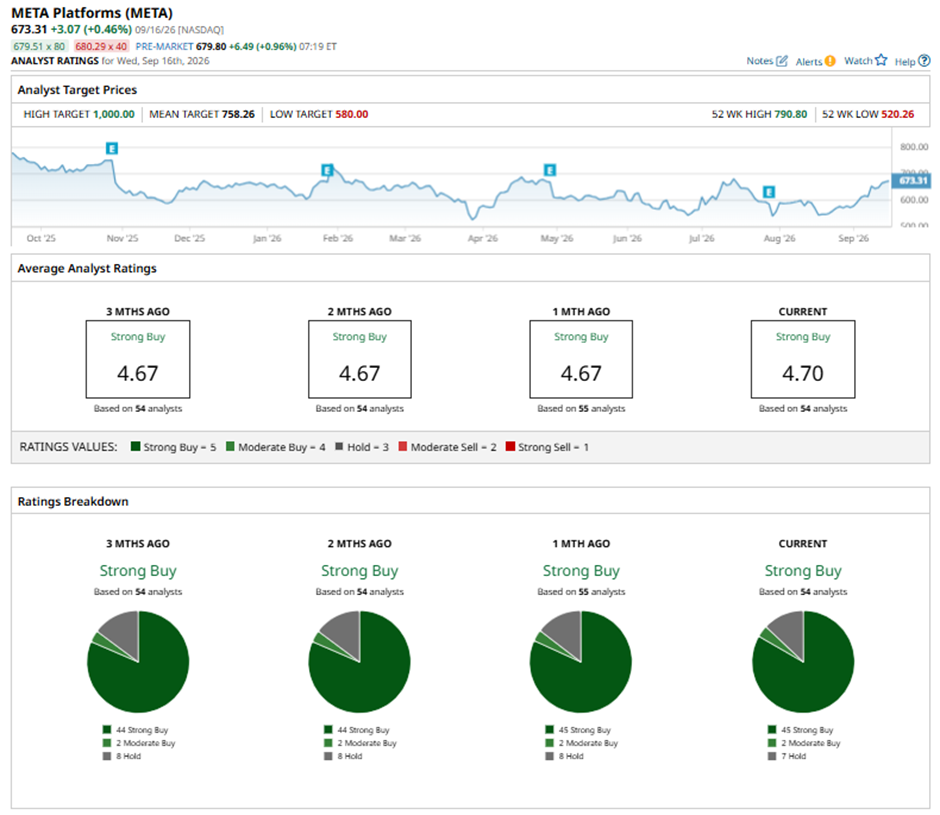
Ahead of the company’s upcoming event, Wall Street remains firmly bullish on Meta stock, with the company earning a consensus “Strong Buy” rating. Among 54 analysts, 45 recommend “Strong Buy,” two give a “Moderate Buy,” and seven have a “Hold” rating. The average price target of $758.26 points to about 12.6% upside, while the Street-high target of $1,000 suggests Meta could climb as much as 48.5% from here.
On the date of publication, Anushka Mukherji did not have (either directly or indirectly) positions in any of the securities mentioned in this article. All information and data in this article is solely for informational purposes. For more information please view the Barchart Disclosure Policy here.