
How Merger Disclosure Lawsuit At DNOW (DNOW) Has Changed Its Investment Story
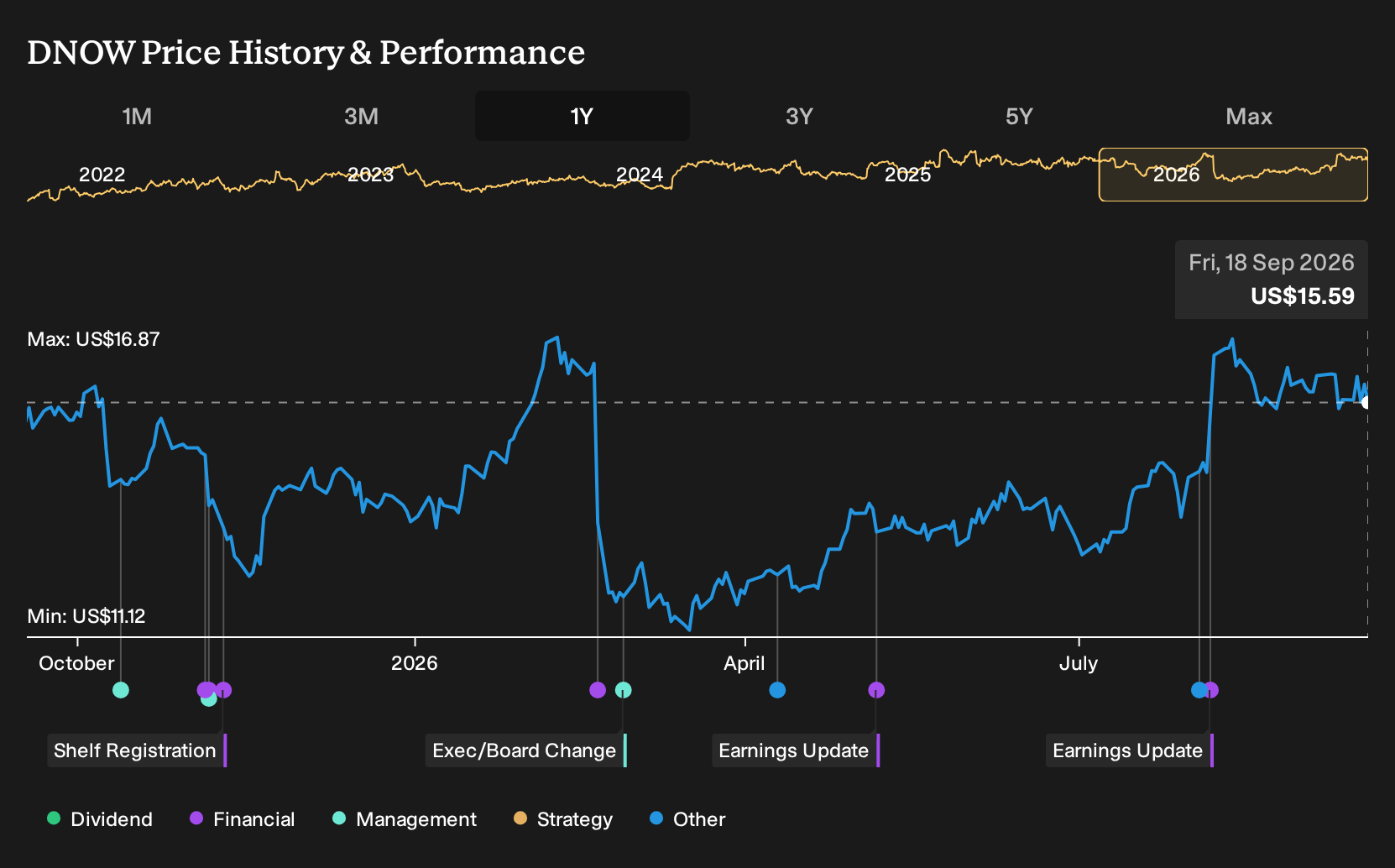
- DNOW is facing a securities class action that alleges the company misled investors about risks tied to its MRC Global acquisition, particularly undisclosed ERP integration problems that later coincided with operational disruption and uncertainty around financial guidance.
- The litigation focuses on how DNOW portrayed complex enterprise software integration in merger materials, which relates directly to management execution, operational resilience, and the quality of disclosure investors rely on to judge the business.
- We will now look at how this disclosure-focused lawsuit over the MRC Global integration could reshape DNOW's broader investment narrative.
Balance legal risk in your portfolio by scanning a hand-picked 30 resilient stocks with low risk scores that may offer steadier fundamentals than DNOW while this lawsuit plays out.
DNOW Investment Narrative Recap
To own DNOW, you need to believe the distribution platform, digital tools and energy transition exposure can turn current losses into sustainable earnings. The short term story now hinges on whether management can keep day to day operations steady while dealing with MRC Global ERP integration issues and the related class action spotlight.
If integration problems keep disrupting ordering, logistics or customer service, that could weigh on revenue and margins at the wrong time. The biggest near term catalyst remains execution on energy evolution, midstream and digital initiatives. The key risk has shifted toward operational and disclosure credibility around complex IT and merger integration work.
The Rosen Law Firm’s reminder about the October 2, 2026, lead plaintiff deadline is the clearest operationally relevant update tied to this case. It confirms the class action is moving through the process and keeps attention squarely on how DNOW described the MRC Global ERP situation relative to what investors later experienced in terms of disruption.
For you, this announcement matters because it could extend the period where integration quality, internal controls and communication practices stay under scrutiny. That can affect management focus while DNOW is trying to scale midstream activity, expand energy evolution sales and push digital offerings like AccessNOW, all of which are important operational catalysts.
How DNOW’s Forecasts Sit Next To The Lawsuit Risk
Analysts are not ignoring DNOW’s ERP and integration headaches, yet their published numbers sketch out a very specific financial path that investors can compare against the legal overhang. That forecast implies a business that moves from today’s loss making position to positive earnings while still digesting the MRC Global systems work and dealing with disclosure questions raised in the class action. For you, the task is to judge whether those assumptions feel realistic once the friction from software disruption, customer service strain and management distraction is layered on top.
DNOW’s narrative projects US$5.8b revenue and US$205.7m earnings by 2029. This assumes 12.5% yearly revenue growth and an earnings increase of about US$393.7m from current earnings of a US$188.0m loss.
The current Simply Wall St excerpt shows analysts assuming revenue expands at 12.5% a year over the next three years, with profit margins moving from a loss of 4.6% today to a 3.5% profit by 2029. That is a sizeable swing. It effectively means the ERP and integration work around MRC Global needs to be handled without repeated operational hits to ordering, logistics or customer relationships that could drag on those margin ambitions. Any sustained disruption to the supply chain platform or AccessNOW usage would make that margin shift harder to deliver.
On earnings, the consensus points to a move from a loss of US$188.0m today to US$205.7m by around August 2029, paired with earnings per share of US$1.14. That is a swing of roughly US$393.7m. For a reader, the key question is not whether that figure looks high or low in isolation. The more useful way to think about it is whether DNOW can drive that earnings change while also investing in integration fixes, legal expenses and any remediation work tied to disclosure controls that the class action may spotlight.
Those same projections tie into a valuation framework that assumes DNOW could be trading on a P/E of 25.9x in 2029, with revenue at US$5.8b and earnings at US$205.7m, based on a discount rate around 8.7%. That multiple is slightly under the cited US Trade Distributors sector P/E of 26.0x, so the implied end point is not wildly out of step with peers on that metric alone. It does, however, lean heavily on the idea that ERP integration, MRC Global system consolidation and related control issues do not permanently dent the business model investors are paying for.
Scrutinising that set of numbers next to the lawsuit, you can think in buckets. First, operational execution, which includes keeping order flows, inventory, and logistics running cleanly on the new ERP while fixing any glitches that contributed to the disruption described in the complaint. Second, financial delivery, which is where those 12.5% revenue growth assumptions and the margin lift to 3.5% need to show up in reported results without repeated “one time” integration costs. Third, disclosure quality, because any future guidance around integration progress will likely be read against the allegations already on the table.
For portfolio decisions, this means DMOW now carries two intertwined storylines. There is the underlying distribution, digital and energy transition thesis that analysts have tried to quantify with the US$5.8b revenue and US$205.7m earnings target for 2029. Alongside that sits the legal and integration risk, where any further ERP setbacks, class action developments or control remediation efforts could shift sentiment on whether those forecasts still look reasonable. Balancing those threads, and testing the published assumptions against your own view of integration complexity, can help you decide how much legal risk exposure you are comfortable holding while this case develops.
Uncover why DNOW's fair value indicates a 20% potential upside to its current price that could narrow quickly.
Exploring Other Perspectives
The three fair value estimates from the Simply Wall St Community span roughly US$18.75 to US$32.09, which is a wide spread for such a small sample. That gap indicates community investors see DNOW very differently. Set those views against the securities class action over the MRC Global merger and consider how integration risk, energy evolution demand and rig activity could reshape the business story from here. Use those contrasts to test your own stance and explore several alternative viewpoints before committing fresh capital.
Explore 2 other DNOW fair value estimates, including one that suggests potential upside of up to 106% from the current price.
Reach Your Own Conclusion
Don't just follow the ticker; dig into the data and build a conviction that's truly your own.
- A great starting point for your DNOW research is our analysis highlighting 4 key rewards and 2 important warning signs that could impact your investment decision.
- See our latest analysis for DNOW. The report includes a comprehensive fundamental analysis summarized in a single visual, the Snowflake, making it easy to evaluate DNOW's overall financial health at a glance.
Looking For More Investment Ideas Beyond DNOW?
If the DNOW story has you rethinking how much legal and integration risk you want in your portfolio, it can help to line it up next to other businesses with different profiles using the Simply Wall St Screener.
- For investors who want potential upside without stretching on quality, consider a curated 16 high quality undiscovered gems selection that combines solid fundamentals with under-the-radar coverage.
- If capital preservation sits higher on your priority list while DNOW works through its class action and ERP issues, compare it with a carefully filtered 30 resilient stocks with low risk scores group that aims for more resilient balance sheets and earnings profiles.
- Income focused readers who prefer cash returns in hand over long dated narratives can review companies in the 7 dividend fortresses list that meet a 5%+ yield hurdle with an emphasis on stability.
This article by Simply Wall St is general in nature. We provide commentary based on historical data and analyst forecasts only using an unbiased methodology and our articles are not intended to be financial advice. It does not constitute a recommendation to buy or sell any stock, and does not take account of your objectives, or your financial situation. We aim to bring you long-term focused analysis driven by fundamental data. Note that our analysis may not factor in the latest price-sensitive company announcements or qualitative material. Simply Wall St has no position in any stocks mentioned.
Have feedback on this article? Concerned about the content? Get in touch with us directly. Alternatively, email editorial-team@simplywallst.com