
Joby Aviation Stock Is Down 54% This Year. Here's Why I'd Buy It Before 2027.
Key Points
Shares of the air taxi maker have plummeted this year.
However, Joby has made several smart acquisitions.
Joby is expected to double its revenue next year.
No U.S. company is closer to commercializing an electric air taxi than Joby Aviation (NYSE: JOBY). And yet in a market that is one of the most expensive in history, Joby's stock has been moving in the opposite direction.
There isn't one reason Joby stock has lost over half its value on the year. Most likely, cash burn, dilution, rising operating expenses, uncertainty around its FAA type certification, and a blistering-high valuation have collectively cooled Wall Street's enthusiasm. Add to that stubborn inflation, rising bond yields, geopolitical turmoil, and now an interest rate hike, and investors have plenty of reasons to shy away from a speculative growth stock like Joby.
Missed AI’s "Act 1"? Act 2 Could Be 15x Bigger. Most investors think they missed the AI boat because they didn't buy Nvidia in 2005. But according to our analysts, we’re only at the end of "Act 1"—the R&D phase. "Act 2" is the global rollout. Continue »
If you're looking for a safe, secure, and relatively stable stock, Joby is probably not for you. But for aggressive investors who are willing to risk substantial downside in pursuit of potentially massive returns, here's why Joby might be a stock to watch in 2027.
Joby could be selling tickets to paying passengers soon
For years, Joby has been developing its own style of electric vertical takeoff and landing (eVTOL) aircraft. The idea is to shuttle passengers along routes that are typically heavily trafficked by road traffic. Joby is targeting places where time is money -- like New York City -- and where saving an hour or so in the air could be worth the premium such a flight might cost.
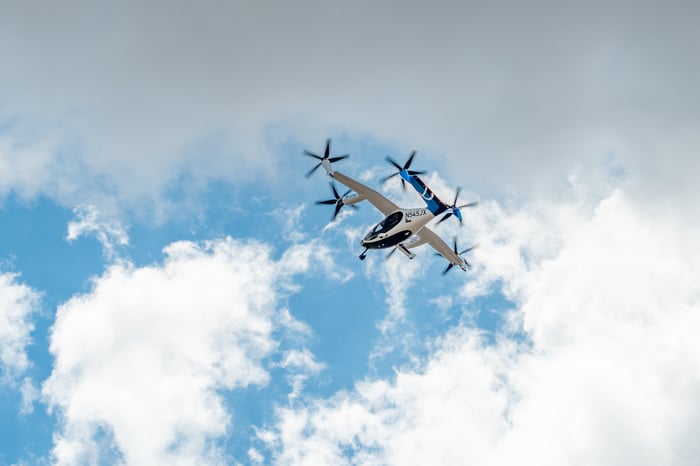
Image source: Joby Aviation.
We don't yet know how much these tickets will cost, because Joby is still waiting for government approval to fly paying passengers. But that information could be available soon, as Joby is set to begin operations across 11 states in 2026 ahead of full FAA type certification.
These pre-certification flights could give Joby something almost as valuable as regulatory approval: real-world flight experience. Over time, the program will progress from carrying only a pilot to shuttling nonpaying passengers and eventually paying passengers.
Don't miss that last part. If everything goes right, Joby could be putting paying passengers in the air as early as 2027.
Cash burn remains a weak spot
To be sure, revenue from these early eIPP flights probably wouldn't amount to much, at least not relative to its cash burn. At the same time, Joby is no longer the pre-revenue company that it once was.
Joby expects between $115 million and $125 million in total revenue this year, largely thanks to its acquisition of Blade Air Mobility, which generated roughly $36 million last quarter. Meanwhile, Resonant Sciences, a defense business Joby plans to acquire, generated more than $100 million in trailing revenue.
These two sources, plus revenue from pre-certification passenger flights, could help offset Joby's enormous cash burn. Indeed, analysts now expect Joby's revenue base to generate almost half a billion dollars by 2028.

Data by YCharts
At the same time, I can understand the arguments against investing in Joby if you don't have a long time horizon. Jim Cramer, host of Mad Money, summed it up best when he said, "I've been against Joby because it's losing a lot of money... It's an interesting spec, but I would not put my money in it."
If today's cash burn makes you uncomfortable, you might want to avoid Joby, too. However, if you have time on your side, picking up a few shares after this year's brutal sell-off could prove shrewd in hindsight.
Steven Porrello has positions in Joby Aviation. The Motley Fool has no position in any of the stocks mentioned. The Motley Fool has a disclosure policy.