
3 Defense Stocks With At Least 5% Revenue Growth
Fresh strikes on Ukraine’s economy and Russia’s infrastructure highlight how quickly global supply chains and national security priorities can change. That keeps governments focused on equipment, logistics, and intelligence spending, which can support steady demand for aerospace and defense contractors. If you want exposure to that spending, this article walks through three stocks from our U.S. defense and aviation supplier screen that aim to offer just that.
The stocks below are just a starting sample, and the full screen surfaced 73 more aerospace and defense companies with equally compelling narratives that are not covered here.
If you want to identify and analyze those extra opportunities in a structured way, head straight to the Aerospace And Defense screener.
General Electric (GE)
GE Aerospace gives you direct exposure to the engines and support services that keep both commercial jets and military fleets flying, which makes General Electric a clear fit for this Aerospace And Defense screen.
General Electric, now focused on GE Aerospace, generates most of its revenue from Commercial Engines & Services at about $37.7b, with Defense & Propulsion Technologies adding roughly $11.5b and Corporate & Other around $1.4b, and carries a market value near $326.1b.
"Acceleration of next-generation engine programs (like CFM RISE with open fan technology and the GE9X) driven by airline demand for significantly improved fuel efficiency and lower emissions; positions GE to capture incremental orders and technology licensing revenue as decarbonization efforts intensify, positively impacting long-term revenue and earnings growth."
What matters next is how one unseen pressure shapes the balance between high margin services, new engine output, and long term cash generation.
That pressure point is exactly what the full narrative for General Electric unpacks, separating temporary mix issues from longer term cash and earnings potential.

Rocket Lab (RKLB)
Rocket Lab is building out an end to end space platform that fits neatly into the Aerospace And Defense theme, with its rockets, satellites, and on orbit services directly tied to real missions for commercial clients and government agencies.
Rocket Lab generates about US$544 million from its Space Systems segment and roughly US$225 million from Launch Services, giving the group broad exposure to spacecraft and launch work, and the business carries a market value near US$38.6 billion.
For investors watching the defense side of the space race, Rocket Lab offers a pure space infrastructure story rather than a broad industrial conglomerate.
"Rocket Lab needs to start achieving positive net margins so it can transform from being a company that burns shareholder funds into one that earns enough cash to self-invest into its growth. Neutron's successful operation should be that turning point; however, Neutron's failure would risk the entire company."
What really matters from here is how one unresolved execution point shapes the balance between scale, pricing power, and long term profitability.
If that turning point is what you care about, read the full narrative for Rocket Lab to see how Neutron, contracts, and capital needs could be decoupling expectations.

Lockheed Martin (LMT)
Lockheed Martin is one of the clearest pure plays on the Aerospace And Defense theme, with its Aeronautics arm supplying F-35 fighter jets and other combat aircraft, backed by sizeable missiles, rotary systems, and space businesses worldwide.
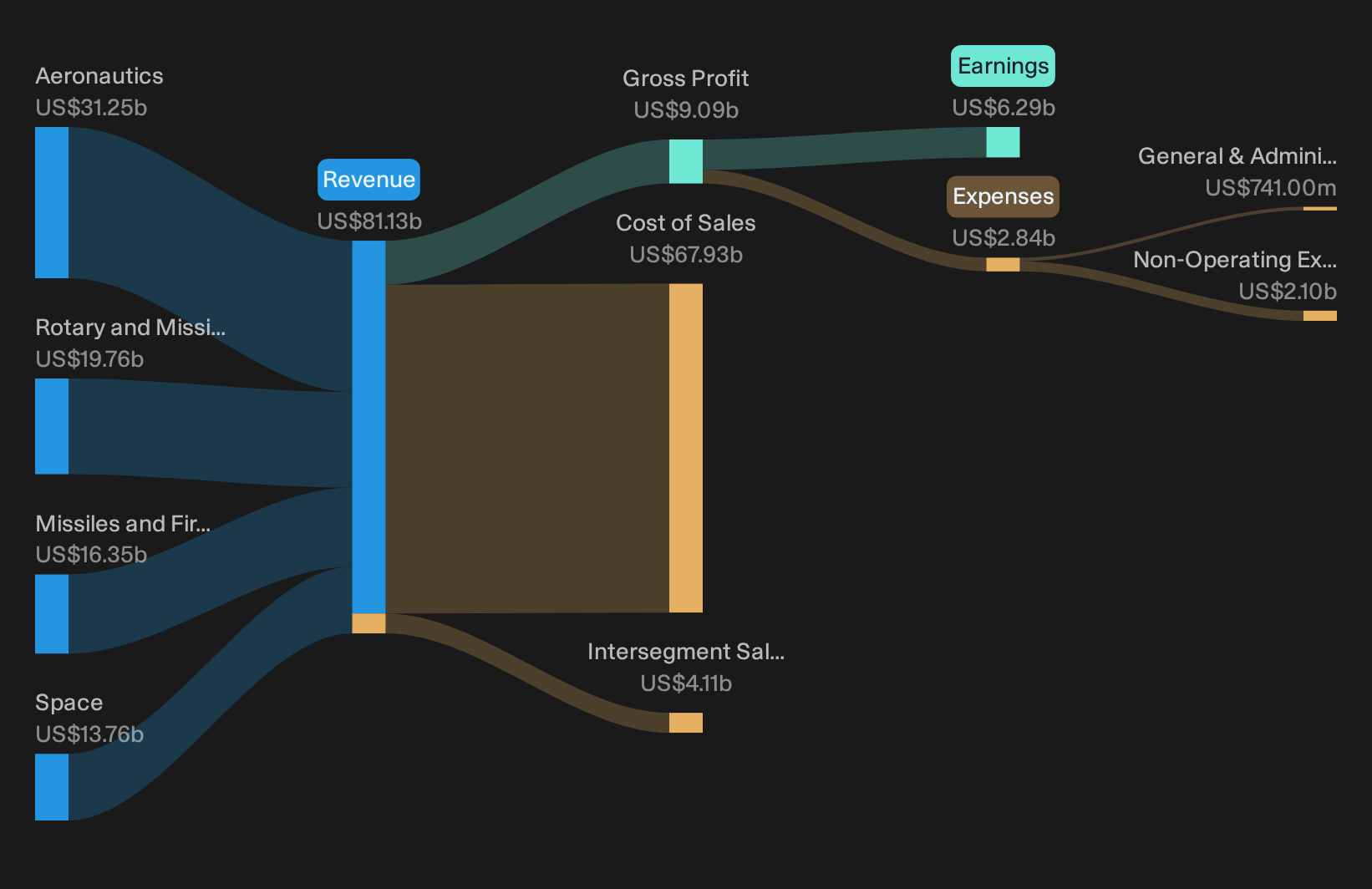
Lockheed Martin generated about US$31.2b from Aeronautics, US$19.8b from Rotary and Mission Systems, US$16.4b from Missiles and Fire Control, and US$13.8b from Space, and the stock carries a market value near US$123.1b.
Investors watching defense spending often look to Lockheed Martin when they want exposure to frontline aircraft, advanced missile systems, and the long pipelines of service work that follow big programs.
"Demand for advanced platforms such as the F-35, PAC-3, THAAD, and hypersonic weapons is being reinforced by actual combat use and rising geopolitical tensions, with multiple U.S. and international customers increasing orders and strong backlog growth likely, positioning Lockheed Martin for robust revenue growth going forward."
What happens if a single pressure point on profitability shifts in either direction could matter more than the headline backlog numbers.
If that profit squeeze is what you are weighing, read the full narrative for Lockheed Martin to see how Lockheed Martin’s backlog, cash flows, and risk profile could be shifting.
Seeking Fresh Alternatives Before They Fly
Fresh ideas move first. The best breakouts often gain momentum while most investors are still watching headlines. Before these themes stop flying under the radar, consider acting early.
- Spot early-stage potential in smaller companies that already show solid balance sheets and fundamentals by running the list of solid balance sheet and fundamentals (23 results) before others catch on.
- Follow long term income trends by scanning the 7 dividend fortresses while payout strength, balance sheet quality, and yield momentum still appear under the radar.
- Track the infrastructure behind AI developments by reviewing the 88 AI infrastructure stocks while capital is still shifting and before the most resilient operators become widely recognized.
This article by Simply Wall St is general in nature. We provide commentary based on historical data and analyst forecasts only using an unbiased methodology and our articles are not intended to be financial advice. It does not constitute a recommendation to buy or sell any stock, and does not take account of your objectives, or your financial situation. We aim to bring you long-term focused analysis driven by fundamental data. Note that our analysis may not factor in the latest price-sensitive company announcements or qualitative material. Simply Wall St has no position in any stocks mentioned.
Have feedback on this article? Concerned about the content? Get in touch with us directly. Alternatively, email editorial-team@simplywallst.com