
What Marcus & Millichap Stock's Multifamily Deal Flow Means For Shareholders
- Marcus & Millichap, through IPA Capital Markets, recently arranged a US$40.3 million non recourse bridge loan for a 312 unit San Antonio multifamily asset and secured US$43 million of construction financing for a 192 unit project in Florida, alongside closing the sale of a 39 unit San Diego apartment property.
- These sizeable multifamily financings and a completed property sale highlight Marcus & Millichap’s ability to source capital and execute brokerage mandates across different markets and project stages, from new development to operating assets.
- We will now look at how Marcus & Millichap’s investment narrative could be affected by this series of large multifamily financings.
Marcus & Millichap Investment Narrative Recap
To hold Marcus & Millichap, you need to believe the brokerage and capital markets platform can turn a transaction heavy model into more consistent earnings, supported by technology, service line breadth, and a gradually healthier financing backdrop. The short term swing factor is straightforward: deal volumes and fees need to support that recently regained profitability.
The biggest operational risk remains its dependence on commissions in a choppy commercial real estate market, with fee pressure and agent retention both in focus. The latest multifamily deals do not remove that exposure. They do, however, show that the pipeline is functioning rather than frozen.
The Birwood Heights US$40.3 million non recourse bridge loan is a clear view into what may matter for you as a shareholder. It highlights Marcus & Millichap’s ability to arrange sizeable debt with structured terms such as a 6.45% stabilized debt yield and 80% loan to value, which keeps its capital markets franchise active even when property sales slow.
That type of financing flow can support advisory revenue while transaction volumes remain uneven. It also increases the importance of execution quality and lender relationships as a real differentiator. If capital access tightens again or competition compresses fees further, these financings may function more as proof of capability than as a meaningful offset to the core cyclicality risk.
Marcus & Millichap’s current analyst script points to revenue of US$1.1b and earnings of US$81.3 million by 2029, built on a 12.0% yearly revenue growth rate and an earnings swing of roughly US$81.9 million, from a loss of US$587.0 thousand today to that forecast profit level.
Uncover why Marcus & Millichap's fair value indicates a 7% potential downside to its current price, which leaves little room for error.
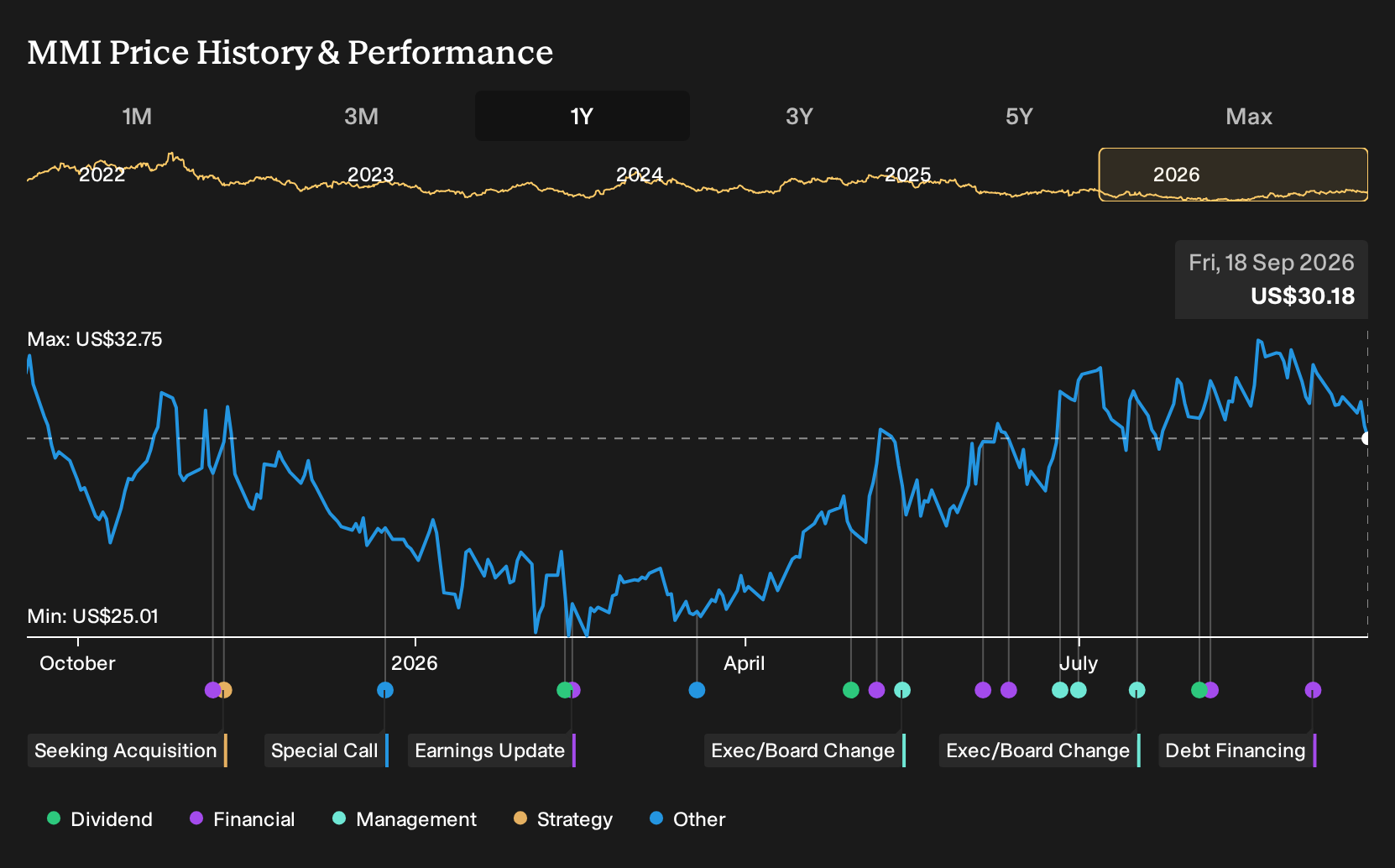
Exploring Other Perspectives
The Simply Wall St Community offers just 2 fair value estimates for Marcus & Millichap, ranging from about US$26.85 to US$28 per share, so even this small sample shows how opinions can diverge. You also need to weigh transaction concentration risk and fee pressure, which could significantly influence how the brokerage model actually performs. Consider exploring more of these community viewpoints before forming your own stance.
Explore another Marcus & Millichap fair value estimate, including one that suggests as much as 11% downside from the current price.
Form Your Own Verdict
Don't just follow the ticker. Dig into the data and build a conviction that's truly your own.
- A great starting point for your Marcus & Millichap research is our analysis highlighting 2 key rewards and 1 important warning sign that could impact your investment decision.
- See our latest analysis for Marcus & Millichap. The report includes a comprehensive fundamental analysis summarized in a single visual, the Snowflake, making it easy to evaluate Marcus & Millichap's overall financial health at a glance.
Looking For More Investment Ideas Beyond Marcus & Millichap?
If Marcus & Millichap has you thinking more broadly about where to put capital to work, it can help to scan a wider set of companies that share some of the qualities you care about, whether that is value, resilience, or income.
- For investors who want potential value combined with quality fundamentals, run a quick pass over 35 high quality undervalued stocks that may be trading below what their financials suggest.
- If capital preservation and steadier profiles matter more to you right now, narrow your search using a focused set of 30 resilient stocks with low risk scores that screen well on business and balance sheet resilience.
- For those hunting for ideas that are off most radars but still underpinned by solid numbers, cast a wider net across 16 high quality undiscovered gems that still show strong fundamentals.
This article by Simply Wall St is general in nature. We provide commentary based on historical data and analyst forecasts only using an unbiased methodology and our articles are not intended to be financial advice. It does not constitute a recommendation to buy or sell any stock, and does not take account of your objectives, or your financial situation. We aim to bring you long-term focused analysis driven by fundamental data. Note that our analysis may not factor in the latest price-sensitive company announcements or qualitative material. Simply Wall St has no position in any stocks mentioned.
Have feedback on this article? Concerned about the content? Get in touch with us directly. Alternatively, email editorial-team@simplywallst.com