
How Investors May Respond To Con Ed Stock Backing NYC Electric School Buses
- First Student, Inc. recently completed the first phase of an electric school bus project for the New York City Department of Education, featuring trenchless First Charge infrastructure, bi-directional charging, and funding support from Consolidated Edison and NYSERDA to reduce construction costs and complexity.
- The project connects Consolidated Edison directly to load-managed fleet charging, in which buses recharge during off-peak hours to help control energy costs and support more efficient power use in a dense urban setting.
- We will now examine how Consolidated Edison's investment narrative could be influenced by its role in this electric bus infrastructure project.
Scan beyond Consolidated Edison and review hand picked grid and electrification opportunities with the 39 power grid technology and infrastructure stocks that may also benefit from long term shifts in urban energy demand.
What Is Consolidated Edison's Investment Narrative?
Owning Consolidated Edison usually comes down to a simple belief. You think a dense, electrified service territory like New York keeps needing reliable wires, pipes, and meters, and you are comfortable with a slower growth, capital heavy utility model that depends on regulators signing off on large buildouts. Recent earnings trends have been solid, with profit growth and net margins that are higher than last year, and the stock trades on a P/E below both peer averages and some fair value estimates.
The school bus project funding in New York fits that story as a small but telling proof point. It shows Con Ed embedded in real world electrification, using off peak charging and grid management rather than only talking about it. In the near term, this kind of pilot is unlikely to move revenue or earnings by itself. The bigger near term levers remain capital spending plans, regulatory decisions, debt coverage and the sustainability of a 3.37% dividend that is not fully backed by free cash flow.
That said, one pressure point sits right next to those attractive grid opportunities and it has to do with how Con Ed is funding...
There's only one way to know the right time to buy, sell or hold Consolidated Edison. Head to Simply Wall St's company report for the latest analysis of Consolidated Edison's Fair Value.
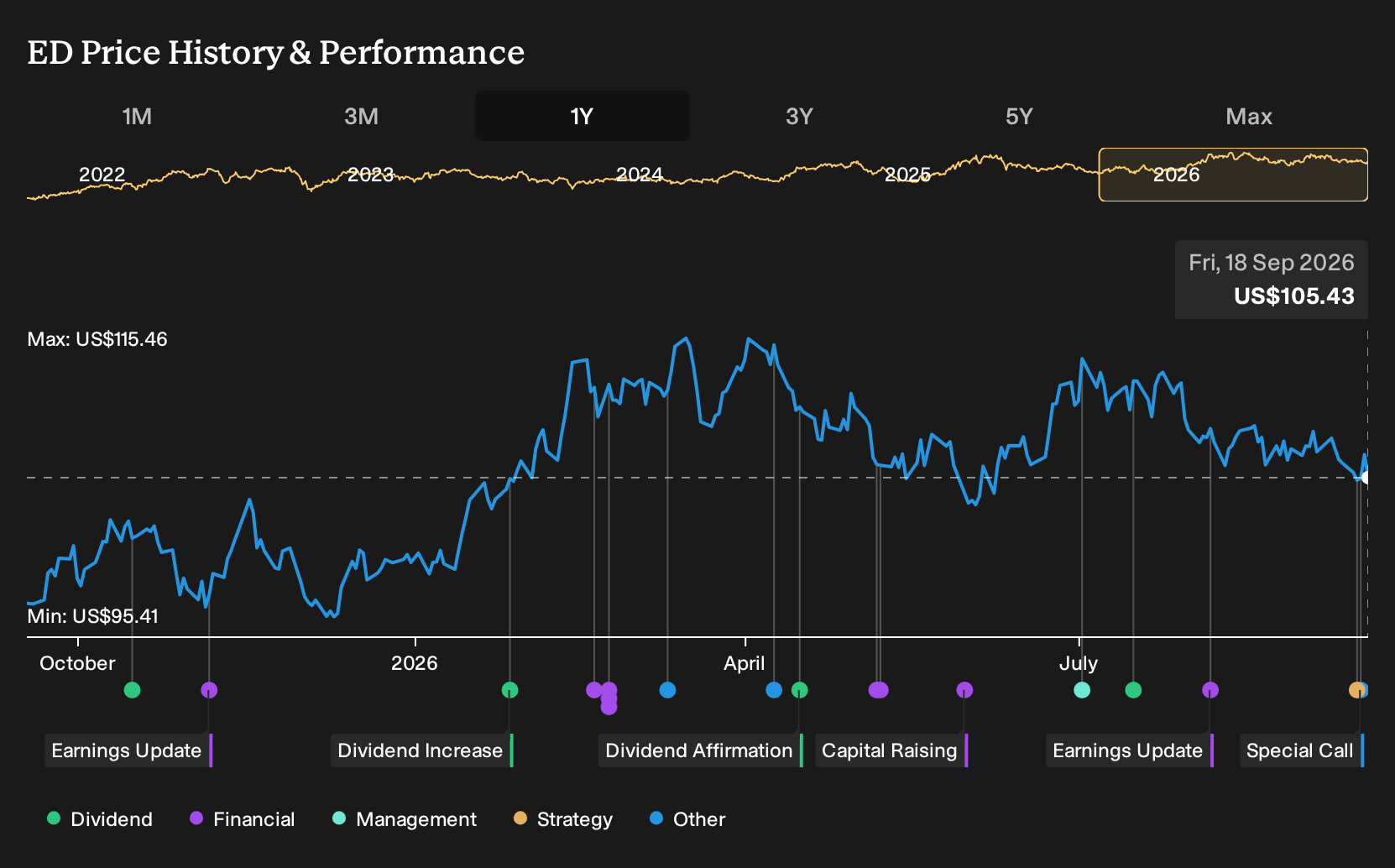
Exploring Other Perspectives
Only two fair value estimates from the Simply Wall St Community cluster tightly between about US$107.65 and US$110.03, which shows how closely some retail analysts group their assumptions on Consolidated Edison. Those figures do not yet factor in the New York electric bus project, so you may want to explore more viewpoints before leaning on any single number.
Explore another Consolidated Edison fair value estimate, including one that suggests it could be worth just $107.65.
Form Your Own Verdict
Don't just follow the ticker. Dig into the data and build a conviction that's truly your own.
- A great starting point for your Consolidated Edison research is our analysis highlighting 4 key rewards and 2 important warning signs that could impact your investment decision.
- See our latest analysis for Consolidated Edison. The report includes a comprehensive fundamental analysis summarized in a single visual, the Snowflake, making it easy to evaluate Consolidated Edison's overall financial health at a glance.
Looking For More Ideas Beyond Consolidated Edison?
Once you understand where Consolidated Edison fits into your portfolio, it can help to widen the lens and compare it with other companies that offer different mixes of growth, income, and balance sheet strength. The Simply Wall St Screener is built for exactly that kind of side by side research, letting you filter for the traits that matter most to you in a few clicks.
- If you want potentially higher upside with higher risk, scan a focused group of 9 elite penny stocks with strong financials and see which smaller businesses line up with your criteria.
- If value is your priority, review a curated set of 35 high quality undervalued stocks that pair stronger fundamentals with what may be more modest market expectations.
- If resilience matters most, filter for 30 resilient stocks with low risk scores and compare companies that score better on financial strength and volatility.
This article by Simply Wall St is general in nature. We provide commentary based on historical data and analyst forecasts only using an unbiased methodology and our articles are not intended to be financial advice. It does not constitute a recommendation to buy or sell any stock, and does not take account of your objectives, or your financial situation. We aim to bring you long-term focused analysis driven by fundamental data. Note that our analysis may not factor in the latest price-sensitive company announcements or qualitative material. Simply Wall St has no position in any stocks mentioned.
Have feedback on this article? Concerned about the content? Get in touch with us directly. Alternatively, email editorial-team@simplywallst.com