
Did Global Contact Center Rollout Just Shift Bandwidth's (BAND) Investment Narrative?
- On 15 September 2026, Bandwidth announced an expanded collaboration with Salesforce, becoming the first certified carrier supporting the global rollout of Salesforce's native Contact Center through its Maestro platform across more than 25 countries.
- This deeper integration into Salesforce's AI-powered contact center gives Bandwidth closer access to large enterprises that want granular control, regulated workflows, and real-time observability for complex customer engagement.
- We will now examine how Bandwidth's investment narrative could be shaped by its role as Salesforce's first certified global carrier partner.
Look beyond Bandwidth and this Salesforce partnership to compare other communications and AI infrastructure plays using our curated 88 AI infrastructure stocks
Bandwidth Investment Narrative Recap
To own Bandwidth, you need to believe that Maestro and AI voice use cases can grow into a larger share of customer communications spend, without eroding margins through heavy discounting or runaway network costs. The expanded Salesforce rollout looks supportive for that thesis because it puts Bandwidth inside more large enterprises that already value governed workflows and compliance.
The key near term swing factor is execution on these complex migrations while keeping service quality high and support costs in check. The biggest risk stays the same. A concentrated enterprise base using one core platform leaves Bandwidth exposed if AI adoption slows or a few large customers pull back on traffic or renegotiate terms.
With no other fresh announcements around this news, the most relevant context is still the existing Maestro and AI narrative. Management already positions Maestro as the orchestration layer that can lift revenue per AI call by 3x to 4x for customers that lean into more advanced workflows and integrations.
The Salesforce expansion plugs directly into that story. It gives Maestro a larger distribution channel into regulated, global enterprises that care about observability and compliant calling. That combination can support the catalyst of higher ARPU and stickier multi year deals, but it also raises the execution bar and the need to keep R&D and network spend under control.
What The Bandwidth Consensus Is Pricing In
Bandwidth's analyst narrative focuses on a long runway for AI enabled calling and global contact center traffic, then layers on fairly specific numbers to make that story add up. Consensus models point to revenue growing at 11.2% a year over the next 3 years, with profit margins rising from 0.3% today to 6.4% by around 2029 as more traffic moves onto Maestro and higher value workflows. Earnings today sit at about $2.3 million, while forecasts call for earnings of $72.9 million by 2029, which implies roughly a 32x step up in profit on those estimates.
On these projections, analysts are effectively assuming Bandwidth reaches 2029 revenues of $1.1b and earnings of $72.9 million, with the stock trading on a future P/E of 44.6x. That compares to a current multiple of 635.2x and is higher than the cited 20.7x P/E for the broader US telecom peer group, so this setup reflects a premium associated with the Maestro and AI contact center angle. The framework also incorporates share count rising 6.77% per year over the next 3 years and a discount rate of about 7.2% to 7.24% to bring those future cash flows back to today.
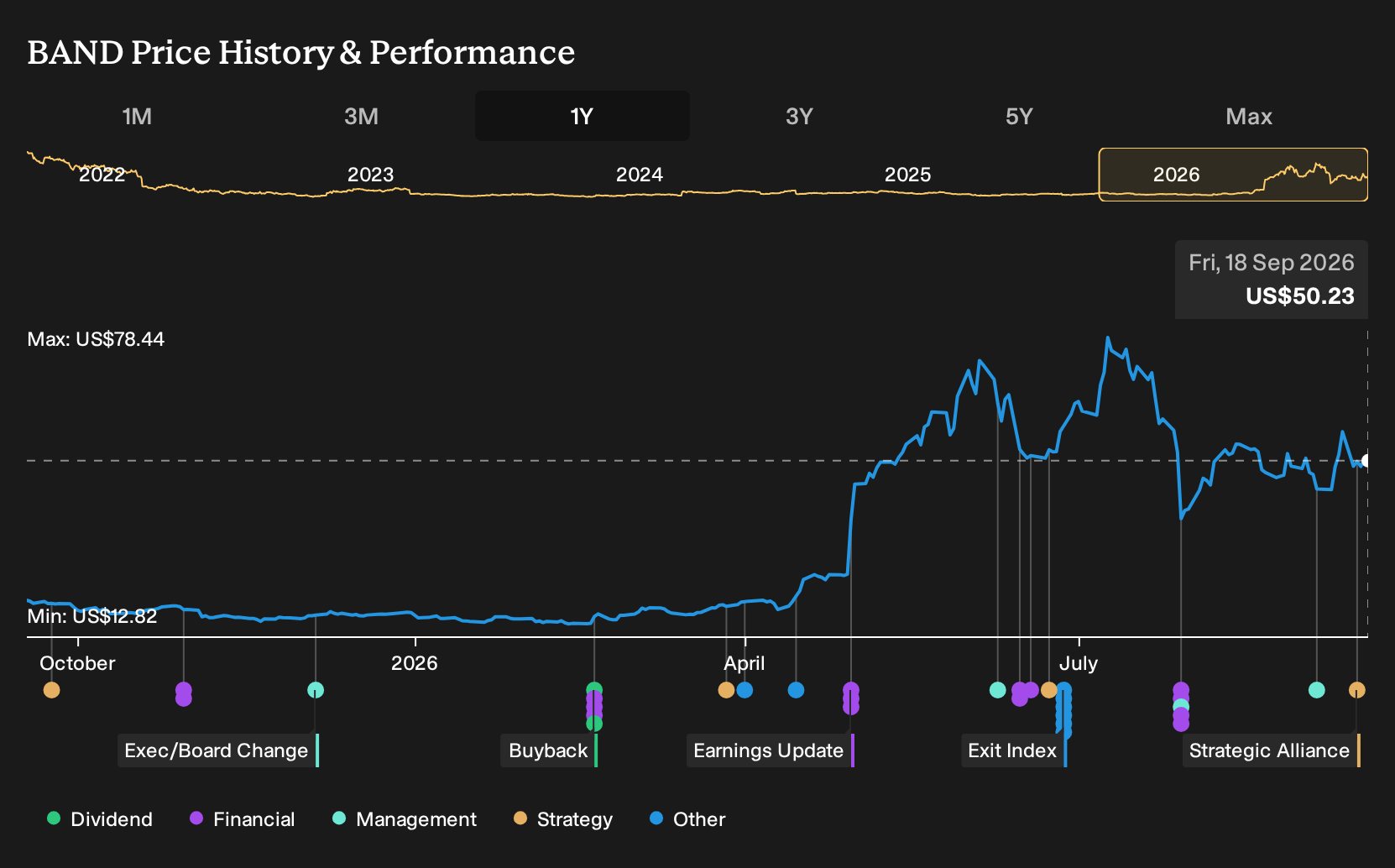
There is a spread of opinion reflected in these targets. The consensus price objective sits at $67.25 per share versus a current quote of $44.69, with the bullish end at $86.0 and the cautious end at $38.0. That gap indicates analysts are not aligned on how durable the AI uplift, Salesforce channel reach, and margin expansion story will be. It also means the same contact center headline can support very different views on what investors may be willing to pay for Bandwidth's earnings profile several years from now.
Bandwidth's narrative centers on $1.1b in revenue and $72.9 million in earnings by 2029. This rests on 11.2% yearly revenue growth and roughly a 32x earnings increase from $2.3 million today.
Uncover why Bandwidth's fair value indicates a 34% potential upside to its current price that could narrow quickly.
Exploring Other Perspectives
One alternate view on Bandwidth leans hard into the AI uplift. The most optimistic analysts were already penciling in about 14.7% yearly revenue growth and earnings of roughly $91.2 million by 2029, well above consensus. Those projections came before this Salesforce expansion, so opinions may change as the story evolves.
Explore 3 other Bandwidth fair value estimates, including one that suggests up to 273% upside from the current price.
The Verdict Is Yours
Don't just follow the ticker; dig into the data and build a conviction that's truly your own.
- A great starting point for your Bandwidth research is our analysis highlighting 3 key rewards and 3 important warning signs that could impact your investment decision.
- See our latest analysis for Bandwidth. The report includes a comprehensive fundamental analysis summarized in a single visual, the Snowflake, making it easy to evaluate Bandwidth's overall financial health at a glance.
Looking For More Ideas Beyond Bandwidth?
Once you have a view on Bandwidth, it can help to cross check your thinking against other companies with very different risk and return profiles. The Simply Wall St screener lets you filter by balance sheet strength, valuation, income focus, and more, so you can build a watchlist that truly fits your own goals.
- If capital preservation sits high on your list, consider starting with a group of resilient businesses by scanning our 30 resilient stocks with low risk scores.
- For investors hunting for quality at a reasonable price, filter for mispriced opportunities using the 35 high quality undervalued stocks.
- If regular cash payouts matter most to you, build a watchlist of income candidates through the 7 dividend fortresses.
This article by Simply Wall St is general in nature. We provide commentary based on historical data and analyst forecasts only using an unbiased methodology and our articles are not intended to be financial advice. It does not constitute a recommendation to buy or sell any stock, and does not take account of your objectives, or your financial situation. We aim to bring you long-term focused analysis driven by fundamental data. Note that our analysis may not factor in the latest price-sensitive company announcements or qualitative material. Simply Wall St has no position in any stocks mentioned.
Have feedback on this article? Concerned about the content? Get in touch with us directly. Alternatively, email editorial-team@simplywallst.com