
Markets tread water amid elevated uncertainty
Howdy market watchers!
Commodity markets enter the final full week of September with a sharply different set of drivers than earlier this month. The grain markets are moving into harvest pressure, China remains the central question for U.S. soybean demand, cattle supplies remain historically tight, and energy markets have become an increasingly serious threat to farm margins. The most important development for agriculture this week may not be a grain price at all: U.S. diesel prices have reached a record $6.29 per gallon, according to Reuters, as disruptions tied to the conflict involving Iran and attacks on energy infrastructure tighten global refined-fuel supplies. Farmers are entering harvest at precisely the time when fuel consumption is at its highest. At the same time, President Donald Trump is preparing to meet Chinese President Xi Jinping in Washington next week, putting agriculture, energy and tariffs directly back into the commodity-market spotlight.
Market Snapshot
Friday's closing futures prices included:
| Commodity | Contract | Friday Close | Weekly Market Theme |
|---|---|---|---|
| Corn | Dec. 2026 | $5.27/bu | Harvest pressure |
| Soybeans | Nov. 2026 | $13.03/bu | China demand vs. harvest |
| Chicago Wheat | Dec. 2026 | $7.13/bu | Lower on global competition |
| KC HRW Wheat | Dec. 2026 | ~$7.81/bu | Lower |
| Live Cattle | Oct. 2026 | $215.85/cwt | Volatile, tight supplies |
| Live Cattle | Dec. 2026 | $216.57/cwt | Firm |
| Feeder Cattle | Oct. 2026 | $323.80/cwt | Lower |
| WTI Crude | Oct. 2026 | $100.30/bbl | Geopolitical premium |
| Brent Crude | Nov. 2026 | $104.87/bbl | Supply disruption |
| Natural Gas | — | $2.912/MMBtu | Modestly higher |
Friday's grain session saw December corn close down 3 cents at $5.27, November soybeans down 16 cents at $13.03, and December Chicago wheat down 13 cents at $7.13. October live cattle gained 20 cents while December live cattle gained 32 cents.
Corn: Harvest Pressure Meets Strong Export Demand
Corn has moved into a fundamentally different phase as harvest accelerates.
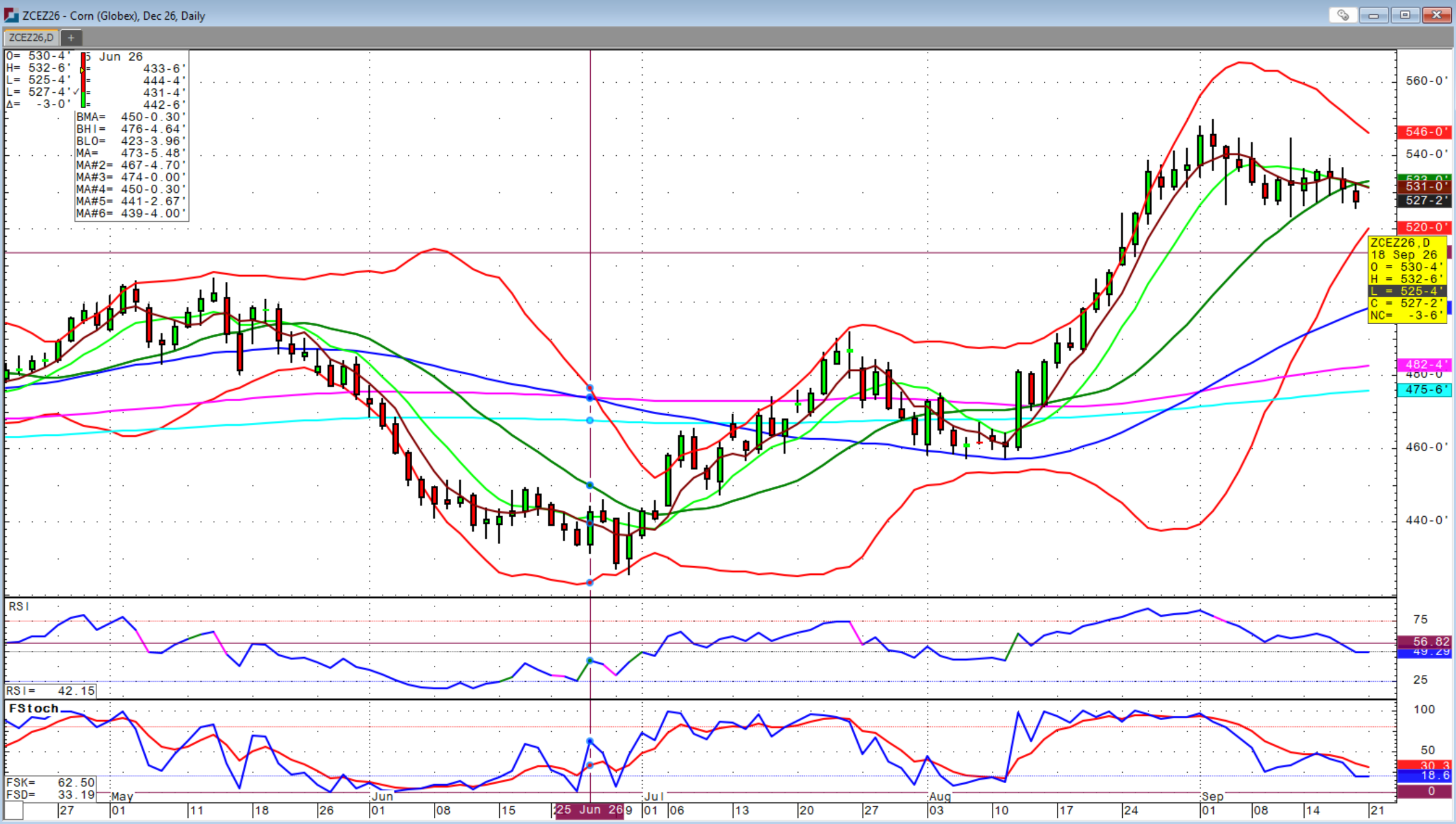
USDA reported that 8% of the U.S. corn crop had been harvested as of the latest Crop Progress report, compared with a five-year average of 6%. Approximately 42% of the crop had reached maturity, compared with the average of 38%.
That means the market is beginning to receive actual yield information rather than relying primarily on weather models and crop-condition ratings.
December corn finished Friday at $5.27, down 3 cents.
The bearish harvest pressure is being offset by surprisingly strong export demand. U.S. corn export sales for the 2026/27 marketing year totaled approximately 1.03 million metric tons in the latest reporting week.
The combination is important: farmers are beginning to put new-crop corn into bins while foreign buyers continue purchasing U.S. supplies.
The question now becomes whether export demand can remain strong enough to absorb the incoming harvest.
For producers, basis could become increasingly important. Futures may remain volatile, but local basis levels will tell the story of how aggressively elevators, ethanol plants, feedlots and exporters are competing for physical corn.
Market perspective: The corn market has moved from weather-driven speculation toward a battle between harvest supply and demand growth.
Soybeans: China Is the Market
Soybeans remain the most politically sensitive grain market.
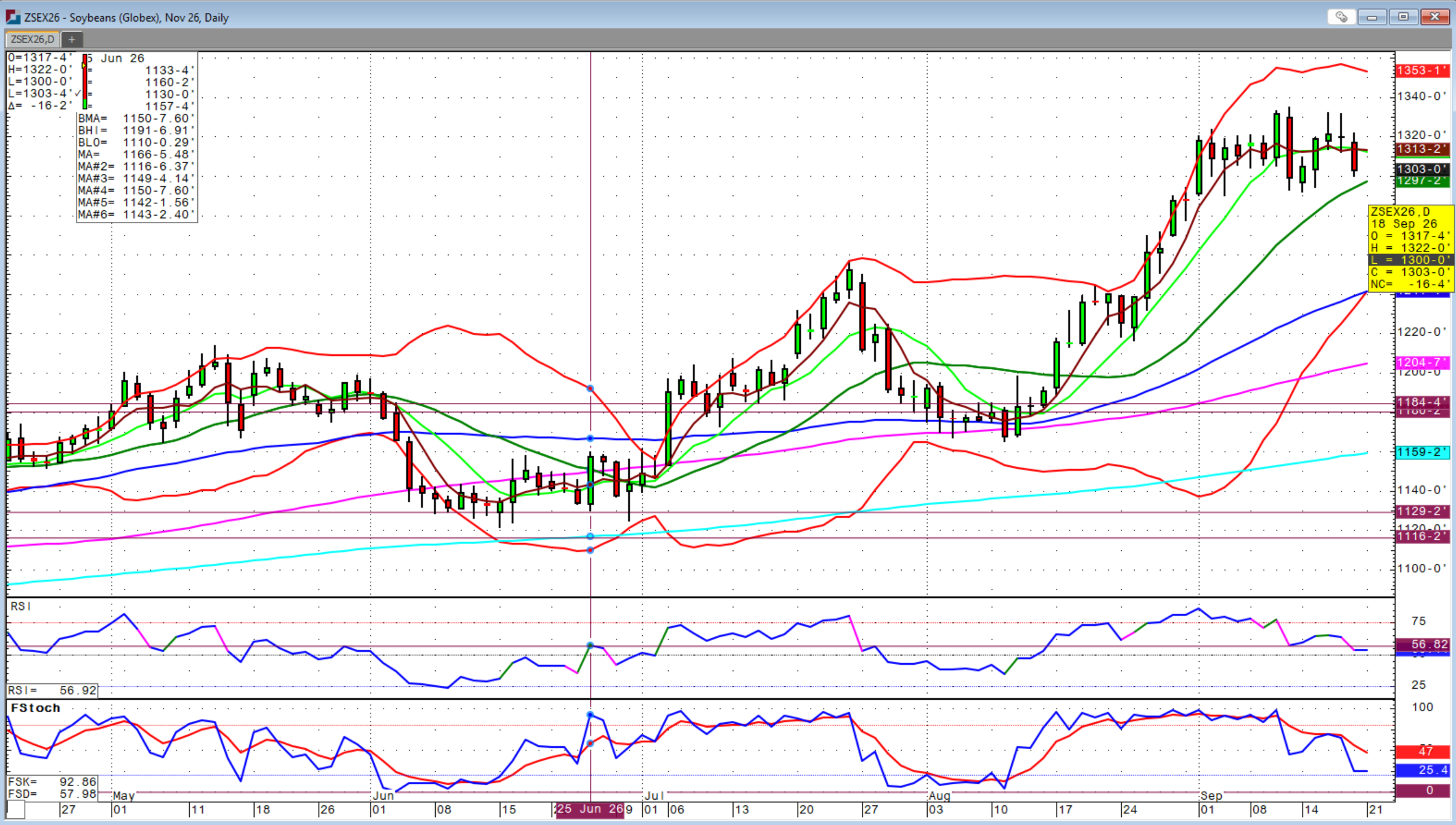
November soybeans closed Friday at approximately $13.03, down 16 cents. The decline came as harvest pressure increased and traders took profits after the recent rally.
USDA reported that approximately 6% of U.S. soybeans had been harvested, compared with a five-year average of 3%. About 44% of the crop was dropping leaves, ahead of the 37% average.
That rapid harvest pace means physical supplies are beginning to enter the market.
Brazil is also a major factor. Conab is forecasting Brazilian soybean production of approximately 180.4 million metric tons, with exports projected at a record 116.2 million tons.
But China remains the potential game changer.
Private exporters reported another 111,000 metric tons of U.S. soybeans sold to China Friday for the 2026/27 marketing year.
More importantly, the Trump-Xi meeting scheduled for next week could determine whether additional U.S. agricultural products receive tariff relief or other trade concessions.
Reuters reports that agriculture is expected to be one of the major negotiating areas, with soybeans, corn and sorghum among the commodities potentially affected by additional Chinese purchases or tariff waivers.
Market perspective: Soybeans currently have two competing forces: harvest pressure and Brazilian supply versus potentially enormous Chinese demand. The outcome of the U.S.-China discussions could be one of the most important soybean-market events of the fall.
Wheat: Rally Losing Momentum
Wheat has surrendered some of its recent gains.
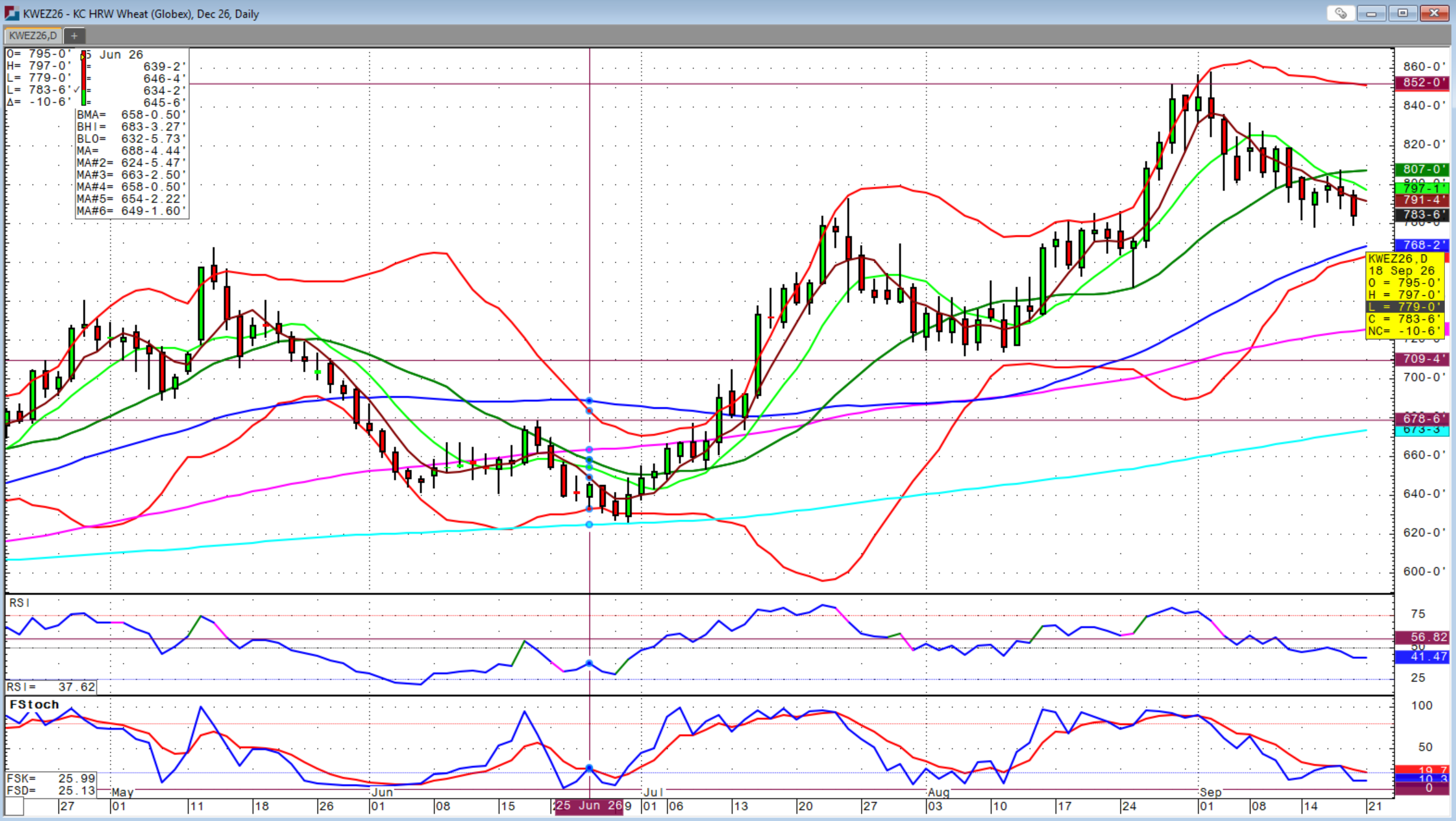
December Chicago wheat closed Friday at $7.13, down 13 cents, while December Kansas City wheat finished around $7.81.
U.S. wheat export sales were approximately 325,900 metric tons in the latest week, up 68% from the previous week but roughly in line with the seasonal average.
The wheat market continues to face intense competition from Russia and other major exporters.
That makes wheat particularly sensitive to changes in the Black Sea export situation. Any disruption to Russian or Ukrainian shipments could provide another geopolitical premium, while improved export flows would pressure U.S. wheat.
For Oklahoma producers, the market is also transitioning toward the next crop. Planting conditions, soil moisture and fertilizer economics will become increasingly important as producers begin making 2027 wheat decisions.
Market perspective: Wheat has less room for production surprises than the market did earlier this year, but global competition continues limiting upside potential.
Cattle: Tight Supplies Remain the Foundation
Cattle markets remain fundamentally different from grains.
USDA now expects 2026 beef production at 24.877 billion pounds, down 90 million pounds from the August forecast. The 2027 projection has also been reduced to 24.835 billion pounds. USDA cited slower fed-cattle and cow slaughter as the primary reason for the reductions.
Cattle slaughter has averaged approximately 8,000 fewer head per weekday during the first eight months of the year compared with 2025.
That is a significant supply constraint.
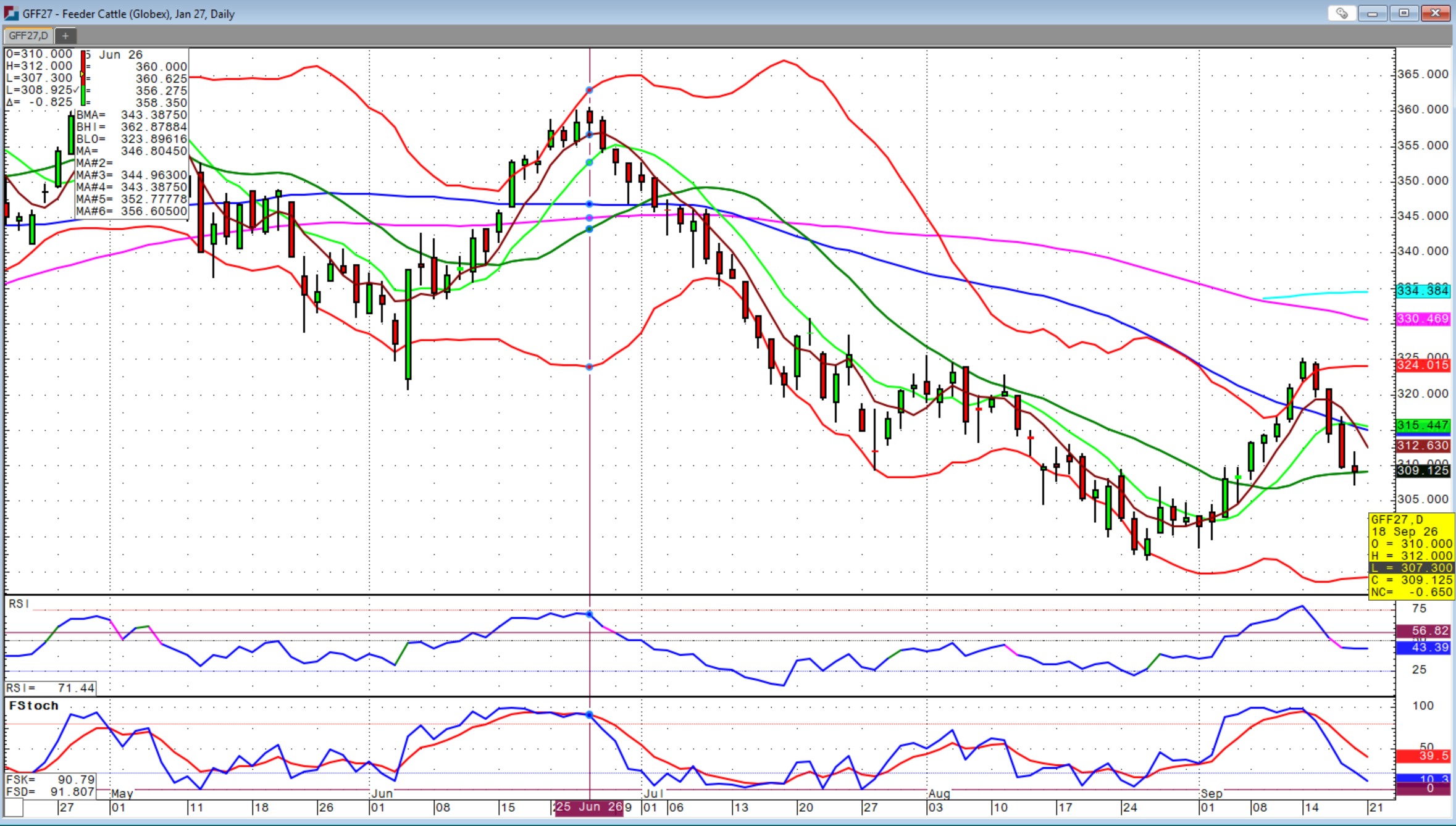
Friday's futures market reflected some volatility but remained historically strong. October live cattle closed at $215.85, while December live cattle finished at $216.57. October feeders closed at $323.80.
Cash cattle trade in the North was reported around $350/cwt, steady with the previous week's weighted average.
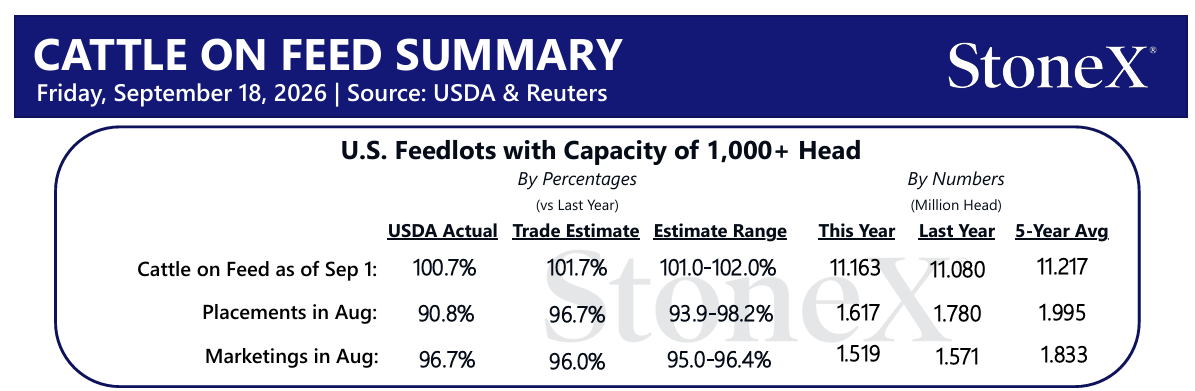
USDA's September Cattle-on-Feed report came in with another bullish bias with 'much' lower-than-expected placements. On-feed figures were also lower than expected while marketings were higher than expected.
The fundamental story remains straightforward: fewer cattle are available, beef production is declining, and producers have not rebuilt the national herd quickly enough to materially loosen supplies.
Market perspective: Cattle remains a supply-constrained market, but extremely high prices mean demand deserves increasing attention. The key question is how much consumers and the foodservice sector can absorb at current beef prices.
Energy: The Biggest Risk to Farm Margins
Energy is now the most significant cost-side issue facing agriculture.
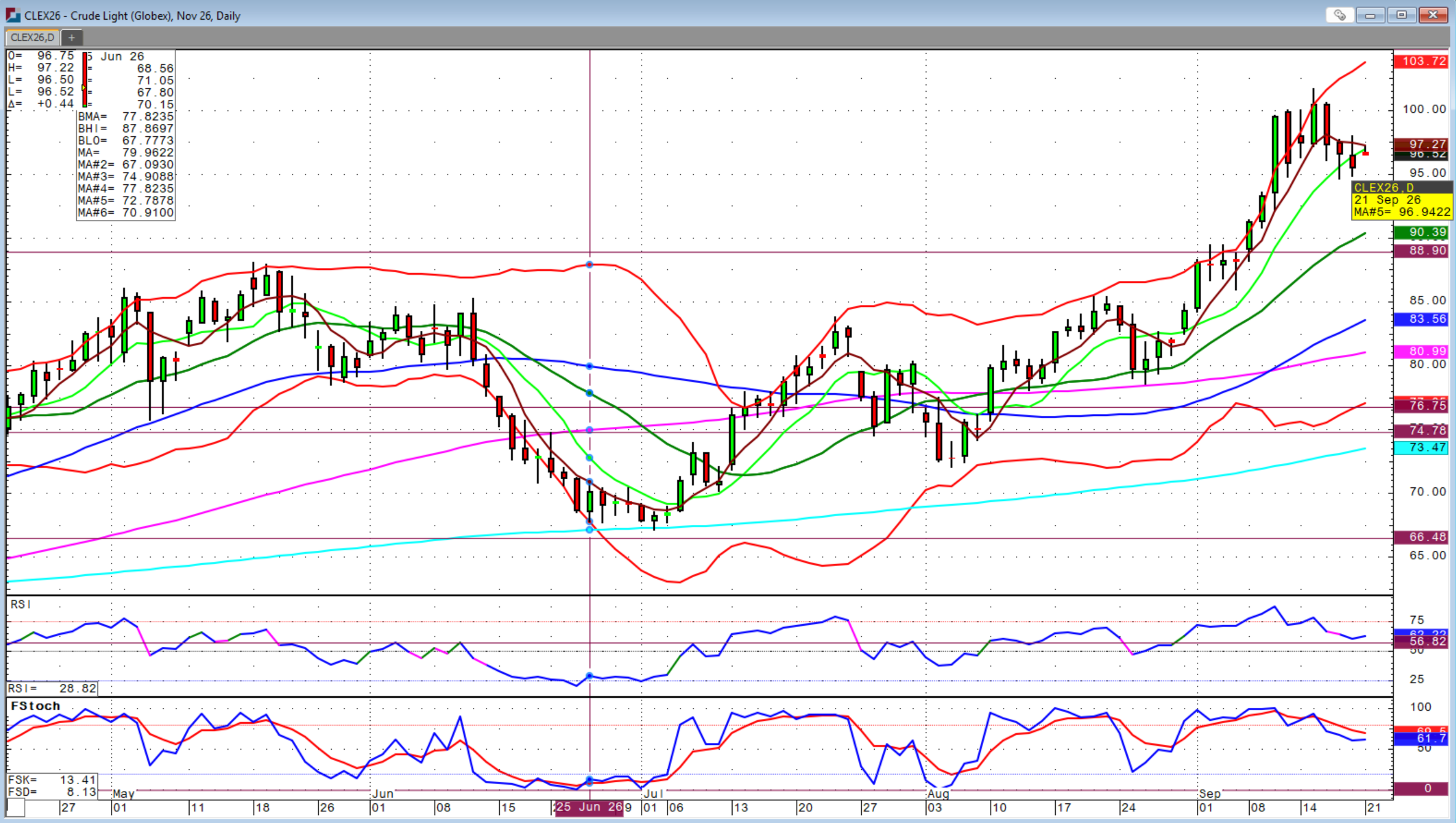
WTI crude closed Friday at approximately $100.30 per barrel, while Brent settled around $104.87. Oil declined Friday after China urged Iran to help limit attacks on Saudi energy infrastructure, but prices remain historically elevated.
The disruption around the Strait of Hormuz and attacks affecting Saudi infrastructure have created a substantial risk premium.
The effect on agriculture is already being felt.
U.S. diesel prices have reached a record $6.29 per gallon, according to Reuters. Purdue agricultural economist Michael Langemeier estimates that higher fuel prices have added approximately $11 per acre to corn costs and $7 per acre to soybean costs compared with last year.
That is particularly painful during harvest because combines, grain trucks, semis, grain dryers and support equipment consume enormous amounts of fuel.
The economics are becoming very real for producers. Reuters reported that one South Dakota farmer expects to spend as much as $1,500 per day to fuel one combine during harvest.
Natural gas is behaving differently. October Henry Hub futures settled at approximately $2.912/MMBtu, up 2.9% for the week. Strong electricity demand and LNG feedgas flows are supporting prices, although record U.S. production continues to limit the upside.
The Bigger Picture for Producers
The commodity market entering late September can essentially be summarized in four themes:
1. Harvest is arriving.
Corn and soybean production is beginning to become measurable rather than theoretical.
2. China matters.
Soybean demand could change significantly depending on the outcome of next week's Trump-Xi discussions.
3. Cattle supplies remain historically tight.
Lower slaughter and declining beef production continue providing fundamental support.
4. Energy costs have become a major margin threat.
Record diesel prices are offsetting some of the benefit producers have gained from stronger grain prices.
The most important development heading into next week may therefore be the intersection of agriculture and geopolitics.
The Trump-Xi meeting could affect soybean and other agricultural demand, while developments involving Iran, Saudi Arabia and the Strait of Hormuz could determine whether $100-plus crude becomes a temporary spike or a more persistent feature of the farm economy.
For producers, the message is increasingly about margin management rather than simply price direction. A $5.25 corn market means something very different when diesel costs $6.29 per gallon than it does when diesel costs $3.50. Likewise, a $13 soybean market becomes more valuable if Chinese demand is sustained, but less attractive if harvest pressure combines with another record South American crop.
The fall of 2026 is therefore shaping up to be a market defined by strong demand opportunities, large physical supplies, historically tight cattle inventories, and unusually high energy costs.
Volatility is likely to remain elevated—and producers who focus on the relationship between commodity prices, basis, freight, fuel and input costs will have a better picture of their actual margin than those watching futures prices alone.
Sidwell Strategies is the one-stop shop to protect cattle with futures, puts, LRP or a combination of all, which is probably the best strategy overall. If you’re ready to trade commodity markets, give me a call at (580) 232-2272 or stop by my office to get your account set up and discuss risk management and marketing solutions to pursue your objectives. Self-trading accounts are also available. It is never too late to start and there is no operation too small to get a risk management and marketing plan in place. Wishing everyone a successful trading week! Let us know if you'd like to join our daily market price and commentary text messages to stay informed!
Brady Sidwell is a Series 3 Licensed Commodity Futures Broker and Principal of Sidwell Strategies. Open your Trading Account with Sidwell Strategies at https://portal.stonex.com/prefill/index/BradySidwellU52F112P. Contact us at (580) 232-2272 or at trade@sidwellstrategies.com.
Futures and Options trading involves the risk of loss and may not be suitable for all investors. Review full disclaimer at https://www.sidwellstrategies.com/fccp-disclaimer-21951.