
Rivian (RIVN) Stock May Be Fully Priced Following CFO Exit
Rivian Automotive has seen its share price move through sharp swings in recent years, and that leaves a clear question for investors who care about the numbers: Is the current US$14.99 price tag meaningfully supported by the sales Rivian is generating today and is expected to produce over time?
- Over the past 3 years the stock has fallen 27.2%, which puts the focus squarely on whether the revenue it is posting can carry the current valuation.
- Rivian's role as an early adopter of Stratasys' new F870 manufacturing system may support expectations for more efficient production and potentially stronger sales throughput over time, while the upcoming CFO transition can influence how the company prioritizes spending and capital needs.
- There is a second opinion on Rivian Automotive worth weighing. See what analysts think Rivian Automotive's shares could be worth.
The issue now is whether Rivian Automotive's current share price is appropriately grounded in the sales the business is producing relative to what the market is paying per dollar of revenue.
If you are weighing Rivian Automotive against other potential ideas, a focused stock screen built around 35 high quality undervalued stocks can be a useful next step in your research.
Has Rivian Automotive Run Too Far on Sales?
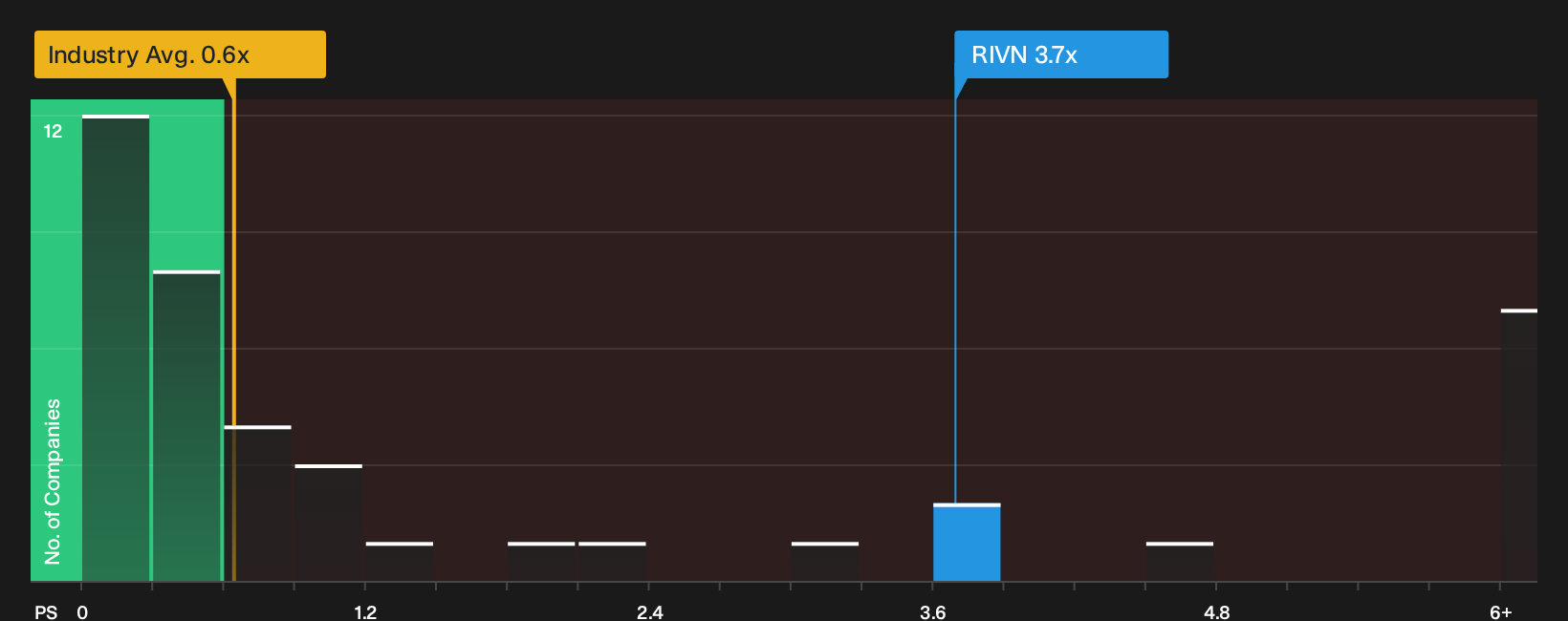
P/S is usually the cleaner lens for Rivian Automotive because the business is still loss making and revenue is the main anchor investors can actually measure. On this metric, Rivian trades at a P/S of about 3.7x, compared with an auto industry average of roughly 0.6x and a peer group closer to 0.6x as well. That is a large premium for each dollar of sales.
Because the current P/S sits above the level suggested by a Fair Ratio model that factors in growth potential, margins, size and risk, the stock screens as overvalued on this framework. The recent adoption of Stratasys' F870 system may help the long term production story, but even with that backdrop, the present multiple already reflects a lot of optimism relative to sector norms. Explore the numbers behind Rivian Automotive's P/S valuation.
The Rivian Automotive Narrative: What Would Justify Today's Price?
Simply Wall St Narratives for Rivian Automotive pick up where this valuation question leaves off and explain what kind of future growth, margin profile and earnings trajectory would need to occur for the stock to be worth significantly more or less than it is today. Each one turns Rivian Automotive's implied fair value into a thesis about the business that you can track over time, and they are available on Simply Wall St's Community page.
Bullish and bearish community views on Rivian Automotive are both detailed, but they hinge on very different expectations for cash, costs and demand.
Bull case: 22% undervalued
"Vertical integration in technology, especially in autonomy, battery, and software, combined with growing software & services revenue (including licensing via partnerships like with Volkswagen) is expected to open new high-margin revenue streams and diversify earnings…"
Discover why this Narrative puts Rivian Automotive at 22% undervalued.
Bear case: 15% overvalued
"Shrinking policy support, cost inflation, and low demand threaten Rivian's margins, cash flow, and ability to justify ambitious expansion plans…"
Explore why this Narrative puts Rivian Automotive at 15% overvalued.
One more Rivian Automotive data point worth checking before you move on
Before you stop at the current multiples and sales profile, it can be useful to see how professional forecasts line up with where this business is expected to be a few years from now. Explore where analysts expect Rivian Automotive to be in a few years.
This article by Simply Wall St is general in nature. We provide commentary based on historical data and analyst forecasts only using an unbiased methodology and our articles are not intended to be financial advice. It does not constitute a recommendation to buy or sell any stock, and does not take account of your objectives, or your financial situation. We aim to bring you long-term focused analysis driven by fundamental data. Note that our analysis may not factor in the latest price-sensitive company announcements or qualitative material. Simply Wall St has no position in any stocks mentioned.
Have feedback on this article? Concerned about the content? Get in touch with us directly. Alternatively, email editorial-team@simplywallst.com