
Direct Drive's first stock offering: Benmao Technology (06731) leads the power revolution, 15 times revenue growth in 3 years
“Direct Drive First Stock” - Benmao Technology will soon be listed on the Hong Kong Stock Main Board.
The Zhitong Finance App learned that Benmao Technology has launched global sales on September 21 and will close its offering on September 24. In this global sale, the company will sell 50 million shares, of which 2.5 million shares will be publicly sold in Hong Kong and 47.5 million shares will be offered internationally. The sale price is HK$21.6 per share. The trading unit for H shares is 100 shares. The stock code is “06731”. It is scheduled to land on the main board of the Hong Kong Stock Exchange on September 29.
What the Hong Kong stock market has witnessed is not only the listing of a special technology company, but also an important inflection point on the global robot power circuit. For a long time, the “motor+reducer” solution has dominated the global power architecture, and Benmao Technology has pioneered a new industrialization path adapted to the era of intelligent robots, leading the robotics, intelligent equipment and other industries to start an underlying revolution from speed reducers to direct drives. As the world's first listed robotics company with direct drive technology as its core capability, the company has filled the gap in segmented racetracks and is expected to set a new value benchmark for the industry.
Direct drive the first share, with high compound revenue growth
According to the prospectus, Benmao Technology, founded in 2020, has built three core robot technology platforms: robot power module, wheel foot robot, and modular splicing, as well as two product lines: robot power module and robot machine, forming a two-wheel drive development system from core component empowerment to the entire airport landscape.
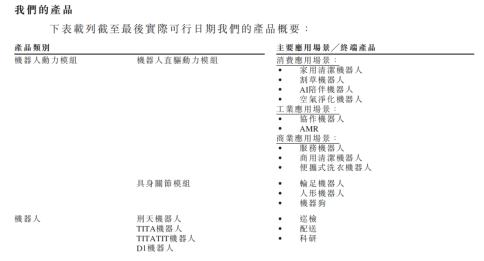
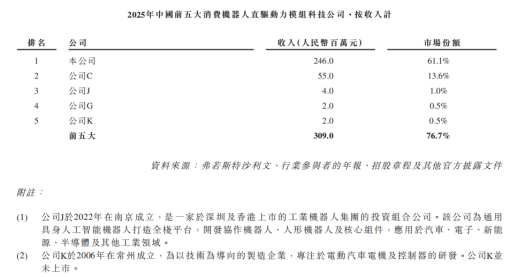
In terms of large-scale delivery and application of direct drives, Benmao Technology has embarked on a highly elastic growth curve. According to Frost & Sullivan data, in 2025, the company shipped about 8.5 million sets of direct drive modules throughout the year. It is the first and only company in the world to ship more than 5 million sets of direct drive modules per year, and its market share is in an absolute leading position. As of the first half of 2026, about 5.7 million sets of direct drive modules have been shipped, and they have entered the supply chain of four of the world's top ten consumer robot manufacturers.
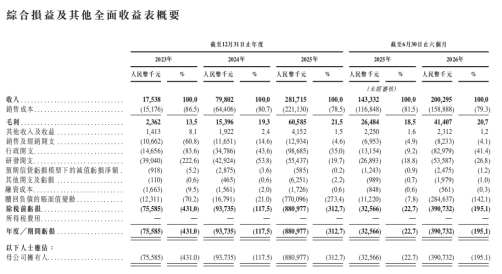
From 2023 to 2025, the final technology revenue increased from 17.538 million yuan (RMB, same below) to 282 million yuan, a three-year compound growth rate of 300.8%; in the first half of 2026, it achieved revenue of 200 million yuan, an increase of 39.7% over the previous year. Profitability improved simultaneously, and the scale effect led to an increase in gross margin from 13.5% in 2023 to 21.5% in 2025; gross margin for the first half of 2026 was 20.7%, an increase of 2.2 percentage points over the previous year.
Looking at the revenue structure, in the first half of 2026, the company's robot power module business revenue was 186 million yuan, accounting for 94.5% of total revenue. It is worth noting that thanks to the rapid start-up of commercial applications, the company's robot machine business achieved revenue of 10.997 million yuan in the first half of the year, an increase of more than three times over the same period in 2025.
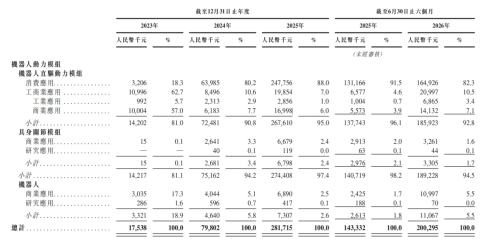
Benmao Technology's current revenue structure shows the typical growth pace of hard technology companies: prioritizing large-scale mass production by relying on standardized power modules to complete technical verification and diluting the high initial R&D investment; with direct drive technology as the core, empowering complete machine products and scenario solutions, and gradually completing the evolution from a hardware component supplier to an intelligent system solution provider.
Direct drives vs. speed reducers accelerate the end of an era of traditional power
In the hard technology circuit competition, technological innovation is the greatest common denominator of victory, and it is also the core undertone for “Direct Drive First” to stand at the top of the power track.
According to the Zhitong Finance App, traditional robot driving systems rely on speed reducers to amplify motor output torque, thereby outputting strong driving force under high load and high impact resistance conditions, and adapting to scenarios such as industrial production lines, warehousing and logistics, and heavy equipment operation. However, in next-generation, high-precision, and high-dynamic application scenarios such as intelligent service robots and embodied robots, this solution has structural shortcomings that are difficult to eradicate: gear meshing causes insufficient positioning accuracy and commutation stuttering; multi-stage transmission causes response lag, making it difficult to meet the flexible motion needs of intelligent robots; in addition, high mechanical wear rate, high operating noise, and limited service life, it is difficult to match the development trend of consumer-grade and intelligent robots.
In response to the inherent defects of traditional drive architectures, direct drive technology replaced traditional transmission solutions with structural innovation, and completed all-round upgrades in the four core dimensions of accuracy, response, energy consumption, and operation and maintenance. It not only restructured the technical standards of robot power systems, but also redefined the underlying power logic of intelligent manufacturing and intelligent equipment. This underlying power revolution is driving the global industrial transmission system to leave the traditional model of inefficient and limited efficiency and enter a new era of intelligence with high accuracy, high response, low energy consumption, and low cost.
Benmao Technology has built a direct drive technology system through independent research and development, breaking down transmission shackles from the bottom and building solid differentiated technical barriers. According to the prospectus, from 2023 to the first half of 2026, Benmao Technology's cumulative R&D expenditure reached 191 million yuan. As of the first half of 2026, the company's 192-person R&D team covered core directions such as robot power modules and motion control, embedded drive control hardware, robot structural engineering, and system-level robot platform development. As of August 10, 2026, the company held 345 registered patents and 163 patent applications awaiting approval, forming a complete intellectual property layout covering hardware, algorithms, and complete machines.
Launched on the product side, Benmao Technology's robot power module forms significant differentiating advantages in terms of failure rate, positioning accuracy, quiet performance, service life and integration efficiency: the integrated drive-control architecture greatly reduces the development cycle and difficulty of end customers; the module's operating noise is only 45-50 dB, which is highly suitable for close to home scenarios; the product's service life can reach 5-10 million hours, and the durability is far ahead of traditional structures; the highly integrated design effectively reduces the size of the whole machine and can be widely adapted to the development of various types of robots.
Two-way technology iteration: building robotics platform-based solutions
Wheelfoot robots are cutting-edge verification carriers for Benmao Technology's direct drive technology. The whole machine uses an integrated power unit, adapts to complex indoor and outdoor environments, and targets highly dynamic scenarios such as university research, factory inspection, and short-distance delivery; it is equipped with a self-developed integrated joint module and cerebellar collaboration algorithm to support movement pattern switching, and relies on physical intelligence to complete sensing, obstacle avoidance and path planning. The measured scenario data continues to flow back, and the direct drive hardware and control logic are continuously optimized.
On the basis of mature power models and perfect wheel foot motion control system verification, the company extended modular splicing technology to achieve multi-machine collaboration and dynamic adaptation for industrial and logistics scenarios, effectively broaden the application boundaries of robot bodies, and pave the way for subsequent diversified commercial implementation.
Together, the two major business divisions form a complete closed loop of technology. At the forward drive level, robot power module technology consolidates the performance of the whole machine, the actual operating condition data accumulated by the robot itself in multiple scenarios, and continuously optimizes technologies such as structural design, thermal management processes and control algorithms of the power module.
Based on this closed loop of technology that can evolve on its own, the final technology forms a complete growth path of direct drive technology innovation, full-field scenario verification, and iteration of upper level intelligent systems. The ability to reuse technology across tracks is also a core difference between platform-based robotics technology companies and traditional hardware vendors. More than hardware iteration, the company simultaneously lays out upper level intelligent algorithms such as embodied intelligence and group collaborative control to meet the development trend of industry integration and intelligence.
Three-tier potential has been revived, and direct drive is already an inevitable global driving trend
From an industrial perspective, the triple potential of policy support, technology iteration, and scenario implementation resonates to accelerate the industrialization of direct drive technology and open up long-term upward space on the global power circuit. With forward-looking technology layout and mature mass production capacity, Benmao Technology accurately grasps industry upgrade opportunities, and future growth potential will continue to be unleashed.
At the policy level, under the global trend of energy saving and carbon reduction, direct drive technology's outstanding energy efficiency is a perfect fit. In the first half of this year, four departments including the Ministry of Industry and Information Technology issued the “Implementation Plan for the High-Quality Development of Energy-Saving Equipment (2026-2028)”, which clearly lists direct drive motors as key energy-saving equipment to provide support for technology replacement and industrial implementation in terms of top-level design. At the market level, the architecture of traditional deceleration schemes has obvious flaws, direct drive replacement trends are clear, superimposed on consumer robots, service robots, and physical robots, etc., and the growth space for the industry is rapidly expanding.
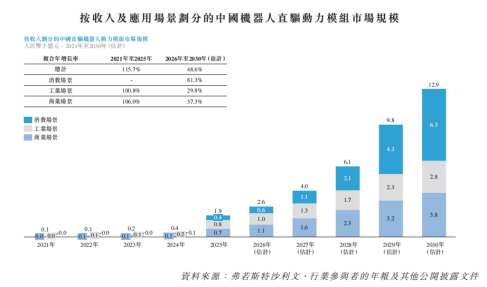
According to Frost & Sullivan data, the global consumer grade direct drive module market size is 2 billion yuan in 2025. With core advantages such as high response, high accuracy, low noise, and compact structure, it is expected to grow to 17.9 billion yuan in 2030. The Chinese market is growing even more rapidly. The domestic consumer direct drive module market is 1.9 billion yuan in 2025, the compound growth rate of the consumer scenario is 81.3% between 2026 and 2030, and the scale will reach 12.9 billion yuan in 2030.
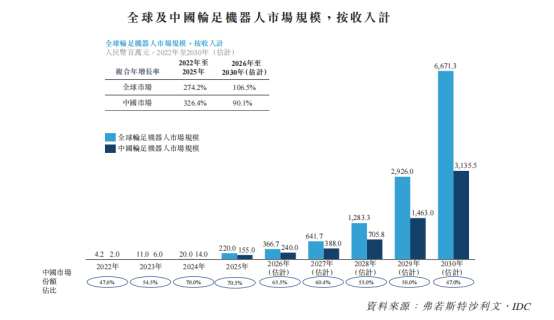
The growth potential of the wheel-foot robot circuit is also outstanding. The global market compound growth rate is 106.5% from 2026 to 2030, and the market size will reach 6.67 billion yuan in 2030; during the same period, the compound annual growth rate of the Chinese market was 90.1%, and the scale increased to 3.14 billion yuan in 2030. The high-growth track will continue to empower the company.
After entering the Hong Kong stock market, the company will rely on the capital market to lay out four major development directions: deep iteration of direct drive technology, expansion of automated production capacity, large-scale implementation of the entire scene, and intelligent algorithm upgrades to further strengthen the three major business collaboration, accelerate the penetration of direct drive technology into all types of robots, and consolidate the moat of robot software and hardware integration.
Conclusions
As the value game in the robot industry extends from the level of machine integration to the independent design of the underlying power architecture, the market's judgment on hard technology companies is shifting. In the past, capital paid more attention to the speed of iteration of complete machine products. Today, the ability to deliver platform-based technology, the depth of self-development of the underlying architecture, and the potential to reuse technology across scenarios, along with intellectual property reserves and supply chain control capabilities, are gradually becoming the core yardstick for measuring the long-term value of an enterprise.
Benmao Technology relies on industrialization achievements formed by a platform-based technology system, which is in line with the development trend of the robotics industry and also matches the value evaluation scale of the capital market. Looking at the industrial environment, implementing intelligence to accelerate the reshaping of the competitive landscape of the robotics industry, global market demand for a new direct driving structure is rapidly expanding. With its mature technical base and mass production verification capabilities, the company opens up a multi-scenario technology implementation path, which can open up space for differentiated growth in industry technology changes and track expansion.