
Why U.S. Physical Therapy (USPH) Is Getting Attention Now
Recent leadership moves at U.S. Physical Therapy (USPH), including the appointment of Nchacha Etta as Chief Financial Officer and Myra Davis to the Board, have sharpened attention on cost discipline and cash flow quality.
The leadership reshuffle at U.S. Physical Therapy is landing at a moment when momentum in the share price has picked up, with a 90-day share price return of 29.87% and a 30-day move of 5.45% off a latest close of US$82.47.
That short-term strength contrasts with a weaker long-run picture. The 3-year total shareholder return is down 9.08% and the 5-year total shareholder return is down 23.59%. This helps explain why renewed focus on discounted cash flow estimates and perceived undervaluation is gaining traction among investors.
Scan beyond U.S. Physical Therapy and compare its setup with a curated 35 high quality undervalued stocks that also pair discounted valuations with solid fundamentals and balance sheet strength.
After a near 30% rebound in 90 days, the obvious question for U.S. Physical Therapy is simple. Has most of the easy upside already played out, or does the cash flow math still point higher from here?
Most Popular Narrative: 12% Undervalued
On the most followed narrative, U.S. Physical Therapy screens as undervalued, with a fair value of $93.67 against a recent price of $82.47. That gap is attributed to cash flow and margin assumptions rather than the latest share price swing.
Strategic cost efficiency initiatives, such as AI-driven clinical documentation, semi-virtualized front desk operations, and recruitment/retention technology, are beginning to materially lower operating and labor costs per visit, directly improving net margins and earnings potential.
Acquisition of high-performing clinics, especially in higher reimbursement geographies like New York, and a robust de novo and acquisition pipeline, provide further expansion of the patient base, enable contract pricing leverage, and increase average net rates, all supporting margin and earnings growth.
See why 1 investors see U.S. Physical Therapy as 12% undervalued.
Result: Fair Value of $93.67 (UNDERVALUED)
Still, Medicare reimbursement pressure and tighter labor markets could easily blunt the U.S. Physical Therapy margin story that underpins that 12% undervaluation case.
Find out about the key risks to this U.S. Physical Therapy narrative.
Another View On U.S. Physical Therapy’s Valuation
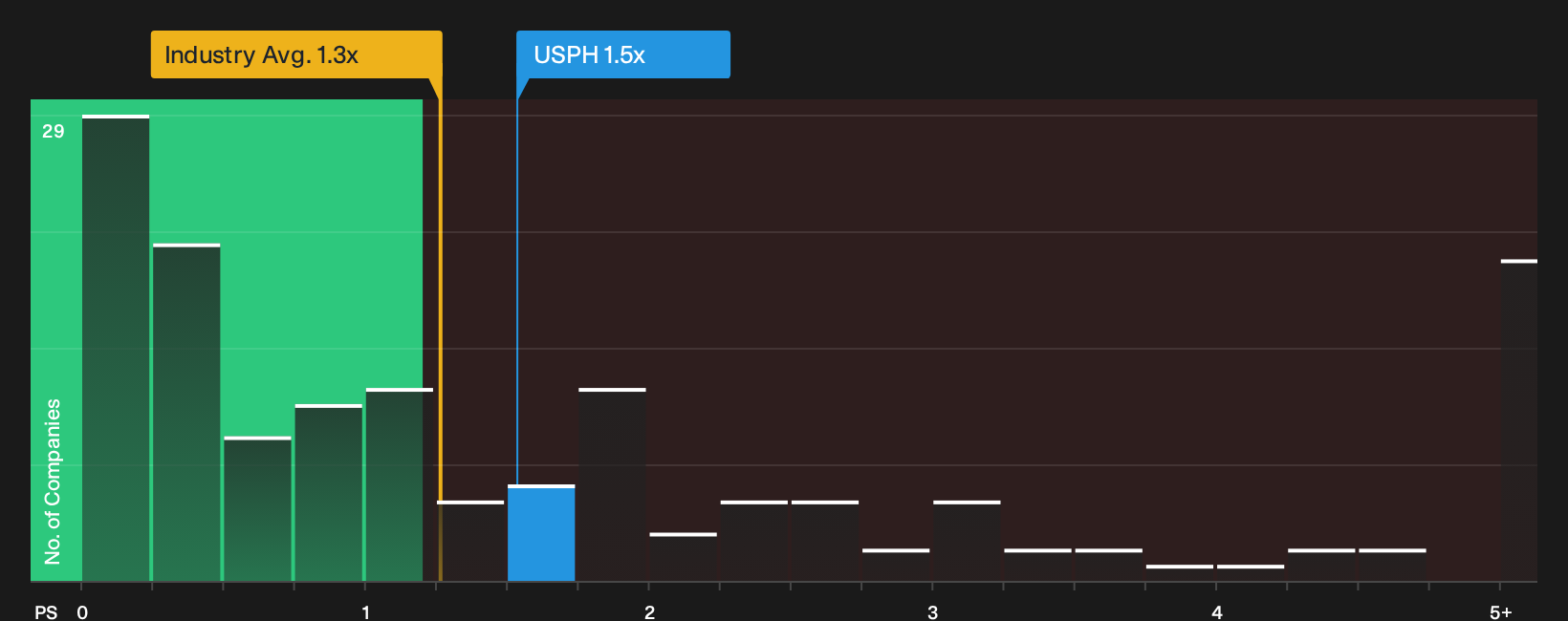
On a simple revenue multiple, U.S. Physical Therapy looks anything but cheap. The stock trades on a P/S of 1.5x, compared with 1.3x for the wider US Healthcare group and 1.4x for closer peers, while the fair ratio points lower again at 0.8x.
That gap suggests investors are paying a premium for the USPH story even as recent returns have lagged the sector and the broader market. If the market leans back toward the fair ratio over time, that premium could compress rather than expand. Is the current price rewarding enough for that risk, or is the DCF-led undervaluation doing too much heavy lifting in your thesis?
See what the numbers say about this price — find out in our valuation breakdown.
Next Steps
Mixed messages in the recent performance and valuation story for U.S. Physical Therapy make this a stock you really need to see firsthand. Take a few minutes to scrutinize the fair value work, check the risk flags and weigh up the upside for yourself through the 2 key rewards and 2 important warning signs.
Looking for more investment ideas beyond U.S. Physical Therapy?
If U.S. Physical Therapy has sharpened your focus on valuation and quality, it makes sense to widen the lens and line up your next potential moves.
- Target dependable income streams by reviewing 7 dividend fortresses that combine higher yields with disciplined payout profiles.
- Hunt for mispriced opportunities by scanning the 16 high quality undiscovered gems that pair strong fundamentals with limited market attention.
- Prioritise resilience in tougher markets by concentrating on the 30 resilient stocks with low risk scores that score well on balance sheet strength and stability.
This article by Simply Wall St is general in nature. We provide commentary based on historical data and analyst forecasts only using an unbiased methodology and our articles are not intended to be financial advice. It does not constitute a recommendation to buy or sell any stock, and does not take account of your objectives, or your financial situation. We aim to bring you long-term focused analysis driven by fundamental data. Note that our analysis may not factor in the latest price-sensitive company announcements or qualitative material. Simply Wall St has no position in any stocks mentioned.
Have feedback on this article? Concerned about the content? Get in touch with us directly. Alternatively, email editorial-team@simplywallst.com