
Under Armour (UAA) Faces Fresh Doubts Following Baird Downgrade, Is It Still Below Fair Value?
Baird’s September 14 downgrade of several sportswear stocks put Under Armour (UAA) back under the microscope as investors reconsider expectations for athletic apparel demand and consumer spending resilience.
Under Armour’s latest share price of US$4.88 comes after a 1-day share price return of down 1.81% and a 30-day share price return of down 9.46%. This extends a 90-day share price return of down 15.57%, even as the 1-year total shareholder return is slightly positive at 2.09%. This signals fading short term momentum following Baird’s downgrade, while longer term holders have still experienced substantial value erosion over three and five years.
Spot opportunities beyond Under Armour by scanning a hand-picked 35 high quality undervalued stocks that couples resilient cash flows with balance sheets built to handle softer consumer spending.Under Armour still owns a recognizable performance brand, yet the share price slide since Baird’s downgrade raises a sharper question. Are investors being compensated enough today for the risks that come with this business?
Most Popular Narrative: 22% Undervalued
Under Armour’s most followed valuation story pegs fair value at about $6.28 per share, comfortably above the latest $4.88 close. This puts more pressure on the underlying brand reset and international push to eventually justify that gap.
The ongoing transformation to a brand-first strategy, with a focus on premiumization, tighter SKU assortments, and greater brand storytelling, positions Under Armour to increase average selling prices, improve full-price sell-through, and reduce reliance on discounting, which should positively impact net margins and long-term earnings growth.
Strategic international expansion, particularly in EMEA and initiatives to stabilize the APAC region, diversifies revenue sources and reduces North America concentration risk, driving more consistent and sustainable revenue growth globally.
See why 29 investors see Under Armour as 22% undervalued.
Result: Fair Value of $6.28 (UNDERVALUED)
Still, this narrative can unravel if ongoing tariff and supply chain pressures continue to squeeze margins, or if weak footwear demand keeps dragging on revenue and brand perception.
Find out about the key risks to this Under Armour narrative.
Another View: Under Armour Through Cash Flows
The analyst narrative leans on a fair value of $6.28 per Under Armour share, yet the Simply Wall St DCF model points to a future cash flow value closer to $4.37. That implies the current $4.88 price sits above this cash flow estimate. Which story do you consider more persuasive?
Look into how the SWS DCF model arrives at its fair value.
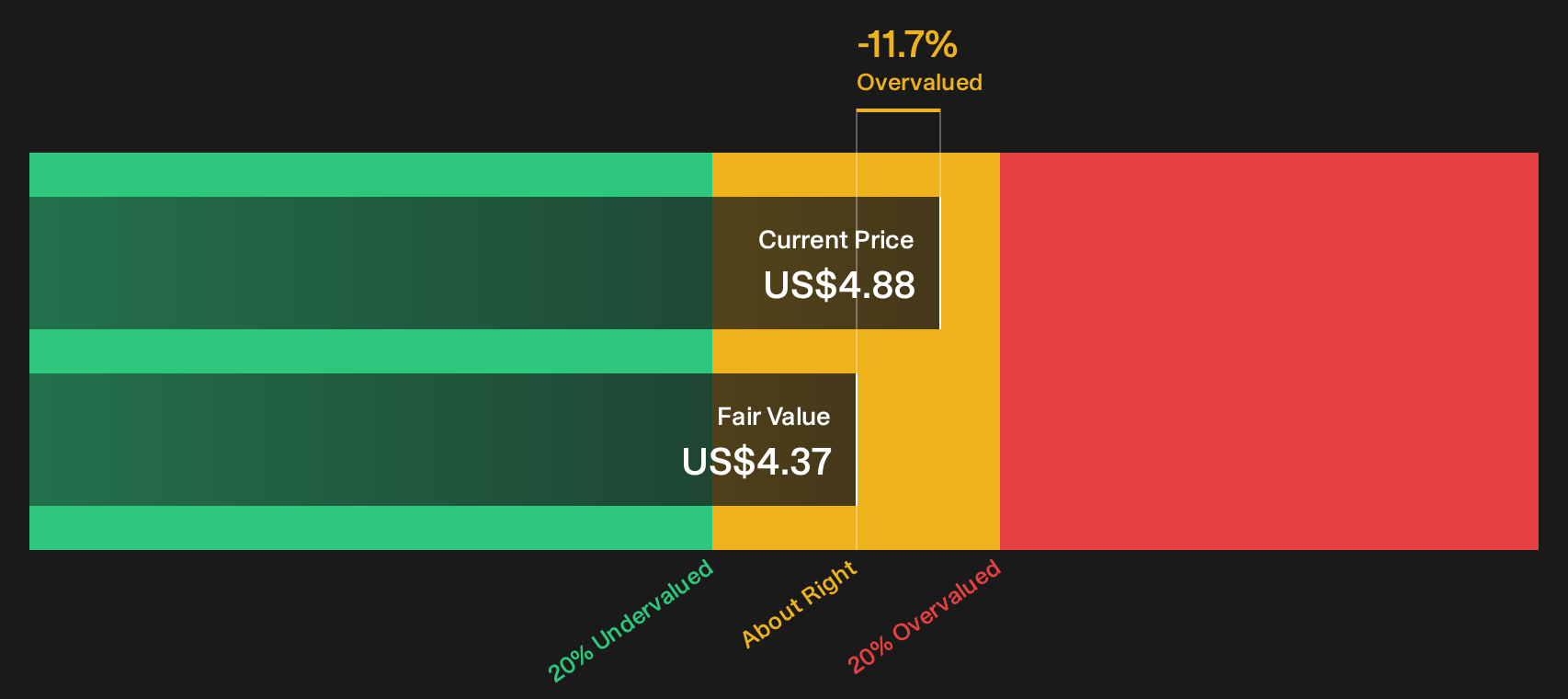
Simply Wall St performs a discounted cash flow (DCF) on every stock in the world every day (check out Under Armour for example). We show the entire calculation in full. You can track the result in your watchlist or portfolio and be alerted when this changes, or use our stock screener to discover 35 high quality undervalued stocks. If you save a screener we even alert you when new companies match - so you never miss a potential opportunity.
Next Steps
If sentiment around Under Armour feels conflicted, that is the signal to focus on the numbers, compare narratives, and decide quickly where you stand. To weigh the bright spots investors are watching, start with the 2 key rewards.
Looking for more ideas beyond Under Armour?
Under Armour may be front of mind today, but your next strong opportunity could sit in a very different corner of the market, so widen the search now.
- Target potential upside in smaller companies before they hit the spotlight by scanning 8 elite penny stocks with strong financials.
- Prioritize resilience by reviewing a 30 resilient stocks with low risk scores that focuses on businesses with more defensive profiles.
- Hunt for quality businesses that the market may be overlooking using a 16 high quality undiscovered gems.
This article by Simply Wall St is general in nature. We provide commentary based on historical data and analyst forecasts only using an unbiased methodology and our articles are not intended to be financial advice. It does not constitute a recommendation to buy or sell any stock, and does not take account of your objectives, or your financial situation. We aim to bring you long-term focused analysis driven by fundamental data. Note that our analysis may not factor in the latest price-sensitive company announcements or qualitative material. Simply Wall St has no position in any stocks mentioned.
Have feedback on this article? Concerned about the content? Get in touch with us directly. Alternatively, email editorial-team@simplywallst.com