
3 Transport Stocks That Could Benefit From Lower Oil Prices
Tech stocks are stealing headlines after Intel’s surge and the Nasdaq 100’s three month high, but the sharp 5.1% slide in crude oil could matter just as much for passenger airlines, whose fuel bills often shape profits. Falling energy prices, upbeat equity sentiment and ongoing Fed uncertainty are creating winners and laggards. This article explains how that mix affects aviation and highlights three stocks exposed to the news.
The three aviation and transport stocks below are just a starting sample. The full screen surfaced 16 more companies with equally compelling narratives that are not covered here.
To go beyond this short list, head straight into the US Passenger Airlines and Transportation Fuel-Cost Beneficiaries screener to identify, analyze and focus on the fuel sensitive opportunities that best fit your own view.
Werner Enterprises (WERN)
Overview: Werner Enterprises is a large truckload carrier moving fuel intensive freight across North America, so diesel swings quickly influence its earnings power.
Operations: Werner generates about US$2.3b from Truckload Transportation Services and US$848 million from Werner Logistics, with most revenue in the United States.
Market Cap: US$2.1b
Werner Enterprises gives this screener a ground level link to fuel costs, since diesel is a direct input into its truckload-heavy model and any sustained move in energy prices can quickly change how investors look at future profitability.
"Rapid advances in automation, AI, and emerging logistics technology threaten to displace traditional trucking models, forcing Werner Enterprises to make increasingly large, ongoing capital investments just to remain competitive."
What happens to Werner’s margins if a single cost pressure in that spending mix moves more sharply than current expectations assume?
If that cost squeeze is on your mind, read the full narrative for Werner Enterprises to see how Werner Enterprises could still turn fuel volatility into accelerating opportunity.

Covenant Logistics Group (CVLG)
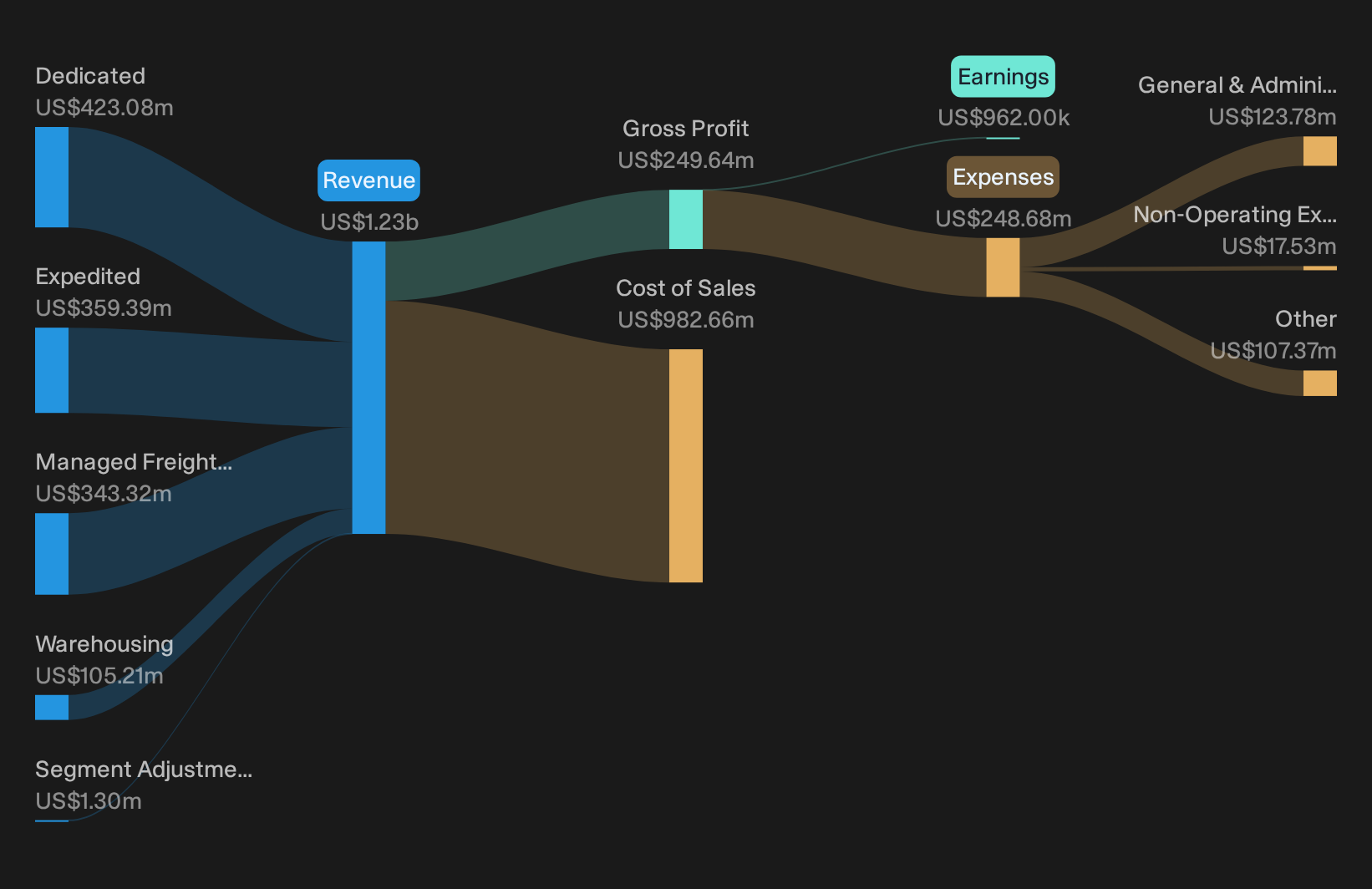
Overview: Covenant Logistics Group provides truckload transportation, dedicated contract carriage, managed freight brokerage and warehousing across the United States, where fuel expenses heavily influence profitability.
Operations: Covenant Logistics Group generates about US$423 million from Dedicated, US$359 million from Expedited, US$343 million from Managed Freight and US$105 million from Warehousing, almost entirely in the United States.
Market Cap: US$858 million
For the US Passenger Airlines and Transportation Fuel-Cost Beneficiaries theme, Covenant Logistics Group is a prime trucking example where fuel, contract structure and asset mix decide how much of any oil-price move ends up in shareholder hands.
"Industry wide constraints on driver availability and increased enforcement of ELD and safety rules are removing capacity from the market and are contributing to rising contract rates, which Covenant Logistics Group expects to capture over time in the form of higher revenue per mile and improved operating margin."
What happens to Covenant Logistics Group’s margin potential if a single unseen pressure quietly reshapes how those fuel sensitive contracts reprice?
When those contracts quietly reset, full narrative for Covenant Logistics Group shows how Covenant Logistics Group could turn fuel volatility into accelerating earnings power and reveal where the real leverage sits.
Knight-Swift Transportation Holdings (KNX)
Overview: Knight-Swift Transportation Holdings runs one of the largest truckload, LTL, logistics and intermodal freight platforms in North America. This gives it direct exposure to fuel costs and freight volumes.
Operations: Knight-Swift Transportation Holdings generates about US$5.0b from Truckload, US$1.5b from Less-Than-Truckload, US$568 million from Logistics and US$397 million from Intermodal, almost entirely in the United States.
Market Cap: US$10.9b
For a fuel-cost beneficiary screen, Knight-Swift Transportation Holdings matters because its nationwide truckload and LTL footprint converts cheaper diesel into meaningful operating leverage.
"The continued expansion and integration of the LTL (less-than-truckload) segment is driving shipment and customer growth, with significant operating leverage expected as new facilities and network investments mature, supporting long-term revenue growth and eventual margin improvement."
The real swing factor is what happens to Knight-Swift’s earnings power if one key assumption about freight pricing quietly shifts.
If that freight pricing swing is what you are watching, full narrative for Knight-Swift Transportation Holdings lays out how Knight-Swift Transportation Holdings could turn network investments into accelerating earnings power.

Seeking Alternatives Beyond Fuel Plays?
Fresh ideas move first. The most interesting stories can break out, build momentum and get fully priced before the crowd even looks. Scan these while it still matters, act now.
- Hunt for potential turnaround income opportunities by scanning 7 dividend fortresses before yields drop or prices fly on the next wave of dividend focused buyers.
- Spot high potential outliers early by running through the curated 16 high quality undiscovered gems while these businesses are still under the radar for now.
- Track the next leg of the commodity cycle by reviewing 17 top copper producer stocks before renewed demand momentum gets fully caught in broader headlines.
This article by Simply Wall St is general in nature. We provide commentary based on historical data and analyst forecasts only using an unbiased methodology and our articles are not intended to be financial advice. It does not constitute a recommendation to buy or sell any stock, and does not take account of your objectives, or your financial situation. We aim to bring you long-term focused analysis driven by fundamental data. Note that our analysis may not factor in the latest price-sensitive company announcements or qualitative material. Simply Wall St has no position in any stocks mentioned.
Have feedback on this article? Concerned about the content? Get in touch with us directly. Alternatively, email editorial-team@simplywallst.com