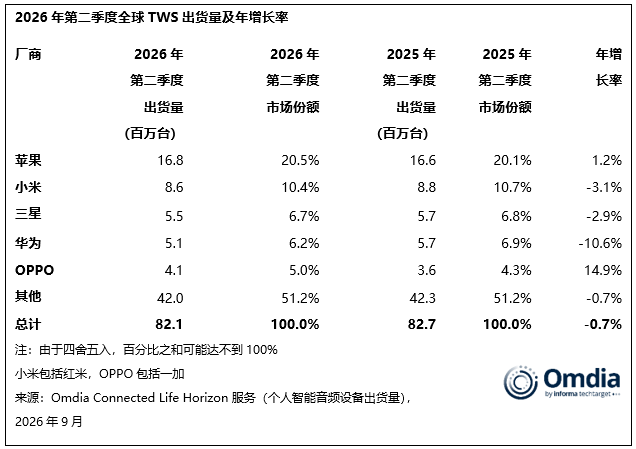
Omdia: 26Q2 global true wireless headphone shipments of 82.1 million units fell 0.7% year on year
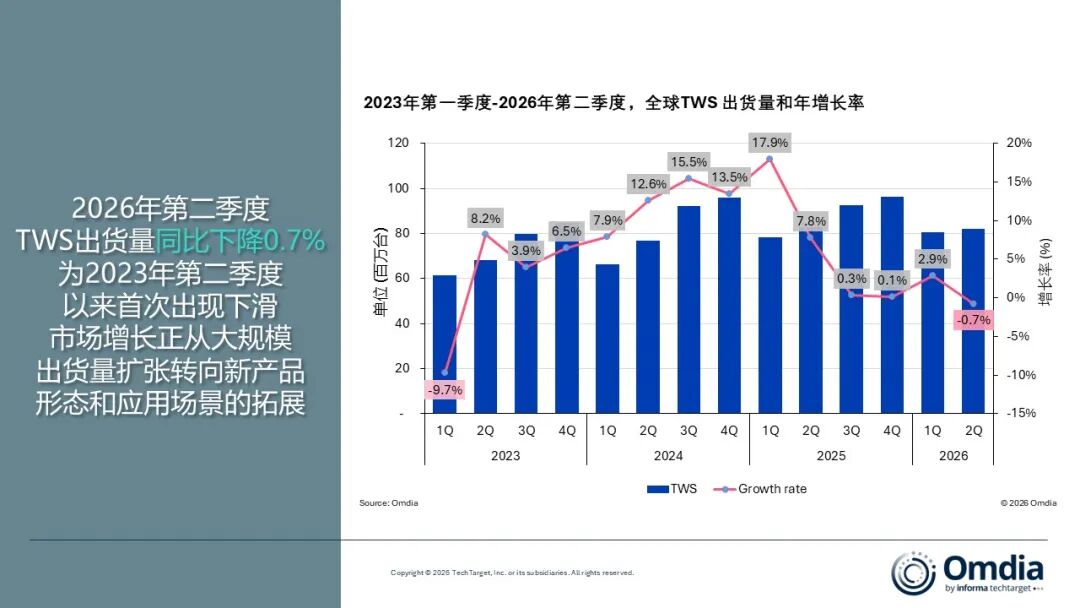
The Zhitong Finance App learned that according to Omdia's latest data, global true wireless (TWS) headphone shipments fell 0.7% year on year to 82.1 million units in the second quarter of 2026. This is the first year-on-year decline since the second quarter of 2023. As the world's largest TWS market, the mainland China market is one of the main reasons for the overall decline. TWS shipments in mainland China fell 9.5% due to the weakening of the impetus brought about by broader consumer electronics stimulus policies and the early release of some switching demand until 2025. Shipments from other major markets, such as the US and India, have also declined, and growth in emerging markets has partly offset these declines.
OWS shipping performance surpasses traditional TWS
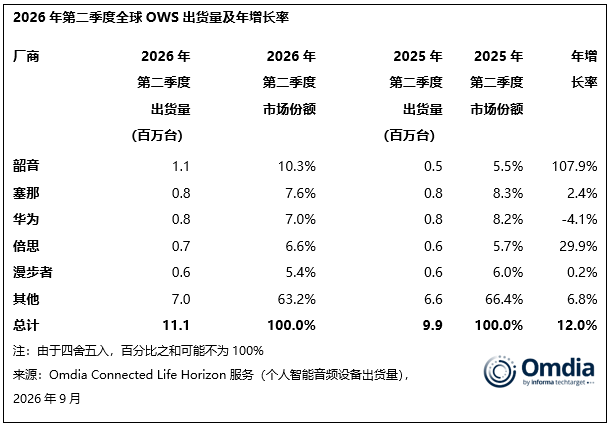
Behind the overall flat TWS market, the shipping performance gap between traditional TWS (including in-ear and semi-in-ear products) and open earphones (OWS) is widening. According to Omdia data, in the second quarter of 2026, traditional TWS shipments fell by 2%, while OWS shipments increased by 12% to reach 11.1 million units. OWS's share of total TWS shipments rose to 13.5% from 12.0% a year ago.
Omdia Research Analyst Claire Qin (Claire Qin) said, “The entry threshold for the OWS category is relatively low, and product quality is still the key to differentiation, which provides development opportunities for many manufacturers. OWS is rapidly becoming an important area for new feature development, particularly AI features involving longer listening experiences and various usage scenarios.”
Ear-clip headphones drive OWS growth
In the second quarter of 2026, ear-clip earphones accounted for most of the shipments of open earphones, and the growth spanned a variety of form factors and price ranges.
Ear-clip OWS accounts for 61% of total shipments, thanks to growing consumer interest in its dual use as an audio device and fashion accessory.
Ear-hook devices account for 39% of shipments, and their secure fit is popular among people in other active use situations such as sports.
The entry-level segment priced at less than $50 grew by 323%, driven by vendors such as Sanag (Sanag), Baseus (Baseus), and QCY.
The $100-199 price range increased 253% year over year, mainly driven by well-known brands such as Huawei, Shokz (Shokz), and OPPO.
Qin Yiyuan added, “The high-end ear-clip headphone segment is still fiercely competitive, and sound quality is a key area for differentiation. Vendors that can meet these challenges are more likely to get space to support their high-price strategies when targeting consumers who pursue both functionality and a sense of style.”
AI features are becoming TWS's next competitive focus
Fierce competition in the TWS market is also accelerating innovation in the field of AI headsets.
Jason Low (Jason Low), research director at Omdia, said, “AI functionality is gradually becoming an important area for differentiating high-end audio devices, covering everything from smart headsets equipped with neural processing units (NPUs) to supporting applications driven by large language models (LLM). Users will continue to prioritize comfort, sound quality, call quality, and active noise cancellation (ANC) performance. At the same time, as consumers increasingly want features that help complete tasks and enhance the overall user experience, AI features are expected to drive further popularity of the product.”
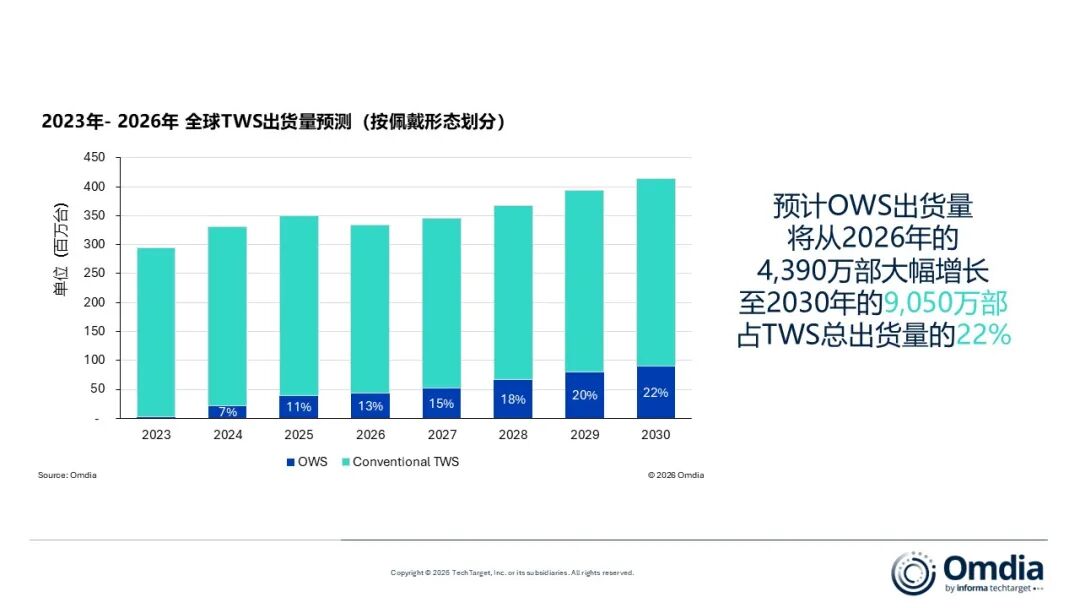
Omdia anticipates that OWS will remain one of the TWS segments with the greatest potential for growth in the next few years. OWS's annual shipments are expected to increase from 43.9 million units in 2026 to 90.5 million units in 2030, accounting for nearly one-fifth of total TWS shipments.
Liu Jiansen concluded, “Successful vendors need to tailor products for clearly defined use cases — fitness, commuting, and office efficiency — while adding smarter features through seamless ecosystem integration.”