
The luxury goods industry's profit expectations are “too optimistic”! Within a month, many major banks were collectively bearish, and luxury stocks headed for the worst year since 2008
The Zhitong Finance App learned that analysts at the Royal Bank of Canada (RBC) said that considering the weakening demand environment and purchasing trends, the market's profit expectations for European luxury goods manufacturers are too optimistic.
A team led by Pilar Dadhania said in a report that the weakening economic background has led to mixed data performance in Asia, and US consumption may also slow down. They pointed out that in a more difficult environment, creative marketing for luxury brands is unlikely to achieve the expected sales boost, and described their position as “more cautious.”
RBC downgraded the stock ratings of LVMH (LVMH) and Burberry Group from “outperforming the market” to “on par with the market.” Analysts lowered the 2027 earnings per share forecasts for Kering Group, Moncler SpA (Moncler SpA), Hermes International, and Swatch Group AG (Swatch Group AG).
Dadhania and colleagues said that expectations for next year's profit “are still too optimistic in our opinion. It assumes that most stocks will accelerate revenue growth and expand profit margins, but this does not reflect the current luxury industry environment, and requires an inflection point in the trend.”
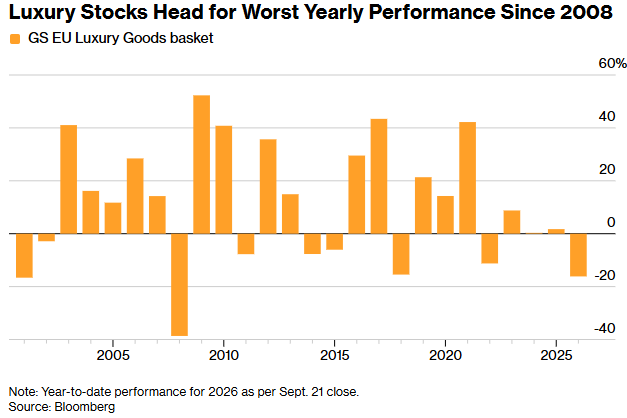
Luxury stocks may record their worst annual performance since 2008
RBC's views add another layer of haze to already disappointing luxury stock investors. The war in Iran pushed up oil prices, heightened concerns about inflation, and triggered a hawkish response from the central bank, which may curb consumer spending. Demand in Asia continues to weaken, further dampening the industry's hopes for profit recovery.
The basket of luxury sector stocks compiled by Goldman Sachs Group has fallen 15% in 2026. By the close of trading on Monday, it was on its way to the worst annual performance since 2008. Weighted stocks LVMC and Hermès were among the worst performing laggards, both falling about 37% since the beginning of the year. RBC analysts say their preferences in the luxury sector are Ferrari and Richemont Group.
Pessimism spreads
Bearish sentiment in the luxury industry is spreading on Wall Street. Over the past month, many investment banks, from RBC and Morgan Stanley to HSBC and Bernstein, have intensively downgraded ratings, target prices, or profit forecasts for European luxury stocks.
The week before, Morgan Stanley lowered the LVMH target price from 520 euros to 450 euros, maintaining a “in sync with the market” rating; J.P. Morgan Chase lowered the target price from 580 euros to 525 euros to remain “neutral”, and expects the fluctuation and weakness of retail sales in China to continue until 2027. HSBC analyst Anne-Laure Bismuth's team also downgraded LVMH and Burberry to “holdings”, bluntly saying investors should not buy due to cheap valuations, unless the “second-order” improvement in sales growth is seen, and no more positive momentum can be seen in the second half of the year. Jefferies, on the other hand, lowered the LVMH target price from 510 euros to 440 euros.
What triggered this round of collective turnaround was the resurgence of demand in Asia. Bernstein analyst Luca Solca's team warned in early September that sample data from mainland luxury shopping malls showed a 12% year-on-year decline in sales in July. This was the “fourth false dawn” of Asian luxury consumption recovery after the pandemic — the previous rebound at the end of 2023, the end of 2024, and the end of 2025 all came to an end. The team lowered the industry's organic growth forecast for the third quarter by 110 basis points to 4.9%.
The strengthening of tax regulations on offshore wealth is also thought to have a “chilling effect” on high-net-worth consumption.
What worries Wall Street more than fluctuations in demand are structural issues. Morgan Stanley pointed out that the “historical pillars” that support luxury premiums — strong pricing power, Chinese-driven structural growth, profit margin expansion, and low profit fluctuations — are being challenged or normalized, and long-term funds continue to avoid this sector; even if valuations have declined sharply, there is no room for valuation repair in the next 12 months.
However, there are structural preferences in the consensus, and hard luxury is unanimously favored: RBC and Bernstein both ranked Lifeng as the first choice, and Bernstein called it the “best target” for the sector; Morgan Stanley is most optimistic about Lifeng, believing that jewelry brands are more resilient in China.
On September 2, UBS listed Li Feng among the top five selected non-essential consumer goods stocks in Europe, pointing out that its valuation is nearly 20 years low compared to its peers; Barclays surpassed Li Feng, Monclays, Burberry, and Prada. Jefferies's latest channel research also shows that hard luxury is still resilient in China when soft luxury is weak.
The main difference is whether valuations are cheap enough, but “more prudent” was still the main tone of Wall Street until the demand trend reached an inflection point.