
3 US Insurance Stocks That Could Benefit From Higher Treasury Yields
When US Treasury yields hover near 5% and cash suddenly looks competitive again, plenty of investors stop at money market funds and call it a day. That can mean opportunities get left on the table as insurance stocks quietly reprice their risks, reserves and investment portfolios in the background. This article walks through three US property and casualty insurers that sit in the crosshairs of this rate shock and explains how rising yields might help or hurt their shares.
The three insurers below are just a small sample of what this rate shock means in practice, and the full screen surfaced 24 more US property and casualty companies with equally compelling narratives that are not covered here. To go deeper into this idea, head straight into the US Property & Casualty Insurers screener to identify, filter and analyze the highest conviction plays in this corner of the market.
Progressive (PGR)
Overview: Progressive is a large US insurer focused on personal and commercial auto and residential property cover, earning premiums and investment income.
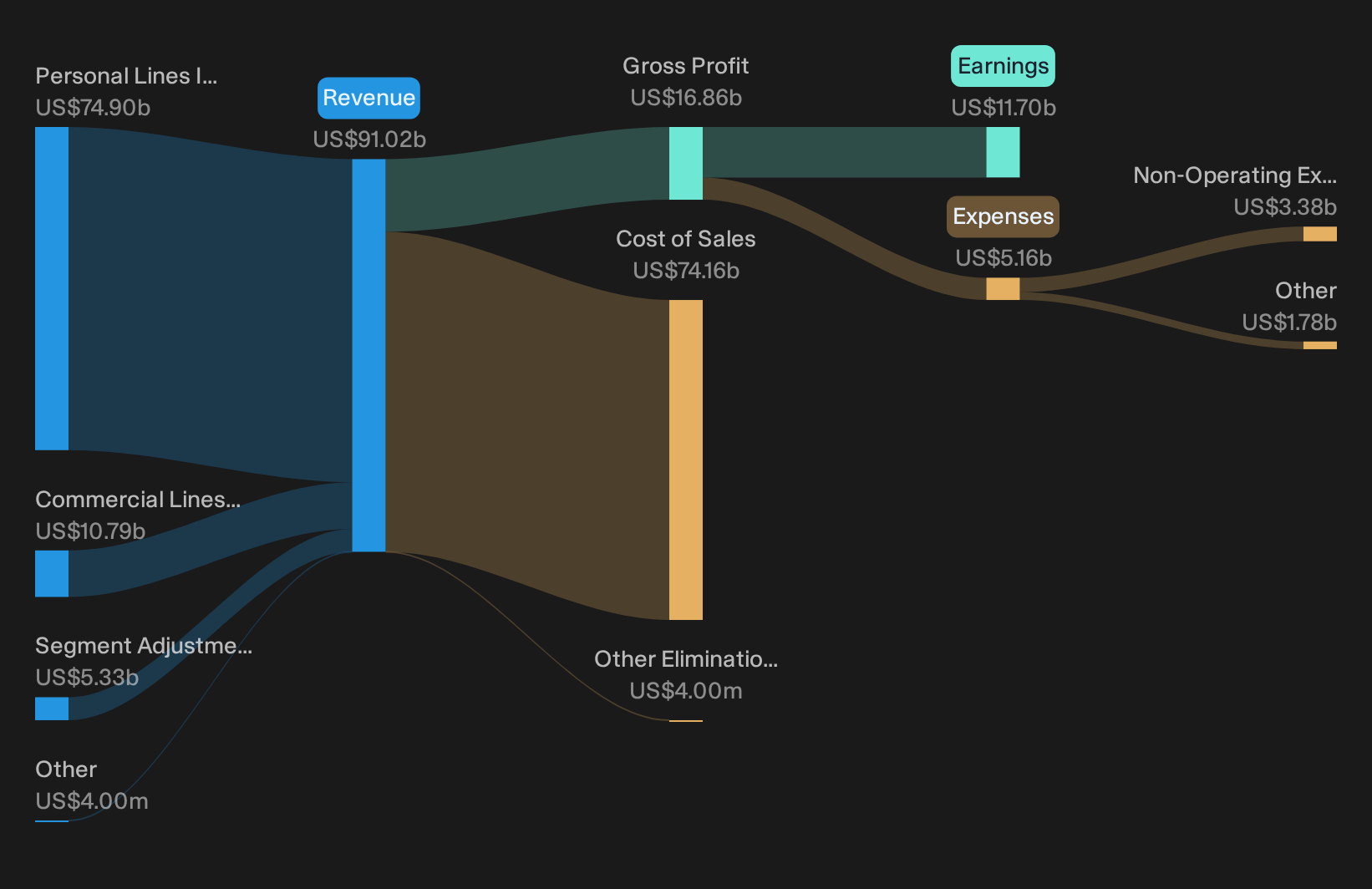
Operations: Progressive generates most of its US$91b revenue from US personal lines including property at about US$75b, plus US$10.8b commercial lines.
Market Cap: US$123.4b
Progressive matters in this screener because a sizeable, relatively conservative fixed income portfolio sits behind a broad auto and property book. This can allow it to recycle maturing bonds into higher Treasury yields more quickly than many longer tail insurers.
"Progressive's scale, data analytics, and rapid pricing response mechanisms continue to support share gains in personal auto as it now holds 18.6% market share and has become the largest U.S. personal auto writer by direct premiums written, which can influence net premiums written and earnings."
What happens to Progressive’s margins if one pressure on claim costs and pricing power moves a little further than analysts currently expect?
If that margin puzzle matters to you, read the full narrative for Progressive to see how Progressive’s scale, capital choices and claim trends could be quietly reshaping the story.
Selective Insurance Group (SIGI)
Overview: Selective Insurance Group is a US property and casualty insurer providing commercial, personal, E&S and flood coverage, supported by a sizeable investment portfolio.
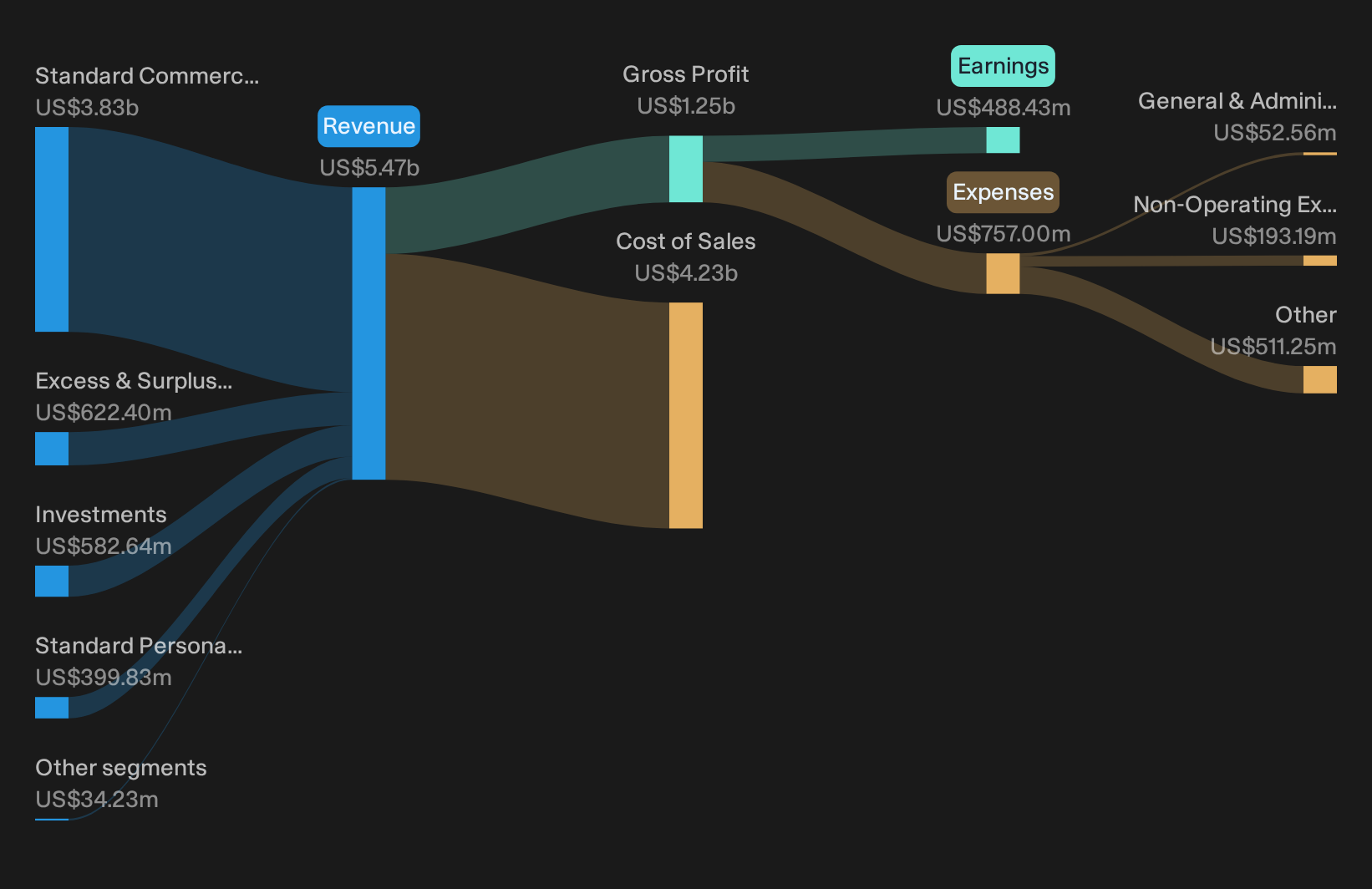
Operations: Selective generates about US$3.8b from Standard Commercial Lines, US$622 million from E&S, US$400 million from personal lines and US$583 million from investments, almost entirely in the US.
Market Cap: US$5.2b
Selective Insurance Group fits this higher yield P&C theme because it combines a traditional US underwriting footprint with a bond-heavy investment book that can reset at today’s rates.
"The company's ongoing focus and investments in operational efficiency, including data analytics, digital claims management, and underwriting tools, are expected to drive improved combined ratios and support margin expansion, leading to long-term net margin and earnings growth."
What really matters for Selective Insurance Group is how one quiet shift in its casualty risk mix ultimately filters through to those future margins.
If that risk mix shift is what you care about, read the full narrative for Selective Insurance Group to see how Selective Insurance Group’s margin story could be quietly accelerating.
Kinsale Capital Group (KNSL)
Overview: Kinsale Capital Group is a US specialty property and casualty insurer focused on excess and surplus lines, using customer float invested mainly in bonds.
Operations: Kinsale Capital Group generates about US$2.0b in revenue from excess and surplus lines insurance written across the United States.
Market Cap: US$8.2b
For investors tracking how higher long term Treasury yields filter into real earnings, Kinsale Capital Group sits at the point where specialty underwriting meets a bond heavy float. That mix can look especially interesting when many broader P&C carriers pull back from complex risks.
"Expansion in higher growth lines such as small business property, high value homeowners, inland marine, personal insurance, agribusiness property and multiple casualty divisions is widening Kinsale's opportunity set at a time when many standard carriers are retrenching."
The real swing factor is how one subtle shift in pricing discipline ripples through that growing float and the margins attached to it.
That pricing discipline question is exactly what the full narrative for Kinsale Capital Group unpacks, showing where Kinsale Capital Group’s underwriting edge could be quietly accelerating beyond headline growth.

Seeking Alternatives Before The Crowd?
Fresh ideas move fast. Breakout stories gain momentum, laggards keep dropping and quiet compounders fly under the radar for now. Scan what matters before it is crowded and consider acting while opportunities remain less followed.
- Identify stronger balance sheets before they attract broad attention by running the list of solid balance sheet and fundamentals (23 results) while the most resilient businesses remain underfollowed.
- Review the 7 dividend fortresses while income-rich opportunities still trade without heavy momentum flows.
- Focus on the 38 profitable AI stocks that aren't just burning cash to track where AI meets real earnings power before these cash generative stories become widely recognized.
This article by Simply Wall St is general in nature. We provide commentary based on historical data and analyst forecasts only using an unbiased methodology and our articles are not intended to be financial advice. It does not constitute a recommendation to buy or sell any stock, and does not take account of your objectives, or your financial situation. We aim to bring you long-term focused analysis driven by fundamental data. Note that our analysis may not factor in the latest price-sensitive company announcements or qualitative material. Simply Wall St has no position in any stocks mentioned.
Have feedback on this article? Concerned about the content? Get in touch with us directly. Alternatively, email editorial-team@simplywallst.com