
UBS (UBS.US)'s new capital regulations broke through, and Parliament was thwarted, and the Swiss Senate passed the CET1 support plan for 90% of overseas subsidiaries
The Zhitong Finance App learned that the Swiss Federal Council (upper house) voted to pass a compromise plan on UBS Group (UBS.US) capital requirements. The plan largely adopted the government's requirements, but it was a failure for this bank.
The plan stipulates that the bank must provide capital support for 90% of the value of its overseas subsidiaries with the highest quality capital (i.e. CET1). Although this standard falls short of the 100% support requirement promoted by the government, it also deviates from a compromise plan favoured by UBS that makes extensive use of convertible bonds. UBS has clearly stated its opposition to this 90% plan.
On Wednesday, the Bundestag passed the proposal by 29 votes to 16, after Treasury Secretary Karin Keller-Zotel sent a signal of openness to the proposal the day before. The bill will now be submitted to the National Assembly (lower house), and the final decision is not expected to be made earlier than next year.
After the voting results were released, the UBS stock price returned to early trading gains, and the closing was basically flat.
Since the collapse of Credit Suisse in 2023, Switzerland has been trying to find ways to make its only global bank withstand the crisis. The core of the government's thinking is to raise equity capital on a large scale. UBS executives strongly opposed this, believing that the move would make it uncompetitive.
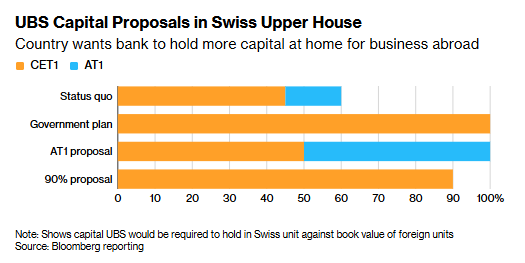
Lawmakers finally chose from three proposals — the three proposals were elected after a debate that went beyond the allotted time, and voting was postponed until Wednesday as a result. The Swiss government's initial proposal required UBS to support its overseas subsidiaries with 100% equity, which could force the bank to inject an additional top quality CET1 capital of up to $20 billion into its domestic entities. The other two options are to seek 90% equity support and provide full support with 50% equity plus 50% of the convertible debt of so-called AT1 bonds.
UBS originally supported the last hybrid plan, while rejecting the others. But before the vote, Keller Zotel delivered a lengthy speech to lawmakers, refuting the arguments put forward by UBS and its supporters in Parliament about the government's plan one by one. In the end, lawmakers voted for a measure more similar to her original proposal than what UBS wanted.
“UBS does not deny that it has the funds needed to carry out this capital supplement,” Keller Zotel said. The key is whether these funds are “used to strengthen the Swiss parent bank in line with the Federal Council's wishes, or to benefit shareholders in the form of dividends and share repurchases.”
Outsiders generally estimate that the government plan is the heaviest for UBS, while the AT1 plan is viewed as the lowest-cost solution, although the latter also means increased capital regulation requirements.
Switzerland's current banking rules require overseas subsidiaries to be provided with 60% capital support, a quarter of which can be covered by AT1 bonds. The government said that during the collapse of Credit Suisse nearly four years ago, current standards have proven insufficient.
UBS is disappointed
In several recent public statements, UBS CEO Sergio Hermotti and Chairman Colm Kelleher both warned lawmakers not to adopt the government's proposal. A group of influential lobbying organizations also issued an open letter making a similar appeal.
UBS acquired Credit Suisse in early 2023 through an emergency transaction led by the government. The bank's management was dismayed by this: after the takeover was implemented, the Swiss authorities instead tried to impose higher capital restrictions on UBS.
Keller Zotel has said that her plan will ensure UBS's resilience in the face of potential crises and save Switzerland from falling into a situation where its largest bank may slide all the way to collapse. She dismissed the idea that AT1 bonds could be used as an alternative to CET1 capital in this case because people generally doubt their applicability in crisis situations.
The voting results will now be submitted to the more left-leaning National Assembly, which may debate them and form its own position at the end of the year. If the two houses disagree on the details, the two institutions will begin passing the bill back and forth to seek to finalize the unified text.
The final ruling on UBS capital requirements will not be made until 2027 at the earliest, and the decision may also be put to a referendum.