
Sandisk Stock Is Down More Than 20% Over the Past 3 Months. How You Should Play SNDK Here.
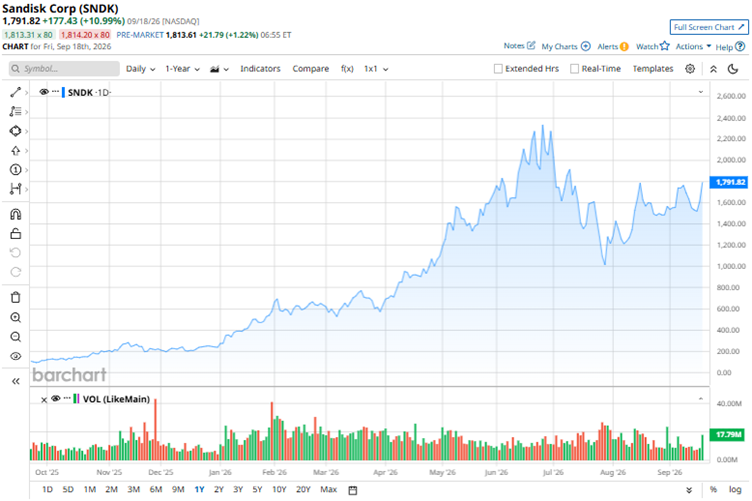
After shares of memory company Sandisk (SNDK) skyrocketed over the past year, it has run into a lull. The stock is down 18% over the past three months, possibly due to profit-taking. However, memory names are going through a volatile time despite the narrative that memory is no longer a cyclical market. Another notable name, Micron Technology (MU), also dropped over the past three months.
This reflects concerns about future artificial intelligence (AI)-related memory demand, brought to the forefront by DeepSeek’s latest V4.1-Flash AI model, which has lower memory requirements. However, memory prices are still rising. According to a TrendForce pricing survey, NAND flash demand is expected to remain largely driven by AI inference workloads and the continued build-out of large-scale data centers. In the third quarter, NAND Flash contract prices are projected to increase by 10%-15% quarter-over-quarter. However, this pace is noticeably slower than in previous quarters.
Sandisk is trying to stay ahead of the curve through a new way of contracting. It launched the New Business Model (NBM), which is focused on long-term contracts that protect it from traditional memory boom-and-bust cycles. The company also introduced a comprehensive multi-year financial framework for fiscal 2028 through fiscal 2030. Over this period, the company anticipates mid-to-high teens revenue growth in line with bit growth, while targeting non-GAAP gross margins near 80% and operating margins around 75%.
Therefore, despite the slight downturn, it might be wise to still favor Sandisk.
About Sandisk Stock
Sandisk is a global semiconductor company focused on NAND flash-based data storage solutions. Headquartered in Milpitas, California, the company designs, manufactures, and markets solid-state drives (SSDs), embedded storage, removable memory cards, USB drives, and wafer-level components.
Its product portfolio serves data center, edge computing, and consumer markets, with enterprise SSDs for hyperscale and AI infrastructure now representing a rapidly growing share of revenue. Sandisk leverages manufacturing facilities in Asia and long-term supply agreements to support customers across cloud, mobile, automotive, and industrial applications. The company has a market capitalization of $262.36 billion.
Over the past 52 weeks, Sandisk’s stock has gained a whopping 1,712.3%, while it is up 654.8% year-to-date. This surge is driven by rising demand for enterprise SSDs and high-capacity NAND as hyperscalers and cloud providers race to build AI infrastructure. Moreover, NAND is undergoing a flash memory pricing supercycle, which has improved the company’s position by driving both higher volumes and much stronger pricing. The stock had reached a 52-week high of $2,354.39 on June 22, but is down 23.9% from that level.
Despite the stellar surge, Sandisk’s stock is trading at a discount to its peers. Its forward-adjusted price-to-earnings ratio of 8.37x is lower than the industry average of 22.91x.
Sandisk Posts Blowout Q4, Powered by AI Data Center Demand
For the fourth quarter of fiscal 2026 ending July 3, Sandisk’s revenue surged 372% year-over-year (YOY) to $8.97 billion, as data center revenue climbed from $213 million to $2.98 billion and edge revenue rose 392% YOY to $5.43 billion. The company’s non-GAAP gross margin climbed by 58.2 percentage points from the prior-year period to 84.6%. Its non-GAAP EPS increased from $0.29 in the year-ago period to $39.25.
For the current fiscal 2027 first quarter, Sandisk expects its revenue to be $10.30 billion to $10.80 billion and non-GAAP EPS to be in the $44 to $46 range. Wall Street analysts are extremely optimistic about Sandisk’s future earnings. They expect the company’s EPS to climb considerably YOY to $45.22 for the current quarter. For fiscal 2027, EPS is projected to surge 201.1% to $208.92, followed by a 20.7% growth to $252.16 in fiscal 2028.
What Do Analysts Think About Sandisk’s Stock?
Last month, Mizuho analysts maintained Sandisk with an “Outperform” rating but lowered the price target from $1,900 to $1,875, which indicates that while analysts are optimistic about the company’s long-term growth prospects, the slight adjustment in its price target shows some near-term volatility.
JPMorgan analysts moved Sandisk from “Not Rated” to “Overweight,” and gave a December 2027 price target of $2,250, citing the company’s Investor Day presentation. Analyst Harlan Sur believes Sandisk is in a unique position to capture the “structural inflection” in NAND demand due to AI infrastructure’s growth. Sur also highlighted the company’s NBM framework, which reduces cyclicality and supports a higher margin profile.
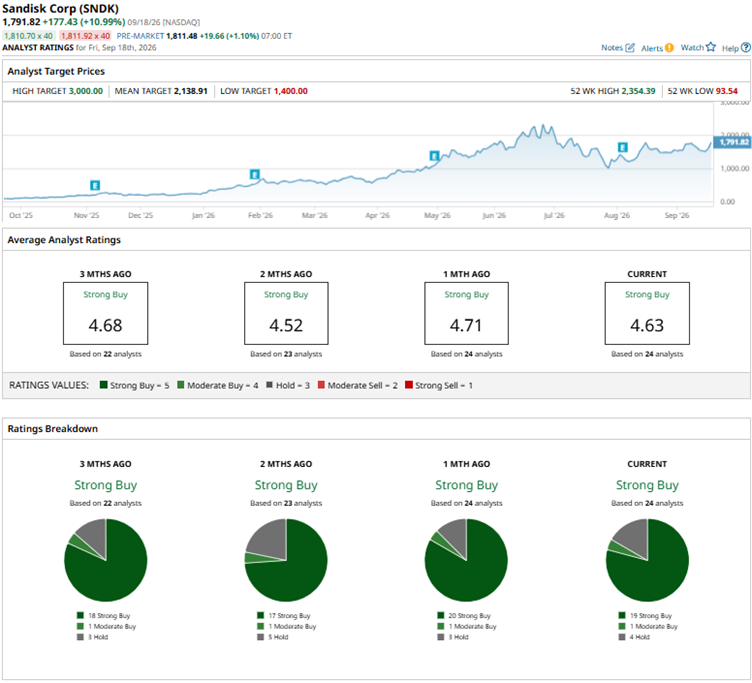
Memory giant Sandisk is an extremely popular name on Wall Street, with analysts awarding it a consensus “Strong Buy” rating overall. Of the 24 analysts rating the stock, 19 have given it a “Strong Buy” rating; one analyst rated it “Moderate Buy,” while four analysts are taking a middle-of-the-road approach with a “Hold” rating. The consensus price target of $2,138.91 represents a 19.4% upside from current levels. Moreover, the Street-high price target of $3,000 reflects a 67.4% upside.
On the date of publication, Anushka Dutta did not have (either directly or indirectly) positions in any of the securities mentioned in this article. All information and data in this article is solely for informational purposes. For more information please view the Barchart Disclosure Policy here.