
Is Essex Property Trust Stock Underperforming the Dow?
California-based Essex Property Trust, Inc. (ESS), with a market capitalization of approximately $17.4 billion, is a fully integrated real estate investment trust focused on multifamily apartments. It acquires, develops, redevelops and manages communities in supply-constrained West Coast markets, including Southern California, the San Francisco Bay Area and Seattle.
Companies worth between $10 billion and $200 billion are generally classified as “large-cap stocks,” and Essex Property Trust comfortably fits this category. Its substantial market capitalization reflects its size, influence and established position within the residential REIT industry. Essex Property Trust stands out through its concentration in high-quality apartment communities across major West Coast markets. Its portfolio of more than 63,000 units benefits from strong rental demand and favorable demographics, while a disciplined investment approach and efficient property management support profitability and long-term portfolio strength.
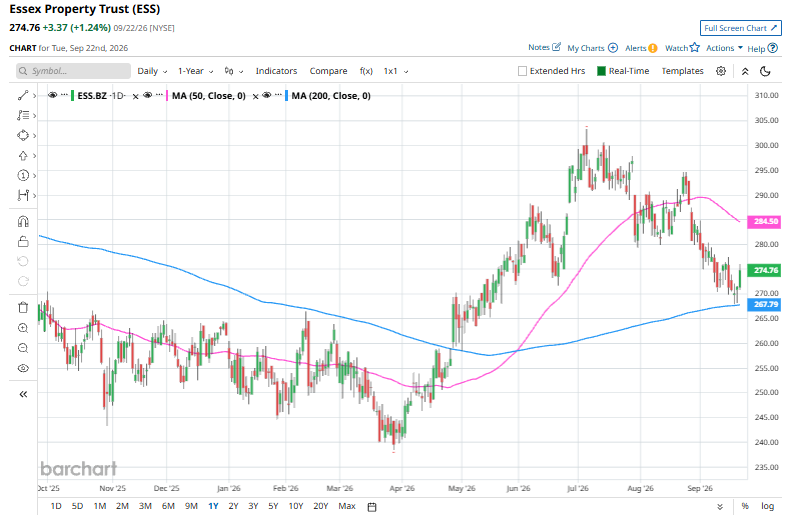
Despite these advantages, ESS remains 9.4% below its 52-week high of $303.35, reached on July 7, 2026. Over the past three months, ESS shares have declined marginally, underperforming the Dow Jones Industrial Average ($DOWI), which posted only marginal gains over the same period.
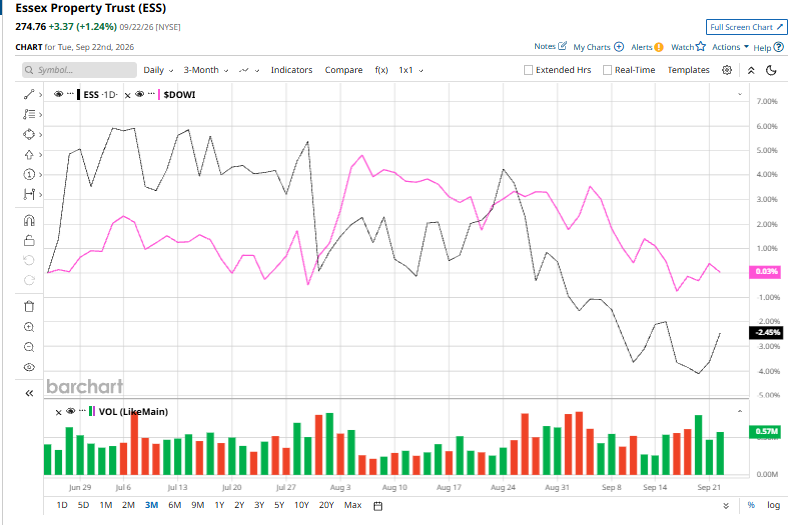
ESS shares have climbed 5% year-to-date and 3.1% over the past 52 weeks, underperforming the Dow’s 7.9% year-to-date gain and 11.8% return over the same period.
The stock has remained above its 200-day moving average since late April but has slipped below its 50-day moving average since late August, suggesting near-term weakness.
Essex Property has lagged the broader market over the past year, and its weak performance may reflect relatively modest underlying earnings growth and uneven operating conditions across its West Coast markets. On July 29, the company reported its second-quarter 2026 results, after which its shares dropped 5% in the following trading session. Core FFO per share increased just 1.2% year over year, while same-property revenue and NOI rose 2.7% and 2.6%, respectively.
Performance also varied across markets, with Southern California posting only 1.5% revenue growth, while Seattle’s NOI declined 2.7% as operating expenses increased 14.2%. Meanwhile, the company’s revised full-year Core FFO midpoint of $16.14 implies only 1.3% year-over-year growth. Together, these trends may have tempered investor sentiment, despite stronger performance in Northern California and an improved 2026 outlook.
Within the competitive residential REIT industry, rival Vivmark Residential (VMRK) has lagged behind, with shares declining 1.1% year-to-date and 4.5% over the past year.
Wall Street analysts remain cautiously optimistic about ESS’s outlook. The stock carries a consensus “Moderate Buy” rating from 26 analysts, while the mean price target of $70.82 implies a 9.8% premium to its current price level.
On the date of publication, Kritika Sarmah did not have (either directly or indirectly) positions in any of the securities mentioned in this article. All information and data in this article is solely for informational purposes. For more information please view the Barchart Disclosure Policy here.