
Restaurant Industry Woes Are Pulling Down QSR Stock. Buy It Now for a 3.5% Yield.
Restaurant stocks are having a dismal run, and names like Domino’s Pizza (DPZ), McDonald’s (MCD), Wendy’s (WEN), and Restaurant Brands International (QSR) are down double digits over the last month. Most restaurant stocks pay fat dividends as companies share their cash largesse with investors, given the industry's near-mature nature.
Specifically, QSR has a dividend yield of 3.5%, and while that might not look as tempting compared with the nearly 5% yield the U.S. 10-year Treasury offers, it's more than three times the S&P 500 Index’s ($SPX) yield. Bill Ackman’s Pershing Square Holdings (PSHZF) is QSR's second-biggest shareholder, holding about a 7.4% stake in the company. In my previous article, I noted that QSR stock wasn’t a compelling buy as much of the positives were already baked into the price. With the stock now down sharply from those levels, let’s explore if it is a “Buy” now.
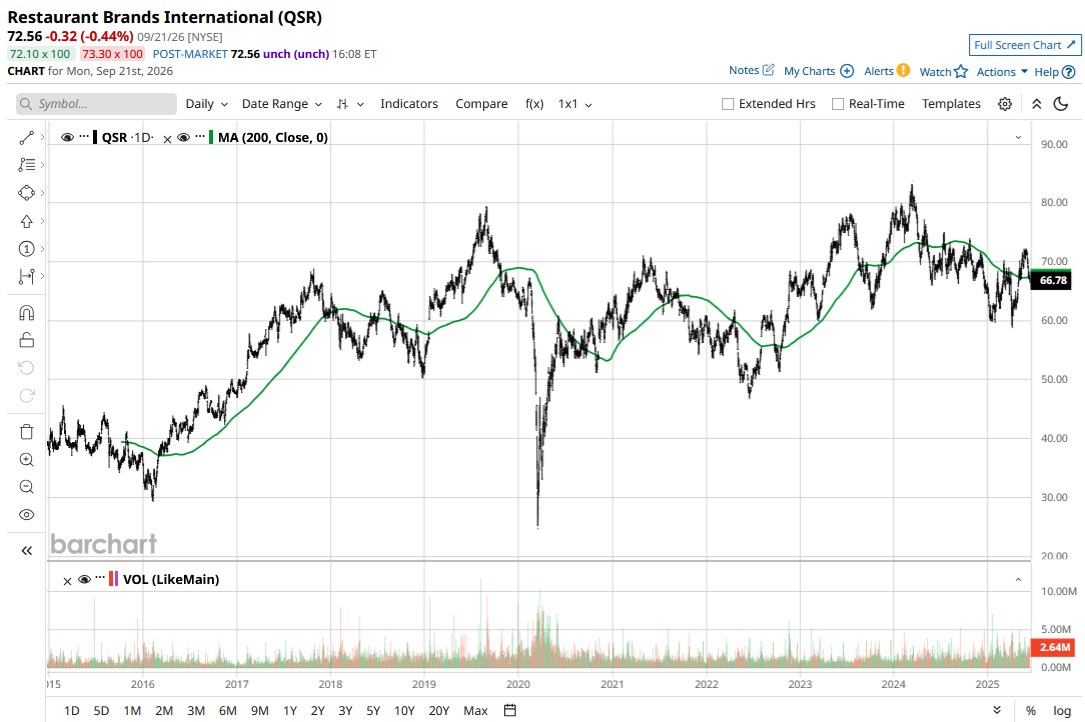
Restaurant Industry Woes
To begin with, let’s examine why restaurant stocks have looked weak over the last month. The macro environment for quick-service restaurants was unfavorable due to the rise in gas prices that are pinching lower- and middle-income families and negatively impacting their spending on other goods. There was an affordability crisis already, and restaurants had to offer promotional offers to drive sales. Despite these offers, same-store sales have been sluggish. Higher input costs further squeezed restaurant margins.
The headlines have started to look even more worrisome over the last few weeks. Meritage Hospitality Group (MHGU), which is among the biggest franchisees for Wendy’s in the U.S., operating 314 restaurants across 15 states, has filed for bankruptcy, blaming record-high beef prices and profitability issues. Moreover, Placer.ai's August 2026 Retail and Dining Index showed dining visits in the U.S. fell 2.4% year over year (YoY) in August, reversing the gains made in the preceding two months. That said, the number is not as scary as it seems and is at least in part due to calendar effects since the Labor Day weekend fell entirely in September this year, distorting the YoY comparison.
Burger King’s Same Store Sales Have Been Robust
Talking of QSR, it has a diversified portfolio of brands and owns Burger King, Tim Hortons, Popeyes Louisiana Kitchen, and Firehouse Subs. While fellow burger chains have been struggling to grow same-store sales, Burger King’s performance has been quite strong. In Q2 2026, the brand’s U.S. same-store sales rose 8.5% while the corresponding number for international business was 5.4%. However, QSR’s other chains pulled down the metric, and at the company level, its same-store sales rose 3.8% in the quarter. Tim Hortons, QSR’s biggest segment, reported a same-store sales growth of barely 0.1%. Popeyes Louisiana Kitchen was another underperforming brand in QSR’s portfolio, and its U.S. same-store sales fell 5.1% in Q2. The company expects the brand’s same-store sales to rise in the back half of the year, though.
QSR’s Valuations Have Come Off
QSR trades at a forward price-to-earnings (P/E) multiple of 18x, which is a discount to the average multiples over the last three years. However, given the restaurant industry’s woes discussed above, other players are also trading at a discount to their historical valuations.
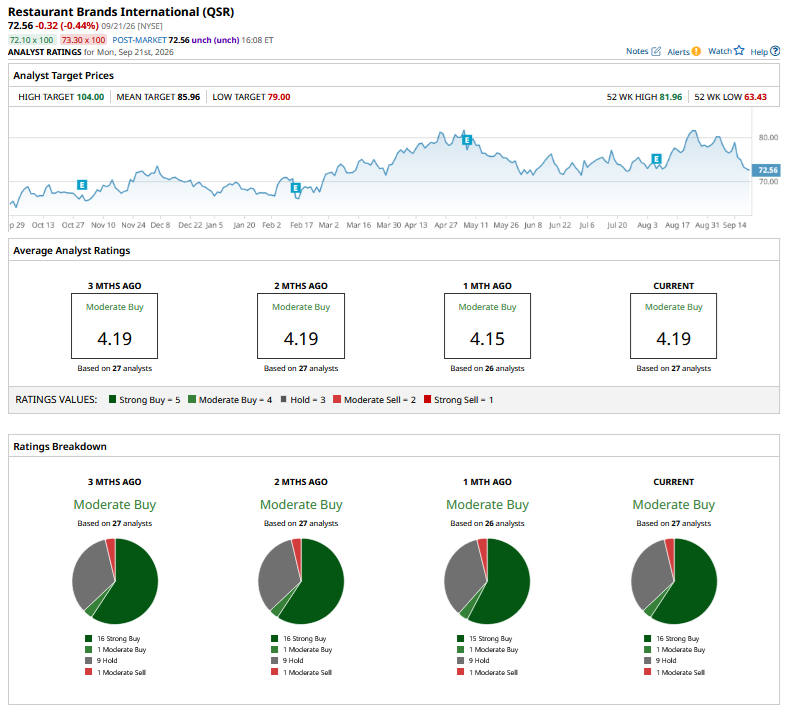
QSR has a consensus rating of “Moderate Buy” from the 27 analysts polled by Barchart. There hasn’t been any major analyst action apart from the cursory target price adjustments over the last couple of months, and the stock’s mean target price of $85.96 is around 18.5% higher than current levels.
Would QSR Stock Appeal to Dividend Investors?
QSR targets a dividend payout ratio between 40% and 60% over the long term, although there can be aberrations, as in 2025 when it overshot that target due to a fall in earnings. The dividend growth has been sluggish, though, and it raised its 2026 dividend by roughly 5% to $2.60. The annual increase was in line with the compound annual growth rate (CAGR) over the last five years.
All said, I believe QSR’s risk-reward has started to look somewhat favorable after the recent correction. The stock can particularly appeal to dividend investors looking for a defensive name that can deliver some capital appreciation with modest dividend increases over the medium to long-term.
On the date of publication, Mohit Oberoi did not have (either directly or indirectly) positions in any of the securities mentioned in this article. All information and data in this article is solely for informational purposes. For more information please view the Barchart Disclosure Policy here.