
A $950 Million Reason to Buy SpaceX Stock
SpaceX (SPCX) is no longer just the company trying to make rockets land themselves. Elon Musk’s space company has built a sprawling business around launch services, the Dragon spacecraft, and Starlink, its satellite internet network. Now that SpaceX has finally entered the public markets, investors have a much closer look at how all those pieces translate into a business.
The stock has been anything but boring since its June IPO. Shares have moved sharply as investors weigh SpaceX’s enormous growth ambitions against the risks that come with an expensive, capital-intensive space business. That volatility makes every major contract worth watching, particularly when the customer is NASA.
And now, NASA has handed SpaceX another reason to stay on the radar. The agency awarded the company $946 million for three additional crewed Dragon missions to the International Space Station, extending SpaceX’s existing Commercial Crew Transportation Capability contract through 2030. The award covers Crew-15, Crew-16, and Crew-17, taking SpaceX’s total missions under the contract to 17 and its cumulative contract value to $5.92 billion.
That is more than another big government check. It adds years of contracted work across launch, ground operations, in-orbit support, cargo transportation, and astronaut return and recovery. With Crew-13 targeted for early October, SpaceX already has more missions in the pipeline.
So, could this $946 million NASA award become an important piece of the SpaceX stock story? Let’s take a closer look.
About SpaceX Stock
Founded by Musk in 2002 and headquartered in Starbase, Texas, SpaceX operates across space transportation, satellite communications, and artificial intelligence. Its reusable Falcon rockets and Dragon spacecraft have reshaped the economics of spaceflight, while Starship is designed to take exploration deeper into space. Starlink has also grown into a global satellite-broadband business serving consumers, enterprises, and governments.
After expanding into AI through xAI, SpaceX now has Cursor under its wings, adding a leading AI coding platform to its growing technology ecosystem. Together, these businesses give SpaceX several long-term growth engines beyond rockets. Its market capitalization currently stands at around $2 trillion.
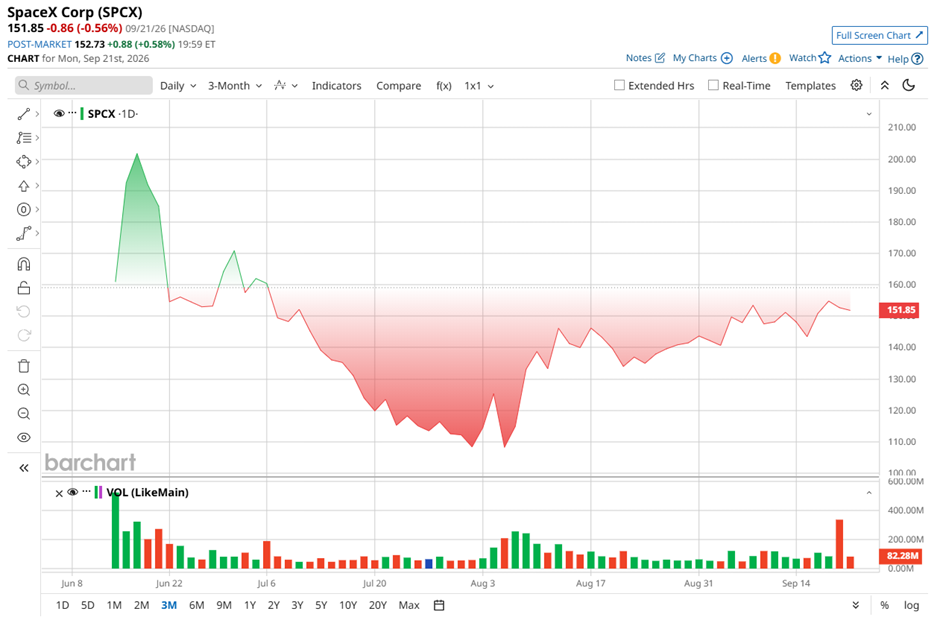
SpaceX may be moving at rocket speed as a business, but SPCX stock has taken a much less predictable path since its June 12 debut. The shares opened at $135 and quickly caught fire, climbing above $200 and reaching $225.64 by the second trading session. Then reality set in. Investors started questioning whether the lofty valuation left enough room for future growth, while upcoming insider lockup expirations added another layer of uncertainty.
That combination sent the stock into a steep slide. By August 3, SPCX had fallen to an all-time low of $104.83. But the mood shifted almost as quickly as it had deteriorated. Bargain hunters moved in, and shares bounced as investors looked ahead to SpaceX’s first public earnings report.
The results brought another reality check. SPCX dropped about 12% as investors digested the company’s enormous AI spending plans and the amount of capital required to fund its expansion. Interestingly, the first lockup expiration did not lead to the heavy selling many had anticipated. Instead, short covering and dip buying helped SPCX climb back above its $135 IPO price.
SPCX is still down 18% over the past three months, but has regained some momentum recently. Shares have gained 10.9% over the past month and 2.5% over the last five trading days. September has largely been a recovery period following the early-August trough.
The bigger story is that SpaceX’s strong operating growth has not translated into a straight-line stock rally. Insider share unlocks, heavy spending revealed in the earnings report, and a valuation built around years of expected growth have all kept investors on edge.
A Snapshot of SpaceX’s Q2 Numbers and Outlook
SpaceX’s Q2 earnings report offered investors a revealing look at where the company is headed. The business is spending enormous amounts of money, but it is also scaling at a pace that is hard to ignore. In Q2, SpaceX reported a loss of $0.09 per share, a 73.5% year-over-year (YOY) decline. Revenue, meanwhile, jumped 91.9% to $7.8 billion, beating Wall Street expectations, with growth led by AI cloud services and Starlink.
Starlink had its strongest quarter yet for customer additions. The satellite internet business added more than 1.7 million customers globally in Q2, up from 1.4 million in Q1, bringing its subscriber base to 12 million. Despite that rapid growth, average revenue per user remained steady at $66 a month. Starlink ended the quarter serving 167 markets and continued expansion into new ones.
Connectivity remained the largest revenue contributor at $4.3 billion, up 65.8% YOY. Consumer revenue increased 44.4% to $2.49 billion, while Enterprise & Government revenue more than doubled to $1.8 billion, helped by aviation wins and stronger U.S. government demand.
Then there was AI, which was arguably the biggest number in the quarter. AI revenue surged 247.5% YOY and 213.1% sequentially to $2.56 billion. New cloud agreements added $1.6 billion in infrastructure revenue, pushing total contracted cloud sales to $14.1 billion. SpaceX also expanded its nameplate computing capacity to 1.4 gigawatts, up from 1 GW in Q1 and just 400 megawatts a year earlier.
The Space segment also moved higher, generating $962 million in revenue, up 29% YOY and 55.4% sequentially. SpaceX completed 10 customer launches and 28 internal launches during the quarter, carrying 485 metric tons into orbit. First-half activity reached 78 launches and 1,041 metric tons. But Starship R&D remained expensive. The segment posted a $542 million operating loss and a $205 million adjusted EBITDA loss. Management said Flight 13 met all objectives after quarter-end, supporting plans to deploy operational V3 Starlink satellites on future Starship missions.
That brings us to the other side of the story — spending. Total costs and expenses climbed 57.8% to $8 billion, while R&D jumped 81.2% to $3.55 billion. Even so, the consolidated operating loss narrowed sharply to $143 million from $970 million a year earlier, while adjusted EBITDA reached a $3.5 billion loss.
Capital spending is where the numbers get especially eye-catching. Capex surged to $18.4 billion, including $15.8 billion tied to AI. Six-month operating cash flow improved to $3.5 billion, but investing activities consumed $34.5 billion. After receiving $85.7 billion from its IPO and raising $25 billion through a bond offering, SpaceX ended Q2 with $100 billion in cash and marketable securities, along with a $47.5 billion backlog.
And management is not exactly tapping the brakes. SpaceX expects capex to remain near Q2 levels for the next two quarters and is targeting more than 2 GW of compute capacity by year-end. Newly contracted cloud services worth $6.7 billion are expected to begin ramping in October over six months. The company believes cloud services, Cursor, and its other businesses could push annualized revenue above $100 billion by December. Meanwhile, V3 satellites are expected to deliver a major capacity boost, with next-generation Starlink Mobile targeted for launch by the end of 2027.
SpaceX has not offered official guidance for the third quarter, leaving Wall Street to fill in the blanks. Analysts currently expect the company to generate about $12.8 billion in revenue and roughly $0.09 in EPS for Q3. For fiscal 2026 as a whole, the consensus calls for a loss of about $0.15 per share.
Looking ahead, analysts see a much different picture emerging in fiscal 2027, when SpaceX is expected to swing to EPS of $1.63. That would mark a significant year-over-year improvement and could indicate that the company’s massive investments in AI, Starlink, and its broader infrastructure are finally starting to show up in the bottom line.
What’s Wall Street’s Take on SpaceX Now?
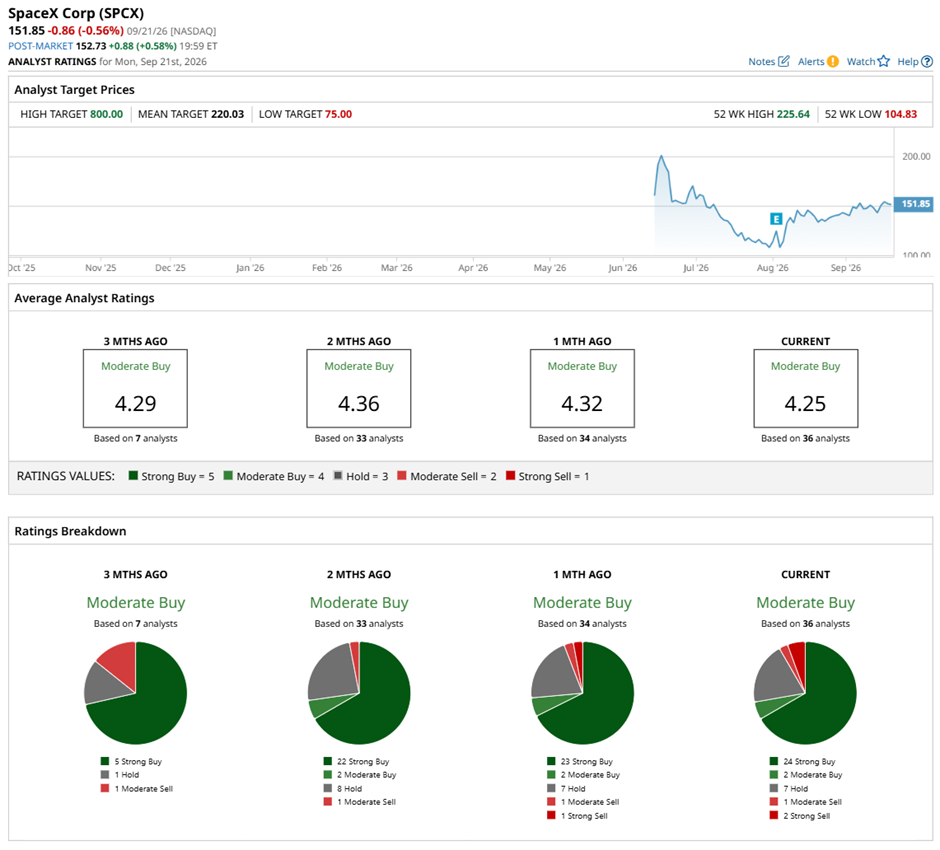
Overall, SPCX stock carries a “Moderate Buy” rating. Of the 36 analysts covering the stock, 24 recommend a “Strong Buy,” two have a “Moderate Buy,” seven are playing it safe with a “Hold,” one is advising a “Moderate Sell,” and the remaining two analysts are outright skeptical, suggesting a “Strong Sell.”
At current levels, the average price target of $220.03 suggests that SPCX stock has upside potential of 44.9%. Meanwhile, the Street’s highest price target of $800.00 implies SPCX could rally as much as 426.8%.
On the date of publication, Sristi Suman Jayaswal did not have (either directly or indirectly) positions in any of the securities mentioned in this article. All information and data in this article is solely for informational purposes. For more information please view the Barchart Disclosure Policy here.