China Merchants Securities: Liquor sales are under phased pressure to improve the health of the industry and wait for demand to be repaired
The Zhitong Finance App learned that China Merchants Securities released a research report saying that liquor sales are under phased pressure, strong varieties are showing resilience, and the health of the industry is constantly improving. There was still a year-on-year decline of about 10% during the Mid-Autumn Festival, but the decline was narrower than in 25 years (-20% sales in '25). Considering that the Mid-Autumn Festival and National Day are staggered this year, some preparations and demand may have moved backwards. The current performance is not fully representative of the two festivals as a whole. Rigid demand for high-end gifts, banquets, and self-drinking is still expected to show resilience. The industry has entered a phase of supply contraction, and the price market is gradually being repaired, but under the influence of weak demand and the uneven pace of corporate adjustments, the repair cycle may be lengthened. In the short term, we will focus on the release of demand on the National Day and changes in inventory after the holiday season, and on verifying the results of demand recovery and industry clearance next year during the Spring Festival.
The main views of China Merchants Securities are as follows:
1. Feedback from the Liquor Festival: Sales declined slightly year-on-year, prices were relatively stable, and the Matthew effect continued
Sales in the double quarter were weaker than expected, price performance was better than demand, and the Matthew effect continued. Summarizing feedback from the Mid-Autumn Festival National Day Liquor channel, overall sales declined by about 10% compared to the same period; Mid-Autumn Festival and National Day are staggered, and the release of some demand may be delayed. Looking at the price band and consumption scenario, high-end liquor is supported by gift demand and Maowu's price increases. The price of Wuliangye improved month-on-month; the mass price band relied on self-drinking, family drinks, and popular banquets, and regional leaders such as Welcome Car performed well; the second-high-end was affected by the contraction of government and business demand and the diversion of strong products such as Maotai 1935. Fenjiu's share of resilience continues to rise, and other brands are clearly under pressure. At the same time, online channels continue to divert offline demand, further weakening centralized stocking during traditional peak seasons.
The problems accumulated by the industry are gradually being solved. Health is improving, but demand recovery is still to be observed. The demand side is affected by a weak macroeconomic environment and policy factors. Government and commercial demand and corporate group purchases are weak; supply continues to shrink, and wine companies have successively repaired the value chain through price control, trade control, and inventory removal. Currently, channel inventories have clearly been removed. In particular, terminal inventories have fallen to historically low levels. Prices for mainstream products have stabilized, but the pace of corporate adjustments varies, and dealer inventories still need to be digested. Mid-Autumn Festival sales fell short of expectations. In the future, we need to focus on observing the release of National Day demand, post-holiday inventory, and the contraction of supply for wine companies. Next year's Spring Festival will be a more important point to verify the recovery in demand and the results of the industry's clearance.
1. Situation by price band and consumption scenario
High-end price performance is better than marketing, and Mao Wu supports the industry's price system. The price performance of high-end alcohol during the Mid-Autumn Festival was relatively positive this year. Overall sales improved, and Feitian and Maotai sold well in 1935. Maotai adjusted its price and launch pace several times during the year. Flying Sky's price was stable in the range of 1,750-1,800 yuan, and the volume of goods required increased. Wuliangye controls prices and controls trade to promote price market restoration. The general five batch price is 770-800 yuan, and the terminal transaction price is not less than 800 yuan. Actual consumption improved after the price drop. Prices at Guojiao have been strong, but sales have declined sharply.
The sub-high-end is under severe pressure, product performance continues to diverge, and Fenjiu's share increases. With the price-quality ratio, tight quotas, and high opening rates after the price reduction, Maotai 1935 continued to divert soy wine such as Qinghualang and Zhenjiu as well as the second-high-end share. The 20-batch price of Fenjiuqing remained at 355-365 yuan, with a year-on-year double-digit decline; Jiannanchun's wholesale price was 380-385 yuan, and sales remained flat and fell slightly; Lute 60, Shuijingfang, and Shide sales fell by more than 20%, and there was a large gap in commercial consumer demand at the 400-500 yuan price range.
Popular price bands are more resilient, family dinners are better than business consumption, and there are highlights in welcome car sales. Demand for family dinners, gifts, and banquet consumption scenarios recovered before the holiday season. Anhui banquet orders were further concentrated in hotels and restaurants, and popular consumption scenarios such as local restaurants showed outstanding performance. Cave 6 and Cave 9 performed relatively well; Bofen's turnover was fast, and Honghulang achieved contrarian growth. At the same time, online wine purchases and price comparisons further divert offline demand, and terminals generally maintain low inventory and make up as they are sold.
2. Regional sales situation
(1) Henan dealer
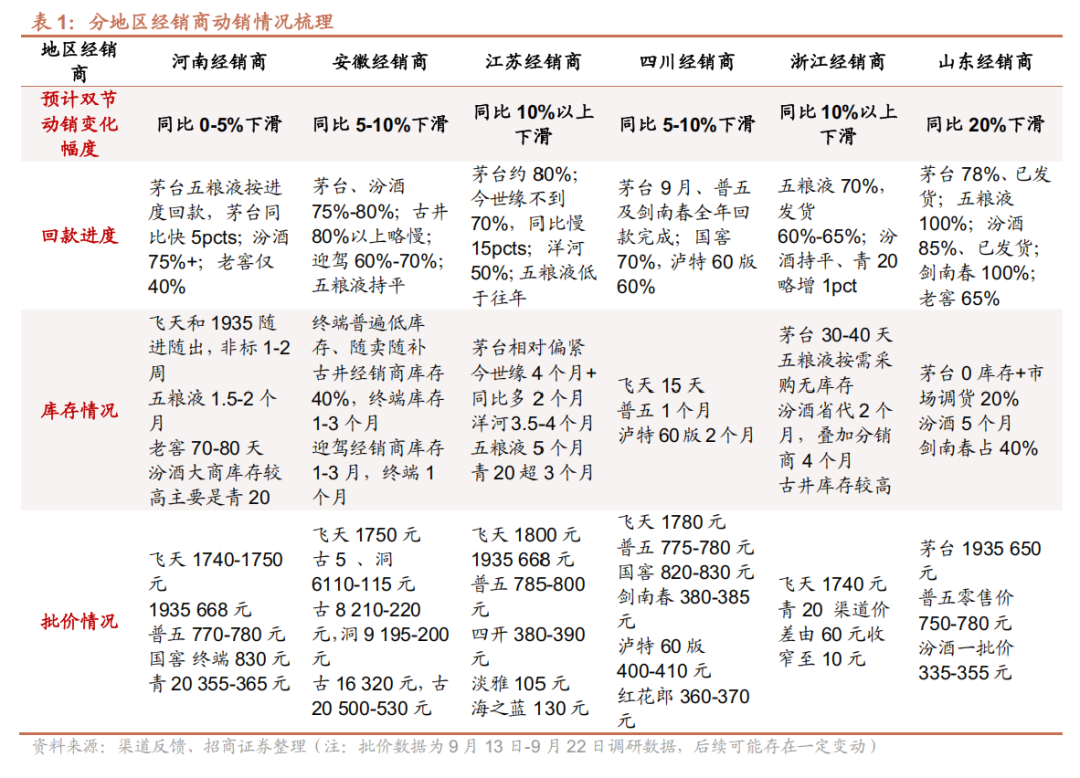
Sales are expected to fall slightly by 0% to 5% year-on-year during the two-year period (consumption scenarios all picked up slightly before the holiday season, the increase in family dinners was relatively obvious, and there was little change in business). Sales of Maotai, Wuliangye, and Fenjiu grew by double digits on average over 25 years, and Laojiao continued to be sluggish. The consumption scene (business, family, banquets) all picked up slightly before the holiday season. Among them, family dinners were relatively obvious, and business demand did not change much. It is expected that sales during the two seasons will decline by 0% to 5% year on year.
(2) Anhui Dealer
Sales in the double quarter are expected to decline by 5%-10% year on year. Channels continue to remove low inventory and prepare goods, terminals generally use pay-as-you-go, pay-back and pressurization tend to be cautious, and sales volume is down 5%-10% compared to the same period last year. The barriers to Huijijiao are still strong, Gujing's basic market is stable, Yingjia Cave 6 and Cave 9 continue to grow, local restaurants drive upward momentum, and Kouzijiao continues to be pressured by group purchases and the contraction of official consumption. Banquet orders are being concentrated on hotel restaurants at an accelerated pace, and online price comparisons are diverting offline demand and increasing share.
Double sales in the Anhui market are expected to decline by 5%-10% year on year, and terminals will continue to have low inventory and low stocking. Furui's basic market is relatively stable, with Yingjiadong 6 and Dong9 continuing to grow. Maotai and Fenjiu performed relatively steadily, and other brands were under pressure as a whole. (3) Jiangsu Dealer
Sales for the second quarter are expected to fall by more than 10% year on year. Demand for banquets and business is under pressure. Large-value purchases have declined, the share of small-value individuals and small businesses has increased, and online sales have increased but not enough to make up for the offline gap. Currently, the decline is more than 10% in terms of the two seasons. Maotai and Fenjiu are better than the industry, and Feitian's performance was better than in the same period last year, when sales were strong in 1935; Wuliangye's sales fell 16%, now Shiyuan fell 20%, and Yanghe and Luzhou Laojiao declined sharply. Yingjiao benefited from the base of workers in southern Jiangsu and Anhui, and the gross profit margin performance of the channel was better than that of other regional liquors.
(4) Sichuan Dealer
Sales in Shuangjie are expected to decline by 5%-8% year on year, and the pace of preparation of goods in Sichuan is clearly late. High-end wine is generally stable. Demand for Maotai is good. Wuliangye dealers have increased by 30 pcts since the beginning of the year, and Guojiao's shipments have recently accelerated; overall demand for sub-high-end wine is weak, and Honghualang bucked the trend and increased by about 10%. The year-on-year decline is expected to fall by 5%-8% this year under the high base of last year's two-quarter concentrated release.
(5) Zhejiang distributors
Sales for the second quarter are expected to fall by more than 10% year on year. Maotai and Fenjiu performed relatively well; the Wuliangye Double Festival and the whole of September saw a 50% decline, Shuijingfang/Jinshiyuan/Jiannanchun fell 10% to 15%, and Gujing fell 20% +. Demand for gifts and business declined, and the increase in the number of banquets was offset by a drop in alcohol consumption and bottle opening rates at single events. Overall sales fell by more than 10% compared to the same period last year, with Maotai falling by less than 10%.
(6) Shandong Dealer
It is expected that sales of Shuangjie will continue to decline year on year. With the exception of Maowu, the average year-on-year decline for other brands is about 20%. Sales of Maotai and Wuliangye increased by about 20% and 25% respectively; Fenjiu and Jiannanchun declined by 8% to 10% and 5% to 10%, respectively, and Guojiao declined by about 35%. Demand for banquets and personal consumption increased slightly, while business and high-end demand was still weak. The 500-800 yuan price band saw the biggest drop, and overall retail sales fell 20% year over year.
II. Core company tracking situation
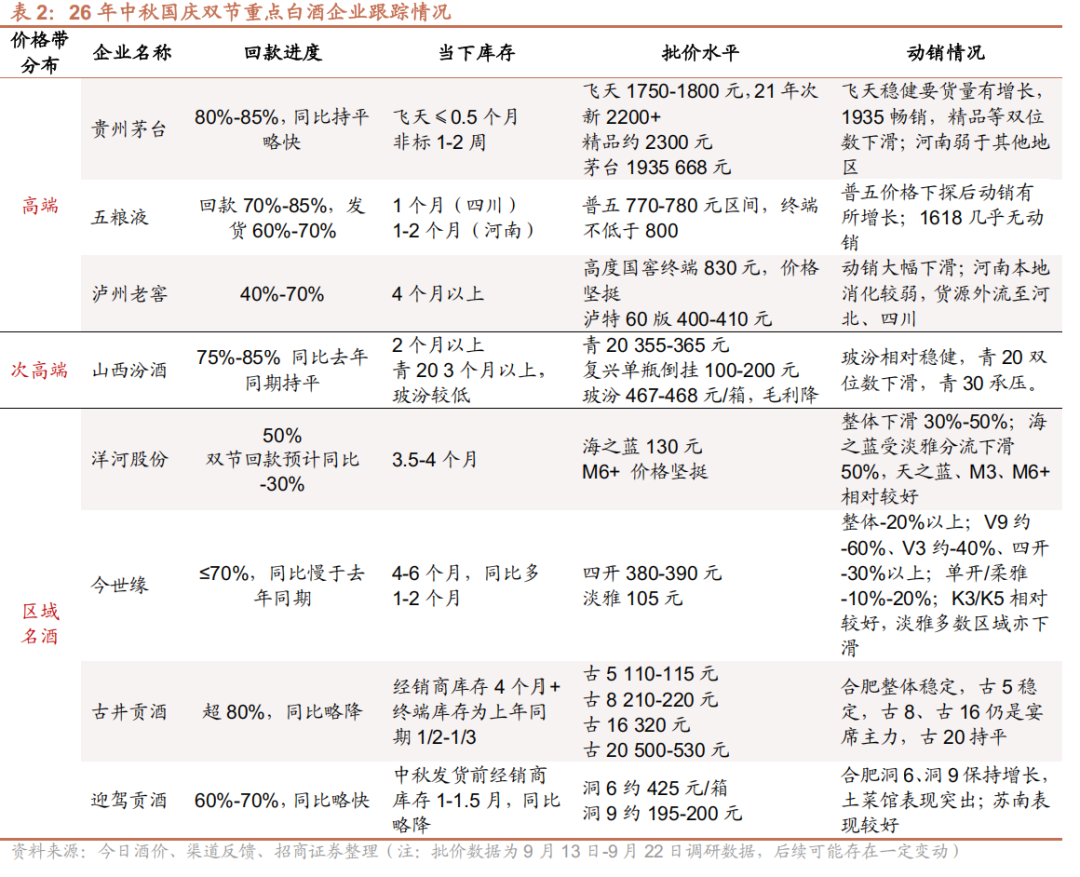
Kweichow Moutai (600519.SH): According to channel feedback, the annual target is about 80%-85% (slightly faster than 5pcts year on year); flying inventory is generally less than half a month, non-standard for about 1-2 weeks, and is at a low inventory level. After the price increase, Flying Sky remained in the range of 1,750-1,800 yuan, leading the industry in price performance; Maotai's 1935 batch price was 668 yuan, benefiting from a high opening rate and tight supply, and sales continued to grow. Flying Sky had a steady volume of goods. It sold well in 1935, but non-standard still declined by double digits. Sales and prices for core products are strong.
Wuliangye (000858.SZ): According to channel feedback, the annual target was about 70%-85% achieved (a slight increase over the previous year, slightly lower than in 24 years), and delivery was only 60% to 70%. Since September, manufacturers have controlled prices and strengthened trade management to promote price restoration. The five-batch price rose back to 770-780 yuan, and the terminal transaction price was over 800 yuan; sales improved after the price drop. Among them, Henan increased 20% year-on-year under a low base, and Jiangsu declined. The dealer's inventory is about 1-2 months, and the whole thing is controllable.
Luzhou Laojiao (000568.SZ): Channel feedback, repayment and sales have all declined compared to last year. Task completion in Henan region is 40% +, and repayment in Sichuan is 70%. The wholesale price of Gaojiao remained at 820-850 yuan. Although it remained strong, sales declined sharply. Local demand in Henan was weak, and some supplies went to Hebei and Sichuan; shipments from Sichuan accelerated after subsidizing inventory and adjusting repayment policies. The Henan region has been in stock for over 4 months, and the Lute 60 version in Sichuan has been in stock for 2 months.
Shanxi Fenjiu (600809.SH): Channel feedback, the annual task completion rate is 75%-85% (same as the same period last year). The rapid turnover of Bofen supports the basic market. The Qing20 sales volume declined by double digits over the same period, and the batch price was 355-365 yuan. The pressure on the Qing30 was even greater, and the revival version had a clear price inversion. The overall channel inventory is over 2 months, and the blue 20 is over 3 months.
Yanghe Co., Ltd. (002304.SZ): According to channel feedback, the target for the whole year was achieved by 50% (significantly lower than the same period last year), and sales are expected to fall by 30% to 50% during the two-season period. Among them, Haizhilan fell 50% due to elegant diversion, and Tianzhilan, M3 and M6+ performed relatively well. The wholesale price of Sea Blue is 130 yuan, and the M6+ price is strong; the channel inventory is about 3.5-4 months, and the short term is still mainly about inventory removal and channel repair.
Current World History (603369.SH): According to channel feedback, the annual target was achieved by less than 70% (year-on-year slow by about 15 pcts), and channel inventory was 4-6 months (up 1-2 months year-on-year). Overall sales declined by 20%. Among them, V9/V3/four-opening fell by 60%/40%/30% +. The decline in single and soft doors was relatively small. K3 and K5 performed well, and most regions of elegant also declined. The starting price is 380-390 yuan, elegant 105 yuan, and generally stable.
Gujing Gongjiu (000596.SZ): According to channel feedback, the target for the whole year has exceeded 80%, which is a slight slowdown over the previous year. Dealer inventory is still 4 months+, with a slight year-on-year increase; terminal inventory has dropped to 1/2-1/3 of the same period last year, less than 1 month in regular stores, and about 2-3 months in major stores. The overall market in Hefei is stable. Gu 5 and gifts have declined. Gu 8 and 16 are relatively good, and Gu 20 remain flat; prices for Gu 16 and 20 have declined, and whether to complete the tasks in the future depends on inventory digestion.
Yingjiagongjiu (603198.SH): According to channel and company feedback, dealers achieved 60%-70% of the annual target, which is better than the same period last year; Hefei dealers' inventory before Mid-Autumn Festival delivery was only 1-1.5 months, slightly lower than the previous year. Cave 6 Cave 9 continued to grow, with batch prices of 425 yuan/box and 195-200 yuan/bottle respectively; the volume of Cave 6 was close to Gu 5. With the same channel profit, the continuous increase in sell-by rate grabbed share. Popular consumption scenarios such as local restaurants showed outstanding performance, and performed well in local wine production.