
Dear General Mills Stock Fans, Mark Your Calendars for September 23
Packaged food company General Mills (GIS) will report its first-quarter fiscal 2027 earnings on Sept. 23, before the market opens. Leading up to the results, investors haven't maintained an overly optimistic view of the stock. Food price inflation has affected the company, as consumers have become more cautious because of higher prices. However, retail trends might be turning.
Advance estimates of U.S. retail and food services sales for August (adjusted for seasonal variation and holiday and trading-day differences, but not for price changes) were up 1.2% (±0.4%) from the previous month and up 6% (±0.5%) year-over-year (YoY). This indicates a stark improvement from the previous month’s 0.5% month-over-month drop.
Against this backdrop, as the company aims for a turnaround, let's take a closer look at General Mills.
About General Mills Stock
General Mills is a global food company headquartered in Minneapolis, Minnesota. It manufactures and markets a broad portfolio of branded consumer products, including ready-to-eat cereals, snacks, convenient meals, yogurt, baking mixes, refrigerated and frozen dough, ice cream, and pet food. Its well-known brands include Cheerios, Nature Valley, Betty Crocker, Pillsbury, Old El Paso, Häagen-Dazs, and Blue Buffalo.
The company sells products through grocery retailers, mass merchandisers, convenience stores, e-commerce platforms, food service operators, and pet food channels. General Mills operates across North America, international markets, pet food, and food service, with products sold in several countries. The company has a market capitalization of $18.93 billion.
Over the past 52 weeks, General Mills’ stock has dropped 29.7%, and it is down 23.9% year-to-date (YTD). It reached a 52-week low of $31.75 on June 4 but is up 11.5% from that level. Consumers are trading down, as the market has become more cautious after years of food price inflation, which has affected General Mills’ sales volume. The company is also investing to strengthen its brands, while weaker volumes, trade spending, and an unfavorable product mix are limiting profitability and pressuring the stock.
On a forward basis, GIS stock trades at a price-to-earnings (non-GAAP) ratio of 11.53x, below the industry average of 14.77x.
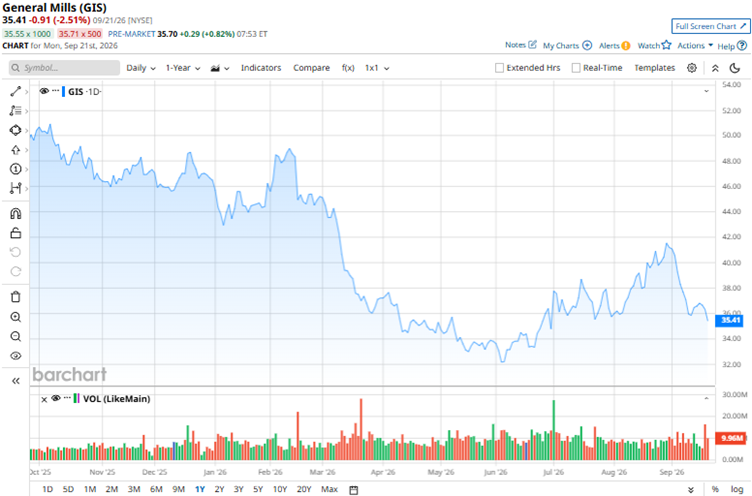
General Mills Reported Fiscal 2026 Results Amid Weak Demand
For fiscal 2026 (ended on May 31), the company faced a subdued backdrop. Markets remained challenging. Weaker consumer sentiment and volatility weighed on category volume growth and pushed more consumer purchases to promotion. General Mills reported a drop in organic volume and its organic price/mix.
Net sales declined 5% YoY (or 2% organically) to $18.42 billion. The company’s topline has also been impacted by divestitures and acquisitions as it moves to sharpen its business. This has also pressured the bottom line. The company’s adjusted operating profit fell 16% from the prior-year period to $2.81 billion, while adjusted EPS also declined 16% YoY to $3.55.
By contrast, General Mills is seeing signs of a market resurgence, including improving retail sales trends and a positive customer reaction to the company’s innovation efforts. This led General Mills to reaffirm its fiscal 2027 financial targets.
The company expects organic net sales to range from down 1.5% to up 0.5%. Adjusted operating profit is expected to decline by 8% to 13% in constant-currency terms. The forecast includes a 9-percentage-point headwind from the absence of the 53rd week in fiscal 2026, normalized corporate incentive expenses, and the impact of divestitures completed during fiscal 2026. Moreover, it is eyeing $3 billion in cumulative cost savings over the four years through fiscal 2030, of which $750 million is expected in fiscal 2027.
Wall Street analysts have a tepid view of General Mills’ bottom-line trajectory. For the upcoming quarterly earnings release (first quarter of fiscal 2027), the company’s EPS is expected to decrease by 16.3% YoY to $0.72. For fiscal 2027, analysts project EPS to fall by 13.8% to $3.06, followed by a 4.9% improvement to $3.21 in fiscal 2028.
Here’s What Analysts Think About GIS Stock
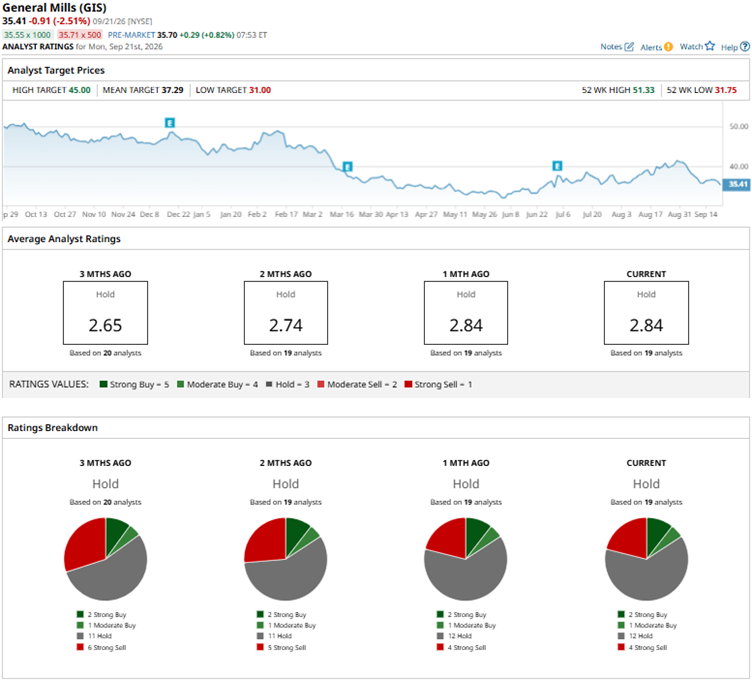
This month, analysts at RBC Capital maintained a bullish “Outperform” rating on GIS stock, alongside a Street-high $45 price target. Meanwhile, Evercore ISI analysts lowered the price target from $39 to $38 while maintaining an “In Line” rating.
BofA Securities analysts raised the price target on General Mills from $39 to $43 while keeping a “Neutral” rating after the firm held a virtual fireside chat with General Mills CFO Kofi Bruce and Vice President of Investor Relations Jeff Siemon.
Wall Street analysts are taking a cautious stance on General Mills’ stock now, with a consensus “Hold” rating overall. Of the 19 analysts rating GIS, two gave a “Strong Buy” rating, one gave a “Moderate Buy” rating, 12 are playing it safe with a “Hold” rating, and four gave a “Strong Sell” rating. The consensus price target of $37.29 represents a 5.3% upside from current levels. Moreover, the Street-high price target of $45 indicates a 27.1% upside from current levels.
On the date of publication, Anushka Dutta did not have (either directly or indirectly) positions in any of the securities mentioned in this article. All information and data in this article is solely for informational purposes. For more information please view the Barchart Disclosure Policy here.