
Jensen Huang’s Latest Nvidia Prediction Sounds Bold. Here’s Why It Might Not Be Bold Enough.
Nvidia (NVDA) CEO Jensen Huang is never shy about his business. He’s made plenty of headlines over the years, including when he claimed that global artificial intelligence infrastructure spending would reach up to $4 trillion by 2030 or when he claimed that agentic AI is a bigger advancement in computing than PCs, mobile phones, or the internet.
Now Huang’s made another claim—that Nvidia, which is already the world’s leading chipmaker and biggest company in the world, will double the number of chips it sells next year.
“I expect Nvidia to sell twice as many chips as this next year as we do this year,” Huang told reporters in Scotland last week.
On the surface, that's a staggering claim, considering Nvidia’s already incredible volume. Here's what the numbers look like if Huang’s prediction comes true.
Nvidia by the Numbers
First, let’s look at exactly how Nvidia has positioned itself in the semiconductor space. The company makes the most popular graphics processing units (GPUs) that are bundled by the thousands in data centers to handle advanced computing tasks, including generative and agentic AI.
Nvidia’s Hopper and Blackwell GPUs sell as quickly as Nvidia can make them. The company is now selling its next-generation chips on the Vera Rubin architecture, which uses NVLink chip-to-chip interconnects so its GPUs and central processing units can share memory and improve efficiency.
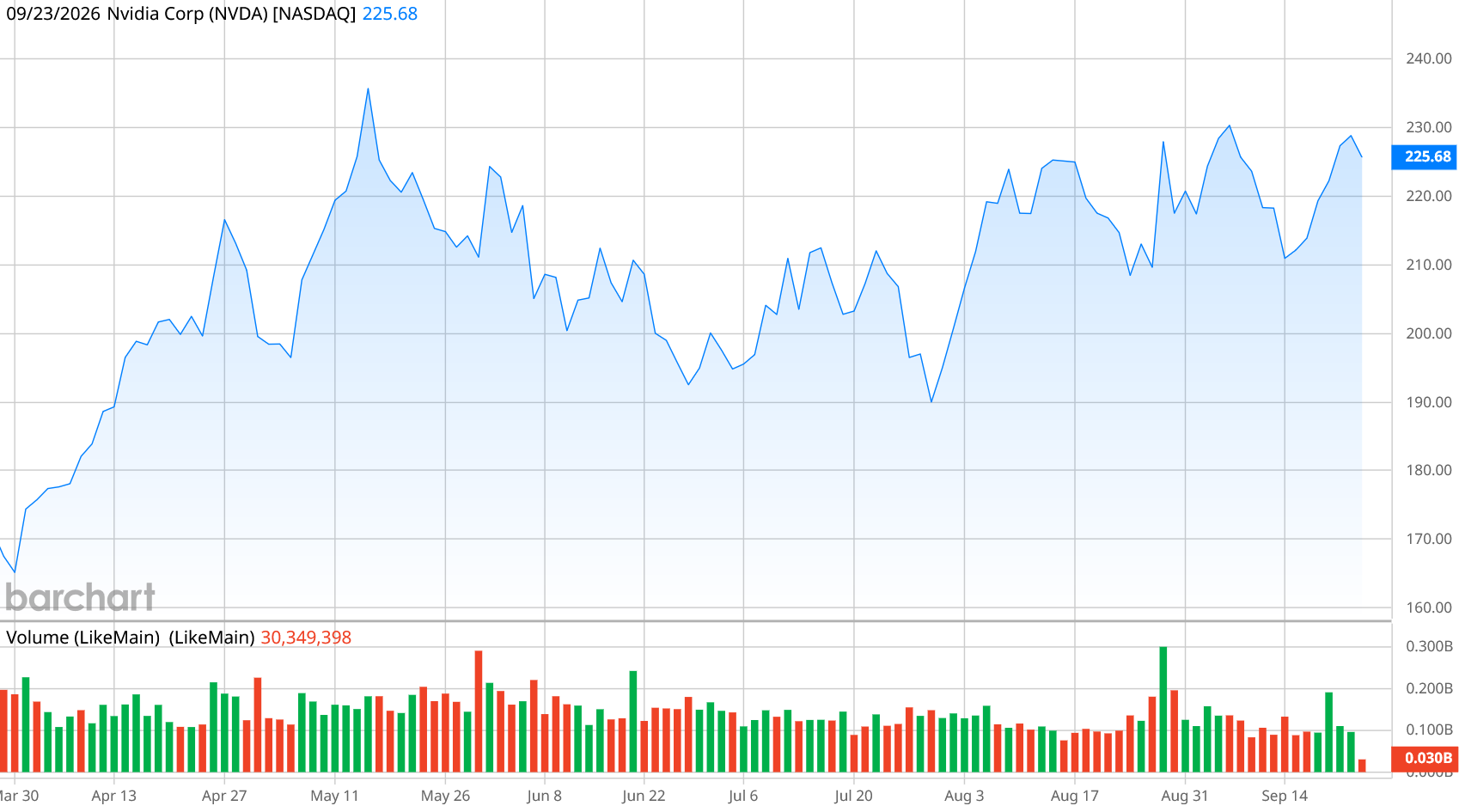
That has helped Nvidia soar in value to become the most valuable company in the world, with a market cap of more than $5 trillion. NVDA stock is up more than 1,000% in the past five years. Growth this year has been somewhat slower, at 21%, but that’s still better than the S&P 500 Index ($SPX).
| Nvidia Growth by Year | Starting Stock Price | Ending Stock Price | Percentage Growth |
| 2022 | $29.82 | $14.61 | -50.3% |
| 2023 | $14.85 | $49.52 | 238.9% |
| 2024 | $49.24 | $137.49 | 171.2% |
| 2025 | $136.00 | $187.54 | 38.9% |
| 2026 (through Sept. 23) | $228.03 | N/A | 21.2% |
Stock prices adjusted to account for a 10-for-1 stock split on June 10, 2024.
In the company’s fiscal year 2027 second quarter (ending July 26, 2026), Nvidia had revenue of $96.2 billion, up 106% from a year ago. And its data center revenue was $89 billion, which is up 117% from a year ago. That means Nvidia’s data center segment generated more than 92.5% of the company’s total revenue in the most recent quarter.
If Nvidia can fulfill Huang’s prediction and double the number of chips it sells in the next year, we can do a rough extrapolation of what that will mean for Nvidia’s revenue and profits. Here’s how much Nvidia made over the last four quarters, which equates to 12 months of business.
| Metric | Q3 FY 2026 | Q4 FY 2026 | Q1 FY 2027 | Q2 FY 2027 |
| Overall Revenue | $57.0 billion | $68.13 billion | $81.61 billion | $96.22 billion |
| Data Center Revenue | $51.2 billion | $62.3 billion | $75.2 billion | $89 billion |
| Gross Margin | 73.4% | 75% | 74.9% | 75% |
| Net Income | $31.91 billion | $42.96 billion | $58.32 billion | $59.69 billion |
For the sake of the argument, we’ll say that Nvidia’s prices will remain roughly the same (although the company has disclosed that prices will increase next year to account for higher memory and DRAM costs). That way, we’ll have a conservative estimate that will roughly assume Nvidia’s current 75% gross margin.
Nvidia generated $302.96 billion in revenue in the past 12 months, with $277.2 billion of that—about 91.5%—coming from data center sales. If Nvidia doubles its chip sales in the next 12 months, it can conservatively expect $606 billion in revenue and nearly $400 billion in net income.
To be fair, my example extrapolates Nvidia revenue, not sales, so it’s not a perfect comparison to the number of chips to be sold. Nvidia will sell more Vera Rubin architecture hardware in the next year, which will come at a different price point, and its revenue and profit margins could be even greater.
But there’s another reason why I think this is an extremely conservative estimate.
$1 Trillion in Revenue? It’s Not Out of the Question.
Remember, Huang isn’t afraid to be bold. And perhaps his boldest prediction was that Nvidia will see at least $1 trillion in cumulative AI chip and system revenue through the end of the 2027 calendar year. That is double Huang’s previous prediction and was a result of the growth of agentic AI—artificial intelligence that can plan, use tools, and take actions on its own without human assistance.
The end of the 2027 calendar year corresponds with Nvidia’s fiscal fourth quarter of 2028. And with Nvidia continuing to show nearly triple-digit growth in revenue, despite its incredible size, Huang’s $1 trillion revenue prediction isn’t far-fetched.
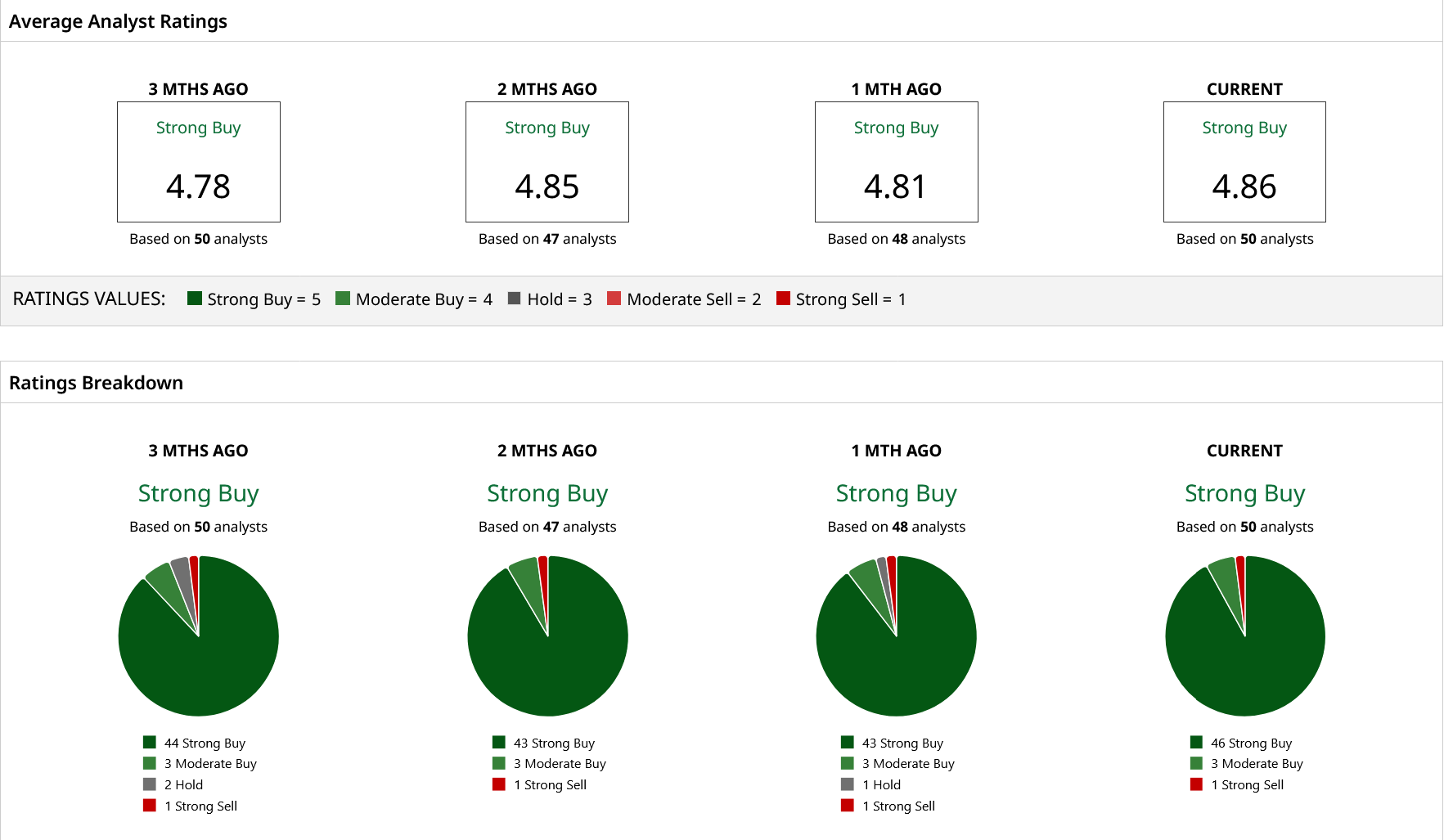
Analysts surveyed by Barchart have a consensus “Strong Buy” rating on NVDA stock, with a mean price target of nearly $326 that represents potential upside of 44%.
On the date of publication, Patrick Sanders had a position in: NVDA . All information and data in this article is solely for informational purposes. For more information please view the Barchart Disclosure Policy here.