
SpaceX Is Winding Down the Falcon 9. What That Means for SPCX Stock.
Elon Musk’s Space Exploration Technologies (SPCX) is preparing to phase out Falcon 9, the rocket that turned the company into a powerhouse in commercial spaceflight, as it shifts its focus to the much larger Starship. The change is significant because the Falcon 9 is still in considerable demand. It completed a record 165 launches in 2025, making it one of the most heavily used rockets in the world. The problem is that SpaceX may be moving away from Falcon 9 before enough replacement launch capacity is available.
The company has reportedly stopped accepting new Falcon 9 rideshare customers, while several spacecraft companies have been told that launches are booked through 2028 or even 2029. With satellite deployments, national security missions, and commercial space projects all growing, the industry could face a shortage of available launches. SpaceX is also increasingly using Falcon 9 for its Starlink satellites, leaving fewer launches for outside customers. Reuters estimates that Starlink accounted for about 79% of Falcon 9's missions in 2026, up sharply from 54% in 2020.
That means SpaceX is effectively competing with its own customers for limited rocket capacity. The long-term answer is Starship, which SpaceX hopes will eventually be fully reusable and capable of carrying much larger payloads. But until Starship can operate reliably at scale, the transition from Falcon 9 could create a temporary gap in the launch market, potentially giving rival rocket companies an opportunity to win customers that SpaceX can no longer accommodate. So, given this new information, how should investors approach SPCX stock now?
About SpaceX Stock
SpaceX has come a long way since its 2002 launch, evolving from a rocket startup into the world’s most active launch provider and the largest space company in the U.S. Falcon 9 has been a major reason for that success, using reusability to lower launch costs and open up space to a broad customer base. NASA, the U.S. Department of Defense, international space agencies, and commercial satellite operators all rely on SpaceX, giving the company a diverse position in the global space market. But with Falcon 9 now expected to wind down, SpaceX is preparing to hand the baton to its next generation of businesses.
And SpaceX is no longer just about rockets. Starlink has become a crucial part of the story, with estimates suggesting the satellite-internet business generates 50% to 80% of SpaceX’s total revenue. That growing cash engine helps fund the company’s wider technology and space ambitions. Then came the February merger with xAI, bringing SpaceX’s space and defense operations together with a rapidly expanding artificial intelligence (AI) company that is pouring money into data center infrastructure.
The combination puts rockets, satellites, AI, and computing under one increasingly broad umbrella. At the heart of Musk’s longer-term vision, however, is Starship. The fully reusable system, made up of the Super Heavy booster and Starship upper stage, is being built to carry both crew and cargo and eventually support missions to the Moon, Mars, and beyond. Musk ultimately wants Starship to help make human transportation to Mars possible and establish a sustained presence beyond Earth. The ambition is enormous, but so are the hurdles, with the program still facing significant technical and operational challenges.
For investors, meanwhile, SPCX has already delivered a roller-coaster ride. SpaceX priced its IPO at $135 a share, opened at $150 on June 12, 2026, and surged to an all-time intraday high of $225.64 on June 16. The rally later lost steam as investors digested soaring AI and data center spending, the company’s unprofitability, and setbacks such as a scrubbed Starship test along with looming insider lockup expirations that could bring more shares to the market.
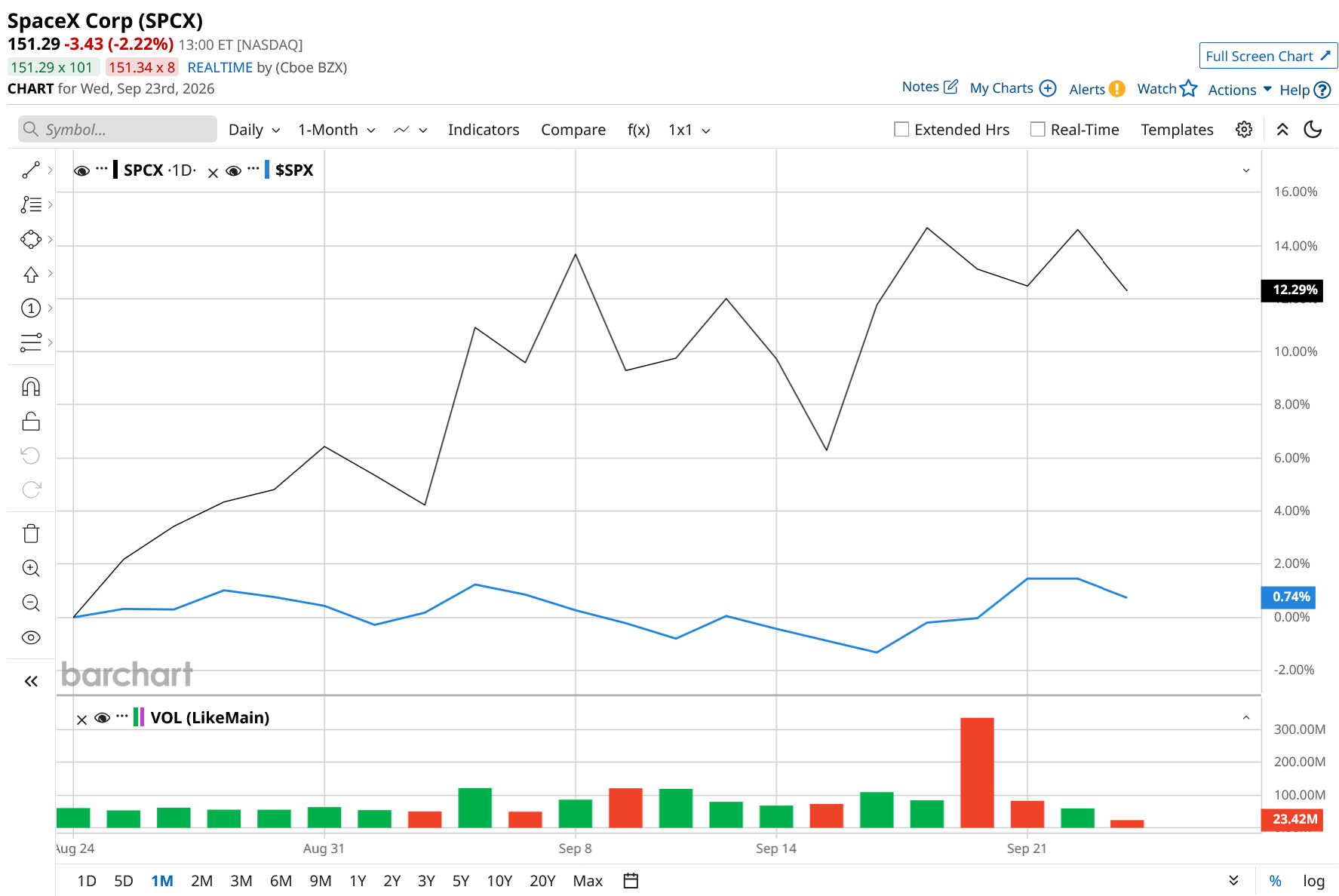
Even after the pullback, SpaceX remains valued at a hefty market capitalization of roughly $2.04 trillion and now ranks among the world's most valuable companies. Moreover, renewed bullish sentiment from high-profile investors such as Cathie Wood has helped the stock regain some momentum lately, with shares up roughly 11% over the past month but flat over the past five days, compared with gains of approximately 1% and 2%, respectively, for the broader S&P 500 Index ($SPX).
Inside SpaceX’s Q2 Earnings Report
SpaceX’s first earnings report as a public company gave investors plenty to cheer about and one major reason to worry. On Aug. 4, the company reported fiscal 2026 second-quarter revenue of $7.81 billion, up a staggering 92% from a year earlier and comfortably ahead of Wall Street’s $6.82 billion estimate. Losses also narrowed sharply, with SpaceX reporting a $541 million net loss, compared with more than $1 billion in the prior-year quarter.
Its loss of $0.09 per share was also much better than the $0.21-per-share loss analysts had expected. Much of that growth is coming from Starlink, which continues to emerge as SpaceX’s financial powerhouse. Revenue from the connectivity business climbed 66% to $4.29 billion, as its subscriber base doubled to 12 million customers across 167 markets.
The enterprise and government business was even faster-growing, with revenue jumping 108% to $1.8 billion, helped by rising demand for the secure Starshield network. SpaceX’s core launch operation, meanwhile, generated $962 million in revenue, a 29% increase from a year earlier, although the company continues to treat the space business largely as a funded research-and-development operation. Then there is AI, the part of the business that is growing fastest and spending the most money.
AI revenue surged 247% to $2.56 billion, but the division also recorded a $1.26 billion operating loss. The space business lost another $542 million at the operating level, while connectivity stood out as the profitable engine, producing $1.66 billion in operating income. More importantly, SpaceX’s total capital expenditure exploded to $18.37 billion, compared with just $2.83 billion a year earlier. About 86% of that spending went toward AI, highlighting just how aggressively the company is building out its next growth engine.
That enormous spending bill ultimately mattered more to investors than the earnings beat. SpaceX shares plunged 13.6% on Aug. 5 as concerns grew over the scale of investment required to support its AI ambitions. Still, the company has plenty of financial firepower. It ended the quarter with $100 billion in cash and marketable securities, boosted by its IPO and a subsequent bond sale. SpaceX also has a $47.5 billion backlog, offering substantial visibility into future business.
How Do Analysts View SPCX Stock?
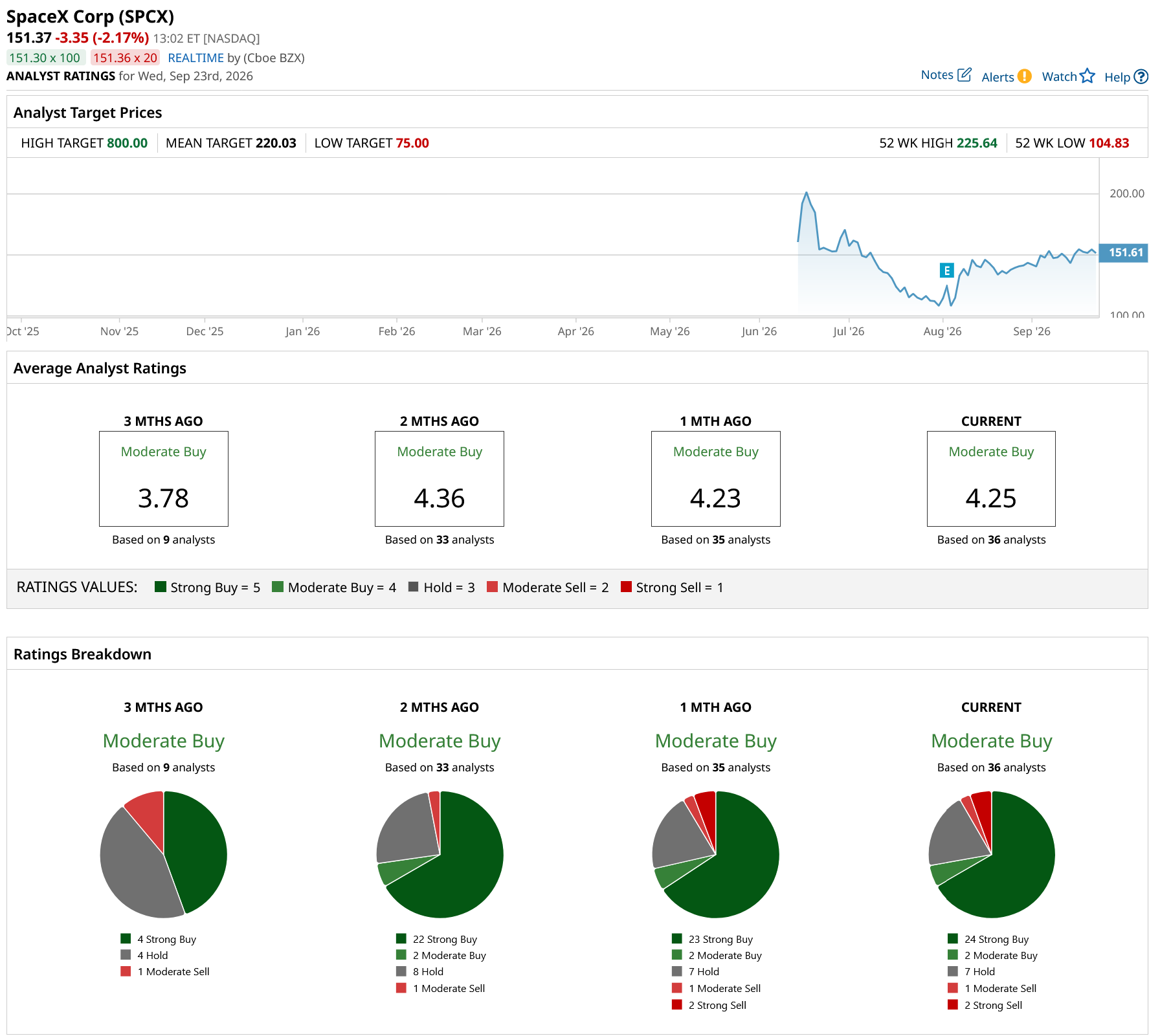
Overall, Wall Street’s view of SPCX stock remains broadly positive, with it carrying a consensus “Moderate Buy” rating. Among 36 analysts, 24 rate it “Strong Buy,” two say “Moderate Buy,” seven recommend “Hold,” one has a “Moderate Sell” rating, and two have issued “Strong Sell” calls. But the real story is the massive divide in analysts’ expectations.
The average price target stands at $220.03, pointing to around 46% potential upside. At the most bullish end, one analyst has set a staggering $800 target, implying gains of as much as 430% from current levels. However, on the low end, there's a $75 target, which would imply an over 100% downside. That unusually wide range shows just how much uncertainty and potential Wall Street sees in SpaceX’s next phase of growth.
On the date of publication, Anushka Mukherji did not have (either directly or indirectly) positions in any of the securities mentioned in this article. All information and data in this article is solely for informational purposes. For more information please view the Barchart Disclosure Policy here.