
CoreWeave (CRWV) Could Be 24% Overvalued Following Its Harell Data Deal
CoreWeave (CRWV) has entered into a multi-year agreement with Harell Data, which will run training, fine-tuning, and inference on CoreWeave Cloud using proprietary biotech datasets under a revenue-sharing marketplace model.
For CoreWeave, the Harell Data deal lands as the share price trades at US$86.76, with a 1-day share price return of 1.56% and a 7-day share price return of 7.22%. However, the 90-day share price return is down 14% and the 1-year total shareholder return has declined 33.72%. This points to short-term momentum building again while longer term holders are still sitting on losses as the market weighs recent capital raises, new product launches, and fresh analyst coverage against the company’s debt funded expansion.
Compare CoreWeave’s AI cloud story with other GPU-heavy plays by scanning our hand picked 85 AI infrastructure stocks that are also tied directly to the build out of compute capacity.
CoreWeave now trades well below the US$141.39 average analyst target after a sharp pullback. The real tension is simple: Are estimates too hot, or is the current price too cold?
Most Popular Narrative: 24% Overvalued
CoreWeave last closed at $86.76 while the most followed valuation storyline pins fair value nearer to $70. That gap frames the Harell Data deal as less about hype and more about whether a debt heavy compute model can justify the current sticker price.
There is a concerning "Capex Treadmill" here. Every dollar of operational cash flow must be recycled immediately into the next generation of NVDA GPUs and optical networking to remain competitive. For long-term holders, this creates a scenario where GAAP profits may exist, but distributable cash flow remains elusive as the company is forced to constantly outrun hardware aging.
See why 48 investors see CoreWeave as 24% overvalued.
According to WIn2026, this compute as a service setup leans heavily on external borrowing, with CoreWeave already reporting that 100% of its liabilities come from higher risk funding sources rather than customer deposits. That structure ties investor outcomes closely to hardware cycles and financing conditions, which can matter more than headline revenue growth when a business is still unprofitable and forecast to remain so over the next three years.
The same narrative flags the gap between strong revenue expectations and weak earnings visibility. Forecast revenue growth of 40.4% per year sits well above both the broader US market at 13.7% and the 20% high growth bar, yet Return on Equity is expected to remain low at 7.2% in three years and management is not projected to cross into sustained profitability over that window.
Valuation views are not uniform. The narrative tags CoreWeave as overvalued at around $70 fair value, while separate fair ratio work suggests the P/S multiple is well below a modelled "fair" level, implying the market price could be anchoring more on balance sheet risk and earnings uncertainty than on top line forecasts.
Result: Fair Value of $70 (OVERVALUED)
Still, CoreWeave could see this narrative challenged if Harell Data style partnerships deepen compute utilization, or if funding costs ease materially and relieve pressure on leverage.
Find out about the key risks to this CoreWeave narrative.
Another View on CoreWeave’s Valuation
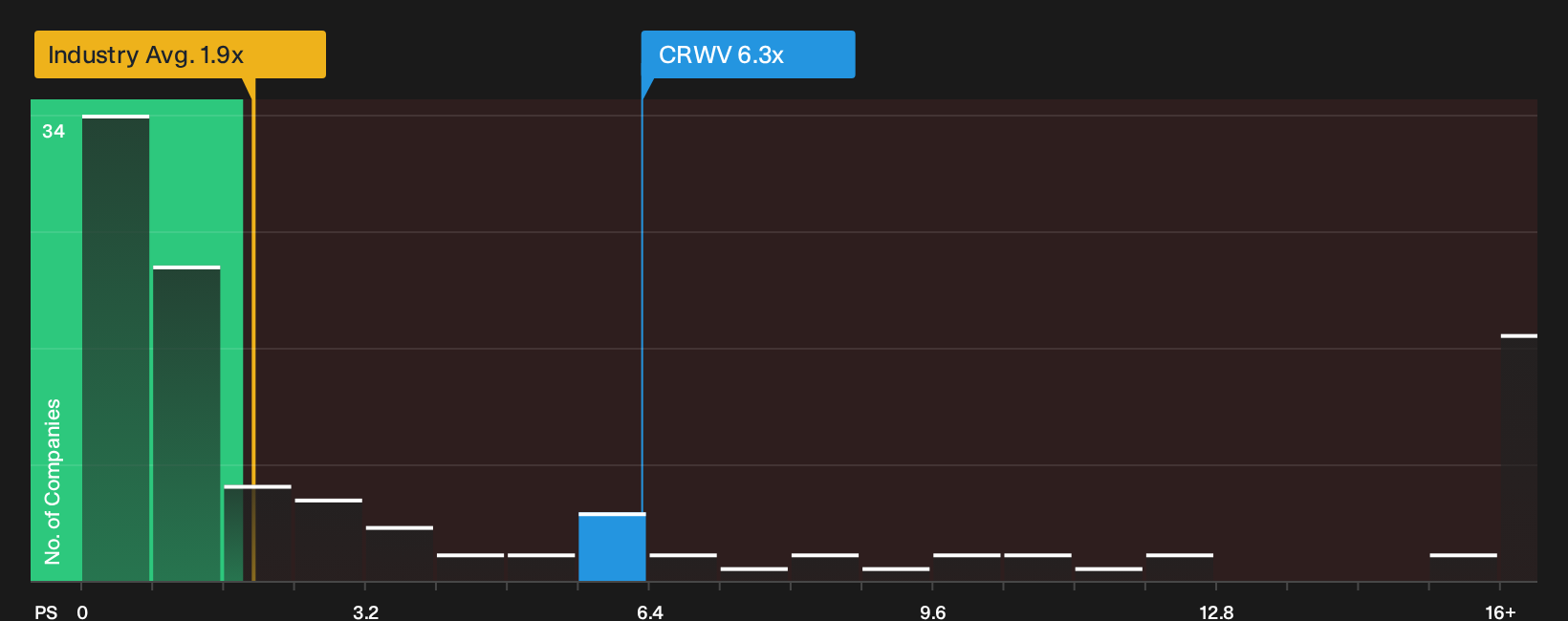
A second lens on CoreWeave uses its P/S ratio. The stock trades at 6.3x sales, which is far above the US IT industry at 1.9x but well below a fair ratio of 22.8x suggested by regression work. That gap can signal either valuation risk or a potential mispricing. Which side do you think it represents for a heavily geared AI cloud operator?
To see how this price stacks up against the underlying numbers, See what the numbers say about this price — find out in our valuation breakdown.
Next Steps
If the split mood around CoreWeave leaves you undecided, consider acting quickly and testing the numbers yourself, starting with the 1 key reward and 3 important warning signs.
Looking for more CoreWeave investment ideas?
Do not stop with CoreWeave. The best opportunities often sit just outside the obvious picks, and a few minutes with a focused screener can change your watchlist.
- Target sturdier balance sheets and stronger fundamentals by scanning our list of solid balance sheet and fundamentals (23 results) to filter for financial resilience before momentum.
- Hunt for mispriced quality by reviewing the 16 high quality undiscovered gems and spot companies the crowd has not fully priced in yet.
- Prioritise capital preservation by working through the 30 resilient stocks with low risk scores and anchor your portfolio around sturdier risk profiles.
This article by Simply Wall St is general in nature. We provide commentary based on historical data and analyst forecasts only using an unbiased methodology and our articles are not intended to be financial advice. It does not constitute a recommendation to buy or sell any stock, and does not take account of your objectives, or your financial situation. We aim to bring you long-term focused analysis driven by fundamental data. Note that our analysis may not factor in the latest price-sensitive company announcements or qualitative material. Simply Wall St has no position in any stocks mentioned.
Have feedback on this article? Concerned about the content? Get in touch with us directly. Alternatively, email editorial-team@simplywallst.com