
McDonald’s Increased Its Dividend by Nearly 4%. How to Play MCD Stock Here.
In a week already packed with dividend announcements from blue-chip names like Microsoft (MSFT), JPMorgan Chase (JPM), and Broadcom (AVGO), one raise stood out for its quiet significance. McDonald’s (MCD) recently reinforced its reputation as one of the stock market’s most dependable dividend payers.
On Sept. 17, McDonald’s Board of Directors declared a dividend increase of nearly 4% from the prior quarterly dividend of $1.86. This increase marks the company’s 50th consecutive year of dividend growth, putting McDonald’s among the rare Dividend Kings, a group of fewer than 60 U.S. public companies that have raised their payouts for at least half a century.
Still, a dividend increase alone does not make the stock an automatic buy. McDonald’s must show that its value initiatives, digital capabilities, international footprint, and franchise-led model can keep sales and earnings moving higher in a more demanding consumer environment.
With the company scheduled to outline its next growth phase at its Investor Day on Sept. 23, is the higher payout enough to make MCD stock worth buying now? Let’s take a closer look.
McDonald’s Dividend Strength Meets Slower Sales Growth
McDonald's operates and franchises quick-service restaurants across more than 100 countries, generating revenue from restaurant operations, franchise fees, and property income. The company's $177 billion market capitalization reflects a system that reached 46,028 locations at the end of the second quarter.
Shares of MCD stock closed at $250.35 on Sept. 22. As of this writing, the stock is down 22% year-to-date (YTD) and down 21% over the past 52 weeks.
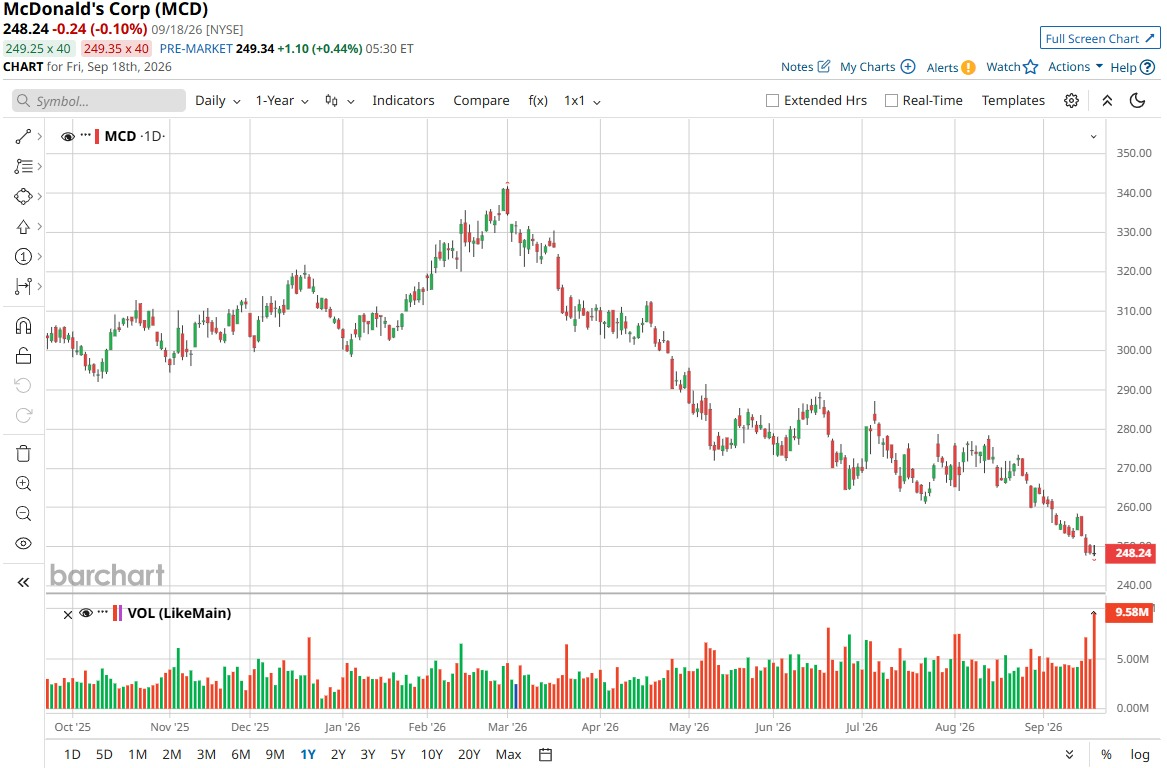
At 19.2 times forward earnings and 16.1 times cash flow, MCD stock trades below consumer discretionary sector medians of 21.7 times and 18.4 times, respectively.
Shareholders of record on Sept. 1 last received a $1.86 quarterly dividend on Sept. 16. McDonald’s new quarterly dividend of $1.93 annualizes to $7.72, implying a 3.1% forward yield using its Sept. 22 closing price. The shares go ex-dividend on Dec. 1, and shareholders of record will receive the payment on Dec. 15.
McDonald's reported second-quarter earnings on Aug. 4. Revenue increased 4% year-over-year (YOY) to $7.1 billion, coming in slightly below the $7.13 billion consensus estimate. This revenue growth reflected a 1.3% increase in global comparable sales, down from 3.8% growth in the prior-year quarter. U.S. comparable sales rose 0.8%, while International Operated Markets delivered 1.5% growth. Global systemwide sales increased 5%, or 4% in constant currencies, to $37 billion.
The company reported diluted EPS of $3.32, up 6% YOY. Excluding $0.06 per-share restructuring charges, adjusted EPS reached $3.38 and surpassed the $3.32 consensus estimate.
Operating margin held at 47%, unchanged from the prior-year period, reflecting the resilience of McDonald's franchise-heavy model. Consolidated operating income increased 3%, or 4% after adjusting for restructuring charges.
That durable cash generation supports the dividend increase. Loyalty-member sales surpassed $40 billion during the trailing 12 months across 70 markets. McDonald's had nearly 220 million active loyalty users at quarter-end, up 13% from a year earlier.
McDonald’s Looks to New Leadership
McDonald’s is putting a proven operator in charge of its most important market. The company appointed Skye Anderson as President of McDonald’s USA on Aug. 4, replacing Joe Erlinger and putting her in charge of nearly 14,000 U.S. restaurants. Anderson has spent more than 26 years with the company and most recently served as Chief Operating Officer of McDonald's USA.
Anderson's assignment is to make McDonald’s more competitive on value, improve the daily restaurant experience, and execute the company’s McDonald’s > NEXT strategy. Those goals directly address the issues behind weak U.S. traffic results.
McDonald’s is also using its menu to create new customer occasions. On Aug. 17, the company began selling the Red Bull Dragonberry Energizer nationwide, its first entry into energy drinks. This is a direct push into the afternoon beverage market, where the company sees room to generate additional visits.
The launch also carries forward lessons from CosMc’s, McDonald’s earlier beverage-focused experiment. A successful rollout would provide an incremental sales lever rather than transform the business overnight.
The wider investment case still depends on execution. Anderson’s ability to improve value perception and traffic, alongside a successful beverage rollout, could strengthen U.S. sales and franchisee profitability.
Wall Street Expects Earnings Growth
McDonald’s will report its September-quarter results on Nov. 4, giving investors a clearer read on whether its U.S. initiatives are gaining traction. The consensus calls for Q3 EPS of $3.39, up 5% YOY from $3.22 in the comparable quarter last year.
Still, Bernstein highlighted uncertainty on Aug. 5. The firm reduced its price target on MCD stock to $295 from $310 while keeping its “Market Perform” rating. Bernstein identified inconsistent U.S. value execution and traffic pressure as the central issues weighing on McDonald's near-term outlook.
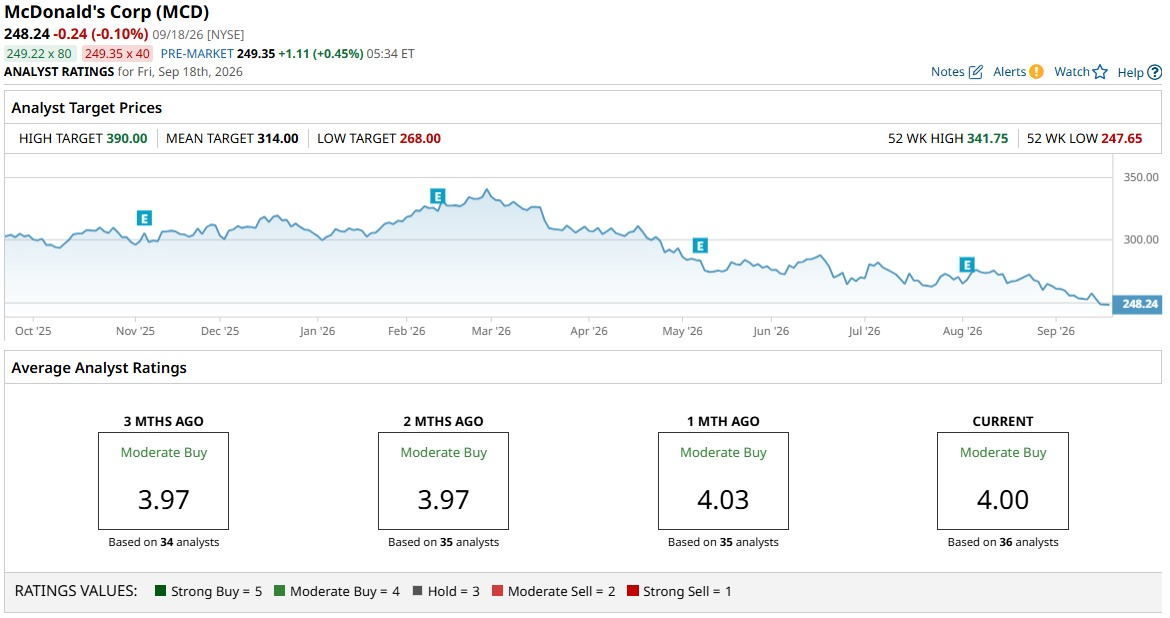
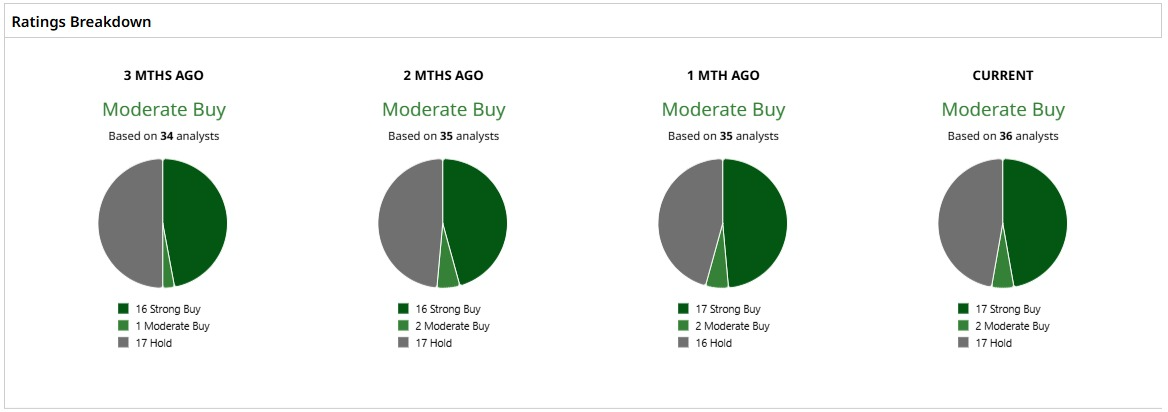
Wall Street’s overall view remains more constructive. McDonald's stock has a consensus “Moderate Buy" rating based on 36 analysts with coverage. The average price target of $313.39 represents potential upside of approximately 31% from current levels.
Conclusion
McDonald’s looks like a reasonable buy for long-term income investors, not a quick-growth trade. Its new $7.72 annual dividend, 3.1% yield, and 50-year increase streak offer real support after the stock’s pullback. The most likely path forward is a gradual recovery, led by better U.S. value execution, loyalty growth, and international sales. Still, investors should expect progress to take time. If traffic improves, MCD stock could reward patient shareholders with income and capital upside.
On the date of publication, Ebube Jones did not have (either directly or indirectly) positions in any of the securities mentioned in this article. All information and data in this article is solely for informational purposes. For more information please view the Barchart Disclosure Policy here.