
3 South African Food Retail Stocks Facing The Real Test Of Pricing Power
South Africa’s food inflation uptick from 0.9% to 1.1% in August has put everyday prices and food retailers back under the spotlight. That small move can matter for your portfolio, as pricing power and cost control begin to separate potential winners from the rest. This article walks through three South African food retailers and consumer staples stocks exposed to this inflation story, and how the latest data could reshape their risk and reward profile.
The stocks covered below are only a small sample of the South African food retailers and consumer staples universe, and the full screen surfaced 9 more companies with similarly interesting stories that are not included here. To see the broader field and focus on the strongest opportunities, head straight to the South African Food Retailers and Consumer Staples screener to identify, compare, and analyze candidates that best fit your portfolio objectives.
Shoprite Holdings (JSE:SHP)
Overview: Shoprite Holdings is a Brackenfell based retailer whose core supermarket chains anchor South Africa’s everyday food basket, with additional liquor, pharmacy, furniture, and financial services offerings.
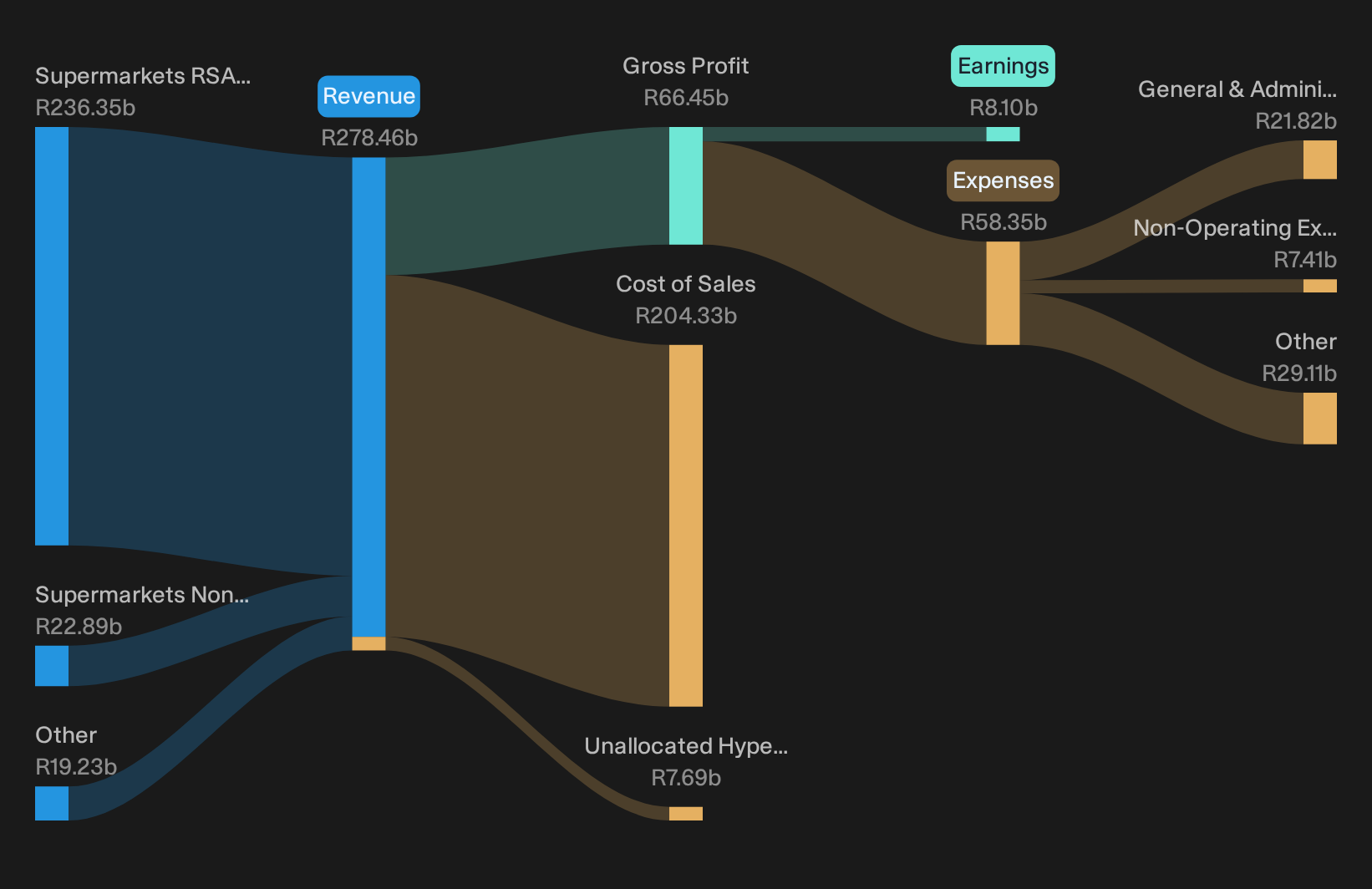
Operations: Shoprite generates most revenue from Supermarkets RSA at about ZAR 236.3b, with smaller contributions from Non-RSA supermarkets, other operations, and hyperinflation adjustments.
Market Cap: ZAR 173.1b
Shoprite Holdings matters for this screener because it is the purest large scale play on South African grocery spending and day to day food staples. Even small shifts in food inflation or consumer behaviour can quickly show up in its store footprint and sales mix.
"Continuous store expansion, with plans to open 123 new supermarkets and 151 total stores, indicates strong future revenue growth potential."
What happens to margins if a single key pressure in the supply chain moves differently from what current plans quietly assume?
If that pressure point has your attention, read the full narrative for Shoprite Holdings to see how Shoprite’s expansion plans could accelerate or stall as food inflation shifts.
Pick n Pay Stores (JSE:PIK)
Overview: Pick n Pay Stores runs supermarkets, hypermarkets, liquor and clothing outlets and online channels that supply everyday groceries and essentials across South Africa and parts of Africa.
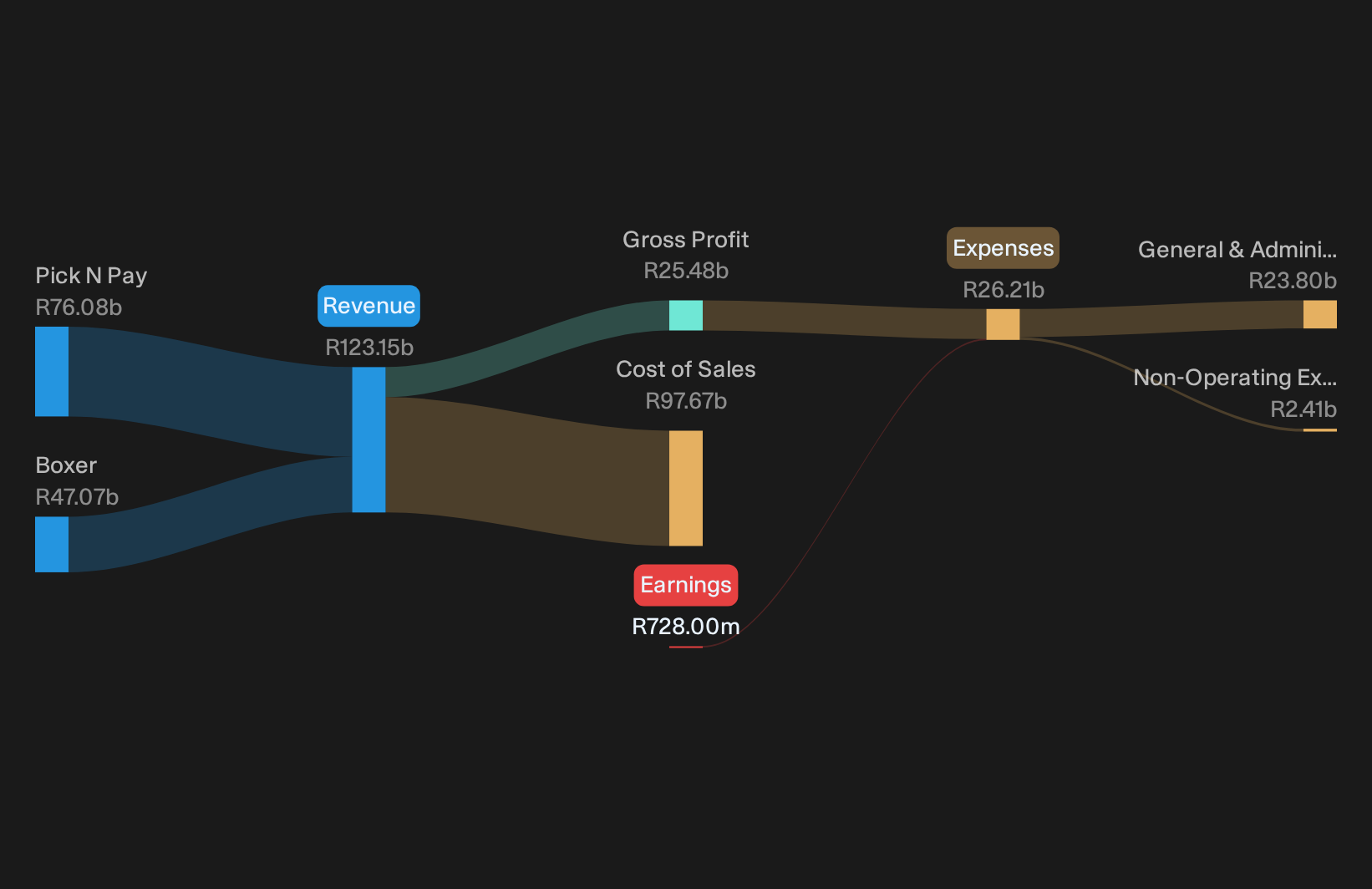
Operations: The group generates about ZAR 76.1b from Pick n Pay and ZAR 47.1b from Boxer, with roughly ZAR 119.2b earned in South Africa and ZAR 3.9b earned in the Rest of Africa.
Market Cap: ZAR 14.3b
Pick n Pay Stores gives you direct exposure to South African grocery spending, where even small moves in food inflation can reshape how its shoppers split baskets between core supermarkets and value-focused Boxer formats.
"The rapid adoption of digital and mobile payments has resulted in Pick n Pay significantly accelerating its omni-channel and e-commerce strategy, including the launch of an integrated app that brings online shopping and loyalty together. As digital penetration increases, this could drive higher transaction volumes and operational efficiencies, which may in turn influence both revenue and margins."
What could happen to that margin story if a single unseen pressure on costs or price competition shifts faster than management expects?
That hidden pressure point is exactly where the real story starts, and the full narrative for Pick n Pay Stores maps how Pick n Pay Stores could turn it into accelerating competitive momentum.
SPAR Group (JSE:SPP)
Overview: SPAR Group is a wholesale and distribution focused business that supplies grocery retailers and consumer staples outlets across South Africa and Ireland.
Operations: SPAR Group generates about ZAR 133.8b from wholesale and distribution of goods and services, mainly across Southern Africa and Ireland.
Market Cap: ZAR 8.7b
For investors watching South African food inflation and consumer staples demand, SPAR Group provides direct exposure to how volumes and pricing filter through a wholesale distribution network that supplies everyday grocery chains.
"The expansion of SPAR2U to 525 sites in Southern Africa and significant growth in volumes is anticipated to boost future revenue streams as consumer demand for expanded services continues to rise."
The real swing factor comes from how one cost heavy link in SPAR Group’s logistics chain reacts if fuel and interest costs move higher.
If that risk link is what you keep coming back to, the full narrative for SPAR Group shows how SPAR Group’s distribution model could turn cost pressure into accelerating opportunity.

Seeking Alternatives Before The Crowd Moves
Fresh ideas move first. By the time prices are flying, the easy part of the breakout can be gone. Scan these curated lists while it still matters and get in early.
- Spot cash rich balance sheets before they get fully priced by running your filters through the list of solid balance sheet and fundamentals (198 results).
- Look for structural demand in critical materials by checking which producers feature in the 17 top copper producer stocks.
- Evaluate income-oriented stocks while yields are still elevated by sizing up the 160 dividend fortresses.
This article by Simply Wall St is general in nature. We provide commentary based on historical data and analyst forecasts only using an unbiased methodology and our articles are not intended to be financial advice. It does not constitute a recommendation to buy or sell any stock, and does not take account of your objectives, or your financial situation. We aim to bring you long-term focused analysis driven by fundamental data. Note that our analysis may not factor in the latest price-sensitive company announcements or qualitative material. Simply Wall St has no position in any stocks mentioned.
Have feedback on this article? Concerned about the content? Get in touch with us directly. Alternatively, email editorial-team@simplywallst.com