
How Investors May Respond To Ardent Health (ARDT) Workforce Planning Partnership
- On 14 September 2026, HealthStream announced that Ardent Health is serving as an early health system collaborator in its ECWP Innovation Partners Program, providing input on clinical workforce development, deployment, and retention across Ardent’s 30 hospitals and more than 280 sites of care in six states.
- Ardent Health’s role in shaping HealthStream’s ECWP approach to clinical workforce planning highlights how management is directly targeting labor stability, a core operating pressure for hospital systems.
- We will now examine how Ardent Health's investment narrative is influenced by its early role shaping HealthStream's ECWP clinical workforce platform.
Ardent Health Investment Narrative Recap
To own Ardent Health, you need to be comfortable with a hospital operator working through tight margins, regulatory uncertainty, and payer friction while leaning on outpatient growth and technology to improve returns. The ECWP collaboration with HealthStream sits squarely in that effort to manage staffing more precisely. It supports the idea that management is trying to address labor cost pressure, not just absorb it.
The biggest short term swing factor still looks like execution on reimbursement and cost control, since payer denials and weaker contracts can quickly offset any efficiency gains. Labor tools like ECWP help, but do not remove headline risks such as potential Medicaid changes, slower revenue growth at 3.8% a year, or already thin 1.2% net margins.
The HealthStream ECWP partnership links directly to one of Ardent Health’s key pressure points. Workforce stability and clinician shortages sit behind a lot of the margin noise. Input into a clinical workforce planning platform could give the group better visibility on staffing needs across 30 hospitals and more than 280 care sites, which matters when labor inflation is a persistent risk.
Analysts already frame technology adoption as a key catalyst for Ardent, pointing to tools like virtual nursing and AI-enabled scribes as levers for efficiency and lower turnover. This ECWP role fits into that same execution thread. If the platform helps lower reliance on expensive temporary labor or reduce churn, it could support the earnings growth forecasts, while still leaving regulatory and reimbursement pressure very much in play.
Ardent Health's narrative projects US$7.2b revenue and US$206.4m earnings by 2029. This is based on 4.0% yearly revenue growth and an earnings increase of about US$72.1m from current earnings of US$134.3m.
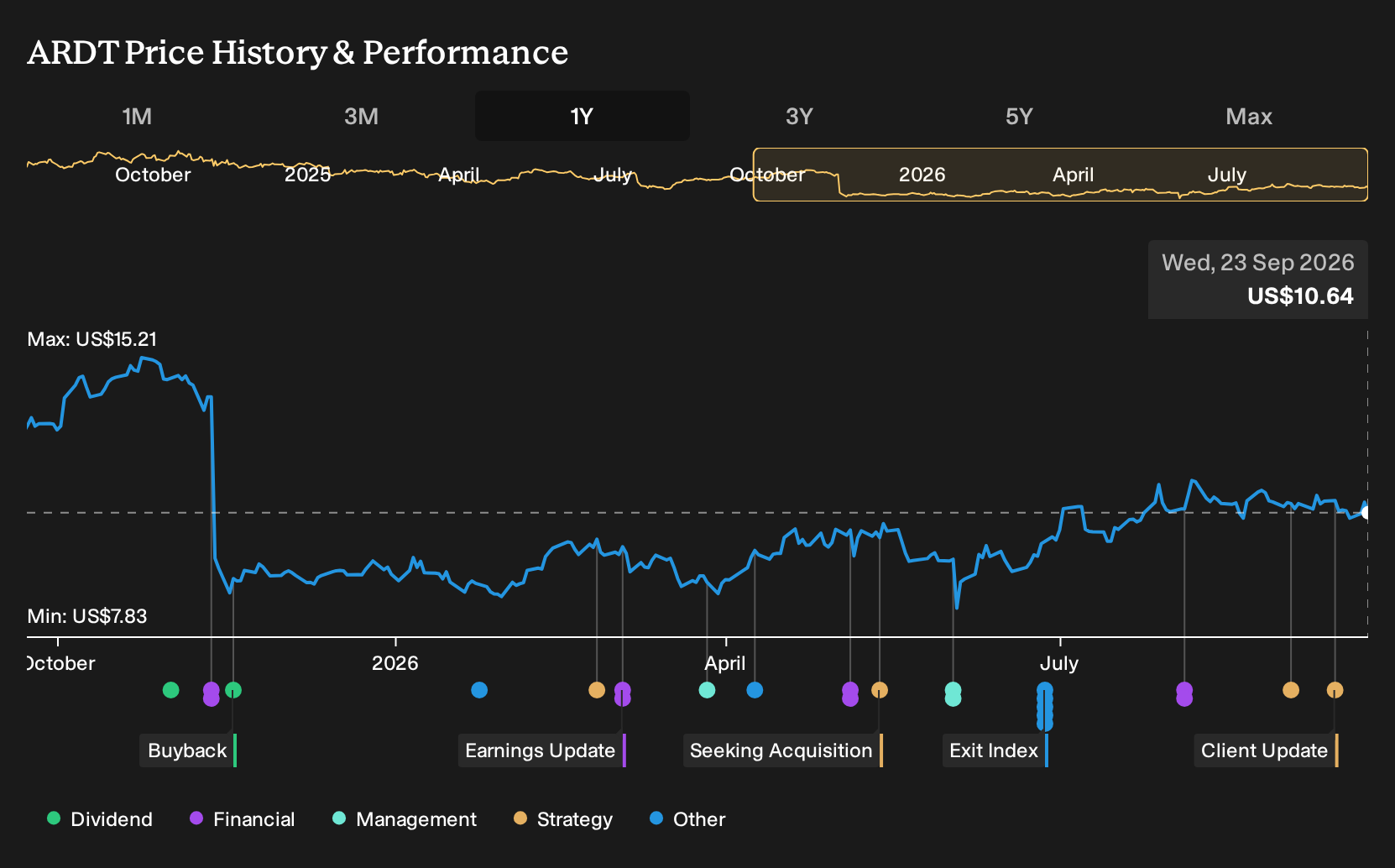
Uncover why Ardent Health's fair value indicates a 17% potential upside to its current price before the market closes that valuation gap.
Exploring Other Perspectives
For a different angle on Ardent Health, focus on debt risk instead of labor tools. The most cautious analysts were modeling only 3.5% annual revenue growth to about US$7.1b and earnings of roughly US$175.5m by 2029. Your read on this ECWP news could affect how reasonable that more downbeat path appears.
Explore another Ardent Health fair value estimate, including one that suggests as much as 76% downside from the current price!
Form Your Own Verdict
Disagree with existing narratives? Extraordinary investment returns rarely come from following the herd, so go with your instincts.
- A great starting point for your Ardent Health research is our analysis highlighting 2 key rewards and 1 important warning sign that could impact your investment decision.
- See our latest analysis for Ardent Health. The report includes a comprehensive fundamental analysis summarized in a single visual, the Snowflake, making it easy to evaluate Ardent Health's overall financial health at a glance.
Looking For More Ideas Beyond Ardent Health?
If the Ardent Health story has sharpened your thinking about risk, balance sheets, and long term earnings power, it can be useful to compare it with other businesses facing very different pressures and opportunities.
- For investors who care most about quality and valuation together, scan a curated set of potential compounders through the 30 high quality undervalued stocks that pair stronger fundamentals with more modest pricing.
- If capital preservation is high on your list, review the 31 resilient stocks with low risk scores that screen for businesses with sturdier financial profiles and lower overall risk scores.
- When you want to find companies with cleaner finances than a typical hospital operator, start with the list of solid balance sheet and fundamentals (23 results) that highlight stocks combining stronger balance sheets with healthier underlying fundamentals.
This article by Simply Wall St is general in nature. We provide commentary based on historical data and analyst forecasts only using an unbiased methodology and our articles are not intended to be financial advice. It does not constitute a recommendation to buy or sell any stock, and does not take account of your objectives, or your financial situation. We aim to bring you long-term focused analysis driven by fundamental data. Note that our analysis may not factor in the latest price-sensitive company announcements or qualitative material. Simply Wall St has no position in any stocks mentioned.
Have feedback on this article? Concerned about the content? Get in touch with us directly. Alternatively, email editorial-team@simplywallst.com