
Holiday Spending Strength Could Test The Case For Kohl's Stock
- Recent seasonal shopping data pointed to solid consumer demand heading into the key holiday period, which has been viewed as constructive for retailers such as Kohl's.
- The upbeat read on discretionary and seasonal spending highlights how sensitive Kohl's operating outlook is to even small shifts in customer purchasing patterns during peak quarters.
- We will now look at how Kohl's investment narrative intersects with stronger seasonal spending trends that underpin expectations for holiday demand.
Kohl's Investment Narrative Recap
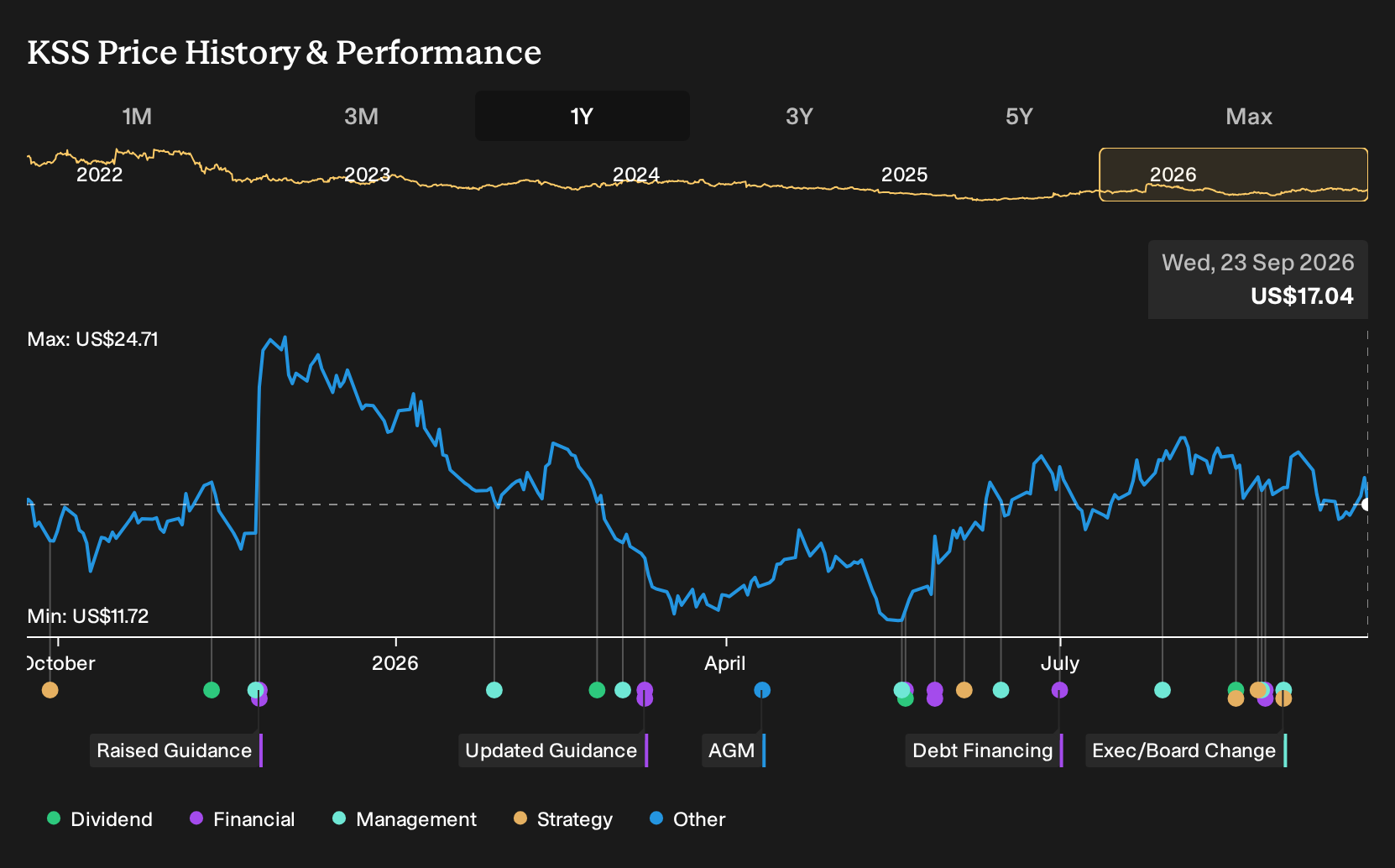
To own Kohl's, you need to believe the retailer can keep converting seasonal demand into steadier traffic, healthier margins, and enough cash flow to fund reinvestment. Stronger seasonal shopping data and the recent 4.9% share price move speak directly to the near term catalyst. Holiday execution remains the key swing factor for sentiment around the operating outlook.
The biggest near term risk is that any lift in discretionary spending proves too shallow to offset pressure from promotions, wage costs, and softer store transactions among middle income shoppers. If holiday demand normalizes quickly, the recent data may not materially change the longer term picture of slow revenue and earnings growth.
With no fresh company specific announcements tied directly to this spending update, the most relevant reference point is still Kohl's broader repositioning effort. Management has been leaning on proprietary brands, the Sephora rollout, and e commerce upgrades to counter weak store traffic and protect margins while the customer base strains under discretionary pressure.
That context matters as you think about catalysts. Strong seasonal demand gives those initiatives a better backdrop to be tested at scale, from coupon led traffic recapture to Sephora cross shopping. It also highlights execution risk. Any misstep in inventory, promotions, or staffing during this period can quickly feed back into already thin net margins and a modestly improving profit profile.
Kohl's Forecasts Versus Holiday Sensitivity
Kohl's is being judged on two clocks at once. Holiday data moves sentiment quickly, while analyst models stretch out to 2029 and try to pin down what a more mature version of the retailer might look like once current initiatives and headwinds have played through. The gap between what shoppers do this quarter and what forecasts assume several years out is where a lot of the investment debate sits.
Consensus expectations effectively treat seasonal upside as a temporary lift rather than a structural reset. Analysts are assuming Kohl's revenue stays roughly flat over the next few years, with profit margins easing from 1.7% today to 1.5% in three years. That framing suggests stronger holiday tickets and better seasonal categories help near term cash generation, but do not yet translate into a clear path to higher long term profitability.
The earnings bridge underlines that cautious stance. Analysts see earnings today at about US$270.0 million and project US$227.9 million by 2029, which implies an earnings decline of roughly US$42 million over the period. Even if holiday seasons come in solidly, this framework leans on the idea that promotions, wage inflation and softer middle income demand counter much of the benefit from stronger seasonal shopping patterns.
Valuation work in the same research assumes Kohl's would reach about US$15.5b in revenue and US$227.9 million in earnings by 2029, with the stock trading at about 13.5x P/E on those forecast earnings. That multiple would still sit below the 20.3x P/E currently quoted for the broader US multiline retail group in the report. For investors, the message is that seasonal beats might help justify a somewhat higher earnings multiple than today if they point to more durable progress, but the baseline model is not baking in aggressive growth.
Short term, this creates an interesting setup. Seasonal strength can help Kohl's prove that its Sephora partnership, own brands and e commerce upgrades convert higher traffic into cash, which matters in a business where net margins are already thin. Longer term, the consensus numbers remind you that the current script assumes only modest efficiency gains and limited revenue expansion, which leaves the retailer reliant on strong holiday execution each year to support its reinvestment plans.
Kohl's narrative projects about US$15.5b in revenue and US$227.9 million in earnings by 2029, with analysts assuming fairly flat yearly revenue trends and an earnings decline of roughly US$42 million from US$270.0 million today.
Uncover why Kohl's fair value indicates a 10% potential upside to its current price that may not last much longer.
Exploring Other Perspectives
Holiday strength looks encouraging for Kohl's, but the most bearish analysts focus on a different pressure point. They worry that softer Sephora at Kohl's trends could weigh on earnings, with their models pointing to revenue of about US$14.8b and profit of only US$148.7 million by 2029. Those forecasts, set before this spending news, show how sharply views can differ. Use them as a reference, then compare several perspectives before deciding how this new data might shift the narrative.
Explore 3 other Kohl's fair value estimates, including one that suggests it could be worth just $18.69.
Reach Your Own Conclusion
Don't just follow the ticker. Dig into the data and build a conviction that's truly your own.
- A great starting point for your Kohl's research is our analysis highlighting 3 key rewards and 2 important warning signs that could impact your investment decision.
- See our latest analysis for Kohl's. The report includes a comprehensive fundamental analysis summarized in a single visual, the Snowflake, making it easy to evaluate Kohl's overall financial health at a glance.
Looking for more investment ideas beyond Kohl's?
If this holiday setup for Kohl's has you rethinking where consumer and retail exposure fits in your portfolio, it can help to line it up against other opportunities with different risk and balance sheet profiles using the Simply Wall St Screener.
- For investors who want income to do more of the heavy lifting, consider companies with strong payouts screened through 7 dividend fortresses that may suit a yield focused approach.
- If capital preservation is front of mind, filter for businesses with steadier financial profiles by reviewing the 31 resilient stocks with low risk scores that aim to keep downside risk in check.
- When you are hunting for future leaders before attention moves their way, scan the 16 high quality undiscovered gems and see which smaller stocks already have fundamentals to back up their story.
This article by Simply Wall St is general in nature. We provide commentary based on historical data and analyst forecasts only using an unbiased methodology and our articles are not intended to be financial advice. It does not constitute a recommendation to buy or sell any stock, and does not take account of your objectives, or your financial situation. We aim to bring you long-term focused analysis driven by fundamental data. Note that our analysis may not factor in the latest price-sensitive company announcements or qualitative material. Simply Wall St has no position in any stocks mentioned.
Have feedback on this article? Concerned about the content? Get in touch with us directly. Alternatively, email editorial-team@simplywallst.com