
How to Play AAPL Stock as New Fitness+ Layoffs Hit Apple
Apple (AAPL) seems to be telling investors it’s time to walk, but not necessarily away from growth. The company is cutting a handful of jobs within its Apple Fitness+ audio-content team, putting roles tied to experiences such as Time to Walk and Time to Run under the microscope. The move comes as Apple continues to invest heavily in the businesses and technologies it believes will shape its next phase of growth.
The Fitness+ cuts also follow a broader restructuring in August that affected more than 200 roles across Siri, software, artificial intelligence (AI), and Vision Pro.
But this doesn’t look like Apple simply hitting the brakes. It’s probably more like Time to Walk – except Apple is changing the route. The company appears to be moving people and resources away from selected projects while putting more weight behind AI, health, and new user experiences. Fitness+ itself is not being scrapped, although new audio content could arrive less frequently.
For AAPL stock investors, the bigger question is not how many employees are leaving. It’s where Apple is cutting, where it is hiring, and what those moves say about its next growth priorities.
Let’s see how investors should play AAPL stock now.
About Apple Stock
For decades, Apple has turned everyday technology into products people rarely imagine living without. From the iPhone that transformed communication to the Mac and iPad that reshaped personal computing, the Cupertino-based giant has built one of the world’s most powerful consumer brands. But Apple’s story no longer ends with hardware. Its Services business — spanning the App Store, iCloud, Apple Music, Apple Pay, and more — has become an increasingly important growth engine, bringing recurring revenue and keeping users deeply connected to its ecosystem. Today, that combination has helped Apple reach a staggering $4.5 trillion market capitalization.
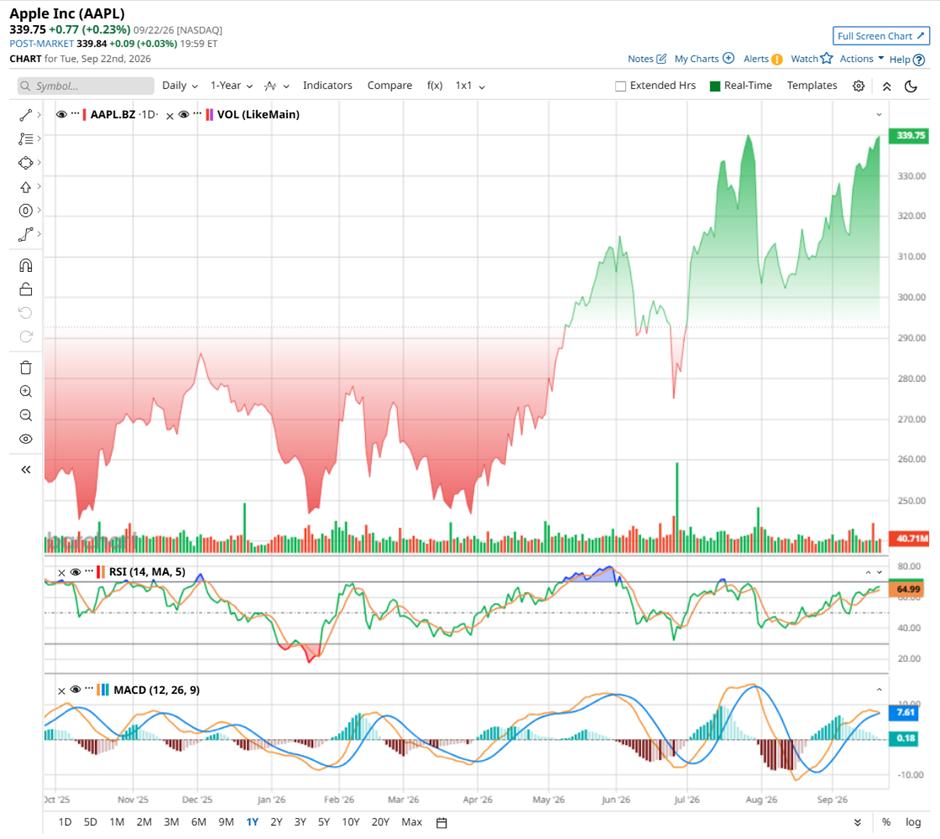
AAPL stock has not exactly taken the straight road higher in 2026. The year began with investors keeping a close eye on interest rates, geopolitical uncertainty, and the heavy focus on the AI trade, all of which created a rough backdrop for big tech. Apple felt that pressure too, with shares spending the early part of the year struggling to gain much traction.
Fast-forward to September, and the mood looks quite different. AAPL stock climbed to an all-time high of $345.34 on Sept. 22, putting the shares up about 15% year-to-date (YTD) and roughly 32.7% over the past 52 weeks. Strong Services growth, resilient iPhone demand, and renewed interest in Apple’s AI plans have helped fuel that rebound. Investors are also watching how Apple could eventually turn AI into another source of value across its massive installed base.
There’s an interesting wrinkle to that AI story, though. Apple has not followed some of its mega-cap peers into a spending arms race on AI infrastructure. Its more measured approach to AI-related capital spending could allow the company to pursue the opportunity without taking on the same level of infrastructure costs weighing on some competitors.
And Apple may have another wearable up its sleeve. Bloomberg reported that the company is working on a screenless health and fitness band that could compete with Whoop. The project has reportedly received support from top leadership but remains a “technology investigation,” meaning Apple has not committed to launching it. If approved, a commercial debut would reportedly come no earlier than 2028.
The bigger near-term wrinkle is profitability. Apple’s latest Q4 outlook warned of increasing pressure from higher memory costs, which are being pushed up by the broader AI infrastructure boom. CEO Tim Cook said Apple has paid more for memory in each of the past three quarters and expects another increase in the September quarter. Apple has already raised prices on some Macs and iPads, while iPhones have so far avoided a price hike. For investors, that leaves the stock balancing strong momentum against rising costs.
Technically, AAPL still has some wind at its back. The 14-day RSI sits around 68, signaling strong momentum while nearing overbought territory. The MACD oscillator is also steady, with the MACD line above its signal line and a positive histogram. Together, those signals suggest buyers remain in control, although the elevated RSI leaves the stock more sensitive to a pullback.
Apple isn’t exactly sitting on the clearance rack. At roughly 38.4 times forward adjusted earnings and 10.4 times sales, AAPL carries a premium to its historical averages and several mega-cap tech peers. The price tag reflects what investors are willing to pay for Apple’s ecosystem, loyal customer base, and steady cash generation.
The dividend adds another piece to the puzzle. Apple has increased its payout for 13 straight years, yet its roughly 12% payout ratio still leaves plenty of breathing room for future hikes. Combine that with billions in buybacks, and the shareholder-return story remains firmly in place.
What the Fitness+ Cuts Mean
Fitness+ is ultimately a subscription business, and that means Apple has to keep giving subscribers a reason to come back. New workouts and programs need to arrive regularly, but producing fresh content also comes with recurring costs. If the experience starts feeling repetitive, subscribers have another reason to walk away.
That makes the latest cuts worth watching, even if they say little about Apple’s broader Services business. Apple generated impressive Services revenue in the June quarter, with a solid 75.6% gross margin. But the company does not break out Fitness+ revenue or profitability, so there is no way to tell from public filings whether the service itself is generating attractive returns.
What the layoffs do suggest is that Apple may be taking a closer look at the economics of this particular content format. One possibility is that Fitness+ could eventually fit more tightly into Apple’s broader Health experience, potentially reducing overlapping content and management costs. For now, though, that remains a strategic possibility, not a confirmed product decision.
A Snapshot of Apple’s Q3 Results
Apple released it fiscal Q3 2026 results last month and the numbers were impressive. Revenue came in stronger than expected, climbing 16.4% year over year (YOY) to $109.4 billion, with adjusted EPS reaching $1.91, ahead of Wall Street’s expectations, while reported EPS rose 28.7% YOY to $2.02. Apple also set June-quarter revenue records for the iPhone, Mac, and Services, while its installed base crossed 2.5 billion active devices for the first time.
The iPhone remains the star of the show. Revenue from the business jumped 22% YOY to $54.3 billion, with the iPhone 17 family helping drive record June-quarter results across every geographic segment. And with Apple preparing to introduce its next generation of iPhones in September, the company is heading into the next quarter with another potential demand catalyst.
Macs are pulling their weight, too. Revenue surged 28.7% to $10.4 billion, supported by the MacBook Neo and MacBook Pro. Apple said demand from both existing customers upgrading and first-time buyers reached records, even as supply constraints limited some sales. That gives its newer, AI-focused Mac lineup a solid base to build on.
Services continues to provide the quieter but increasingly important growth engine. Revenue increased 12% to a record $30.7 billion, while paid subscriptions surpassed 1.5 billion. Cloud, payments, advertising, the App Store, AppleCare, Music, and video all posted June-quarter records. Not everything moved higher, though. iPad revenue fell 6% to $6.2 billion, while Wearables, Home, and Accessories revenue rose 6.5% to $7.9 billion.
Apple’s balance sheet leaves little doubt about its financial firepower. The company ended the quarter with $147 billion in cash and marketable securities against $84 billion in debt. Operating cash flow reached a record $34.4 billion, allowing Apple to return $33 billion to shareholders, including $25.8 billion through buybacks and $4 billion in dividends and equivalents.
For fiscal Q4, Apple expects revenue growth of 9% to 11% YOY, with iPhone revenue projected to grow in the mid-teens and Services growth broadly similar to Q3 on a constant-currency basis. Foreign exchange could trim growth by about 2.5 percentage points, while tighter supply and higher memory costs are expected to weigh on margins, partly offset by existing inventory, lower costs for certain components, and a favorable product mix.
Put it all together, and Apple’s numbers look considerably more like a company reallocating resources than one struggling to find growth. The layoffs may be grabbing headlines, but the financials are telling a different story — iPhone demand is strong, Services keeps expanding, Macs are gaining momentum, and Apple is still generating enough cash to fund its next big bet while rewarding shareholders along the way.
Analysts monitoring the company remain optimistic, predicting Q4 revenue around $113.6 billion, while EPS is anticipated to rise by 7% YOY to $1.98. For the full fiscal 2026 year, profit is expected to be around $8.74 per share, up 17.2% YOY, before surging another 9% annually to $9.53 per share in fiscal 2027.
What Do Analysts Expect for Apple Stock?
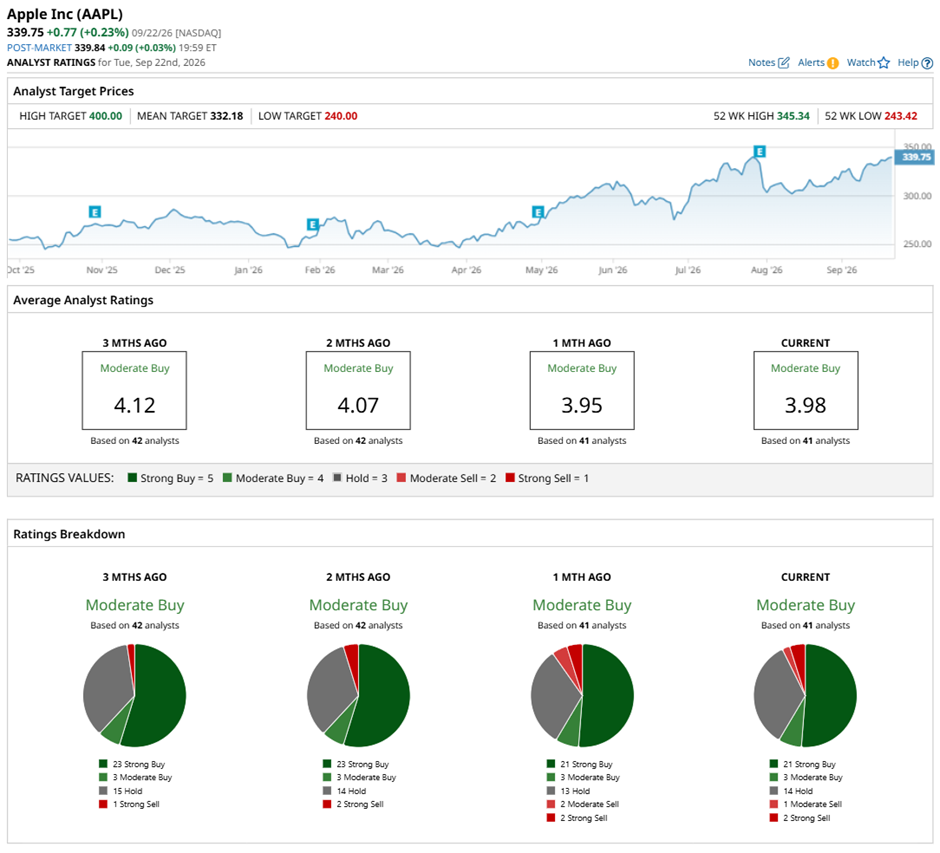
AAPL stock carries a consensus “Moderate Buy” rating, reflecting a mix of optimism and caution on Wall Street. Among the 41 analysts covering the stock, 21 have issued a “Strong Buy” recommendation, while three rate it a “Moderate Buy.” Meanwhile, 14 analysts have a more neutral “Hold” stance. On the bearish side, one analyst recommends a “Moderate Sell,” while the remaining two are outright skeptical, advising a “Strong Sell” rating.
AAPL stock is currently trading above its average analyst price target of $332.18, but the Street-high target price of $400 suggests that the stock could rally as much as 17.7%.
Final Thoughts on AAPL stock
So, what should investors make of the layoffs? Probably not too much around the number of jobs being cut. Apple’s 2026 layoffs are simply too small to move the earnings needle in any meaningful way. The more interesting part is where Apple is cutting and where it is putting its money instead.
The Fitness+ reductions suggest Apple is becoming more selective about content-heavy initiatives, while the broader restructuring points toward a bigger push into AI, Siri, health, and new user experiences. That can be read as tighter resource allocation rather than a company suddenly scrambling to protect profits.
Still, there is another side to the story. Every time Apple reshuffles a team, there is some execution risk. AI is moving fast, and investors are already looking for Apple to turn its enormous R&D spending into products people actually want to use, not just announcements that sound good at a keynote.
For AAPL stock, then, the layoffs are more of a signpost than a destination. The real test is whether Apple can take the money and talent it is freeing up and turn them into the next wave of products, services, and upgrades. At nearly 39 times trailing earnings, that is the part investors should be watching, not the size of the latest pink slip pile.
On the date of publication, Sristi Suman Jayaswal did not have (either directly or indirectly) positions in any of the securities mentioned in this article. All information and data in this article is solely for informational purposes. For more information please view the Barchart Disclosure Policy here.