
3 Financial Stocks Retail Investors Are Watching As Higher Rates Test US Banks
With the Federal Reserve hinting at more modest rate hikes and Treasury yields sitting at levels not seen since 2004, higher borrowing costs are reshaping winners and laggards across US large caps. That shift creates a live test for banks and insurance stocks exposed to this rate backdrop. This article walks through three US Large-Cap Financials picks from the screener and explains how the same macro story can play out very differently for each stock.
The stocks covered below are just a starting sample, and the full screen surfaced 22 more large-cap banks and insurers with equally compelling stories that are not listed here. If you want to identify your own high-conviction ideas, head straight into the US Large-Cap Financials (Banks and Insurance) Benefiting from Higher Interest Rates screener.
Inter & Co (INTR)
Inter & Co taps the screener theme through its digital banking and insurance platform, where rate-sensitive income sits alongside a growing mix of fee-based services that can respond differently to a world of higher policy rates and stronger yield curves.
Inter & Co is a Brazil-focused digital bank and financial platform spanning checking accounts, cards, loans, investments and insurance, with Banking & Spending generating about R$5.5b, Inter Shop roughly R$424 million and insurance and investment activities around R$508 million of segment revenue, and a market value near US$2.4b.
Expanding cross-sell of high-margin financial products (insurance, investments, credit), aided by hyper-personalization and integrated platform features like My Piggy Bank and My Credit, is lifting per-customer revenues and supporting net margin expansion through greater product adoption and customer lifetime value.
What happens to that improvement depends on how one unseen pressure reshapes future pricing power and the sustainability of those higher margins.
That pressure point is exactly where Inter & Co’s story gets interesting, and the full narrative for Inter & Co explains how rate sensitivity, cross-sell and funding costs are interacting.

Credicorp (BAP)
Credicorp plugs into the higher-rate theme through its broad Latin American banking and insurance platform, where a large interest-earning book and fee-heavy services offer multiple ways to benefit from a firmer global yield backdrop, even if policy moves are set outside Peru.
Credicorp is a Peru-headquartered financial group that runs universal banking, insurance, pensions, microfinance and asset management. Universal banking at Banco de Crédito del Perú generates about PEN 15.4b of revenue, microfinance around PEN 2.6b and insurance activities roughly PEN 2.3b, with a market value near US$31.2b.
Recent and anticipated expansion of digital financial services like Yape is unlocking new revenue streams through both increased transaction volumes and lending to previously underserved segments, driving strong growth in fee-based income and supporting sustained top-line expansion.
What happens to that expanding digital ecosystem depends heavily on how one unresolved pressure shapes future credit quality and the cost of funding that growth.
That funding squeeze question is exactly where the full narrative for Credicorp pulls everything together, showing how Credicorp’s digital scale could accelerate outcomes that headline numbers barely hint at.

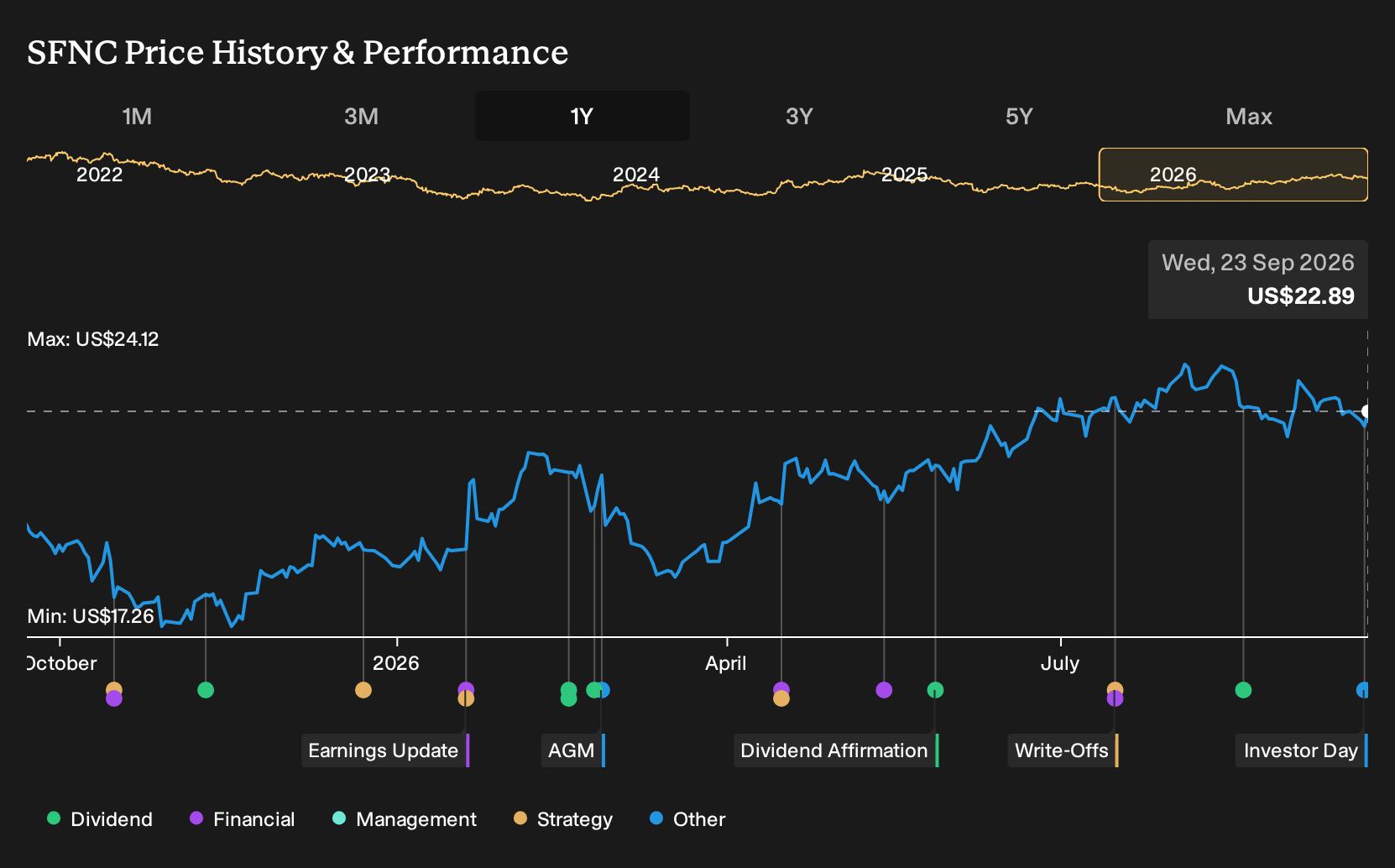
Simmons First National (SFNC)
Simmons First National is a regional lender whose earnings are closely tied to net interest margins. This makes it a clear fit for a higher rate focused screen that looks for solid balance sheets, income streams and dividend history among larger US financial groups.
Simmons First National runs community and commercial banking across six southern and midwestern states, with Community and Commercial Banking generating about US$66 million and Other activities roughly US$44 million of revenue. The stock is valued at about US$3.3b by the market.
For Simmons First National, the higher rate story is not just a macro tailwind. It is also a live test of how effectively management can turn repricing into durable earnings power without overreaching on growth or funding costs.
Continued remixing of the loan portfolio toward higher-yielding variable-rate loans and the repricing of legacy fixed-rate loans at higher rates present a tailwind for net interest margin expansion, enhancing core profitability.
What happens next for Simmons First National depends on how one unseen pressure shapes the balance between richer spreads and the cost of holding on to core deposits.
That trade off is exactly where the full narrative for Simmons First National shows how Simmons First National’s funding mix, credit risk and loan repricing could be quietly accelerating long term earnings power.
Seeking Fresh Alternatives Before They Fly
Fresh ideas move first. By the time every screen lights up, the cleanest entries have often gone. Scan these curated lists while the signals still matter and get in early.
- Target steady cash generators and let the list of solid balance sheet and fundamentals (23 results) guide you toward resilient businesses that can keep funding growth even when conditions turn choppy.
- Ride early momentum in structural themes and track where the money is quietly building through the curated 85 AI infrastructure stocks powering the next wave of computing demand.
- Position for income that keeps working while prices swing and shortlist resilient payers through the hand picked 7 dividend fortresses focused on durable, high-yield distributions.
This article by Simply Wall St is general in nature. We provide commentary based on historical data and analyst forecasts only using an unbiased methodology and our articles are not intended to be financial advice. It does not constitute a recommendation to buy or sell any stock, and does not take account of your objectives, or your financial situation. We aim to bring you long-term focused analysis driven by fundamental data. Note that our analysis may not factor in the latest price-sensitive company announcements or qualitative material. Simply Wall St has no position in any stocks mentioned.
Have feedback on this article? Concerned about the content? Get in touch with us directly. Alternatively, email editorial-team@simplywallst.com