
Should Brand Relaunch Require Action From Wayfair (W) Investors?
- Wayfair has launched a new brand platform, “Wayfair Delivers,” supported by a national campaign featuring Matthew and Kelly Stafford and their family, and highlighting services such as Wayfair Verified, Wayfair Rewards, and its proprietary logistics network.
- The campaign signals a fresh push to link Wayfair’s logistics and curation efforts directly to customer trust and everyday home-life use cases, rather than focusing solely on online assortment breadth.
- We will now look at how Wayfair’s refreshed “Wayfair Delivers” brand focus could affect the broader investment narrative around the retailer.
Compare Wayfair’s home retail push with a curated group of peers that also lean on logistics strength and product curation by scanning the 30 high quality undervalued stocks.
Wayfair Investment Narrative Recap
Owning Wayfair means believing its focus on logistics, merchandising and cost discipline can matter more than a choppy housing market and weak big ticket demand. The key near term swing factor is whether marketing spend and efforts like Wayfair Verified convert into higher quality orders without putting more pressure on already thin profitability and negative equity.
The fresh Wayfair Delivers push sits squarely in that debate. It sharpens the promise of reliability and value, which supports the existing CastleGate and physical store catalysts, but does not by itself change the main risk. If higher advertising intensity fails to lift conversion or repeat behavior, margin strain and funding risk remain central concerns.
The Wayfair Delivers platform is the clearest recent operational move to watch. It ties the logistics network, curation and rewards into one consumer story and rolls it out in high visibility NFL and broadcast slots. For investors, the question is whether this unified message improves order quality faster than it inflates customer acquisition costs.
Everything already flagged around risks and catalysts runs straight through this campaign. Success would likely show up in better conversion on large items, stronger engagement with Wayfair Verified and ongoing use of Wayfair Rewards, without a step up in losses on the US$12.9b revenue base. Weak payback would leave advertising spend, negative shareholders’ equity and reliance on higher risk funding as unresolved pressure points.
Wayfair's current analyst script points to revenues of US$16.1b and earnings of US$555.9m by 2029. That view assumes revenue grows about 7.5% a year and that earnings rise by roughly US$876.9m from a loss of US$321.0m today.
Discover why Wayfair's fair value indicates a 26% potential upside to its current price that could close faster than many investors expect.
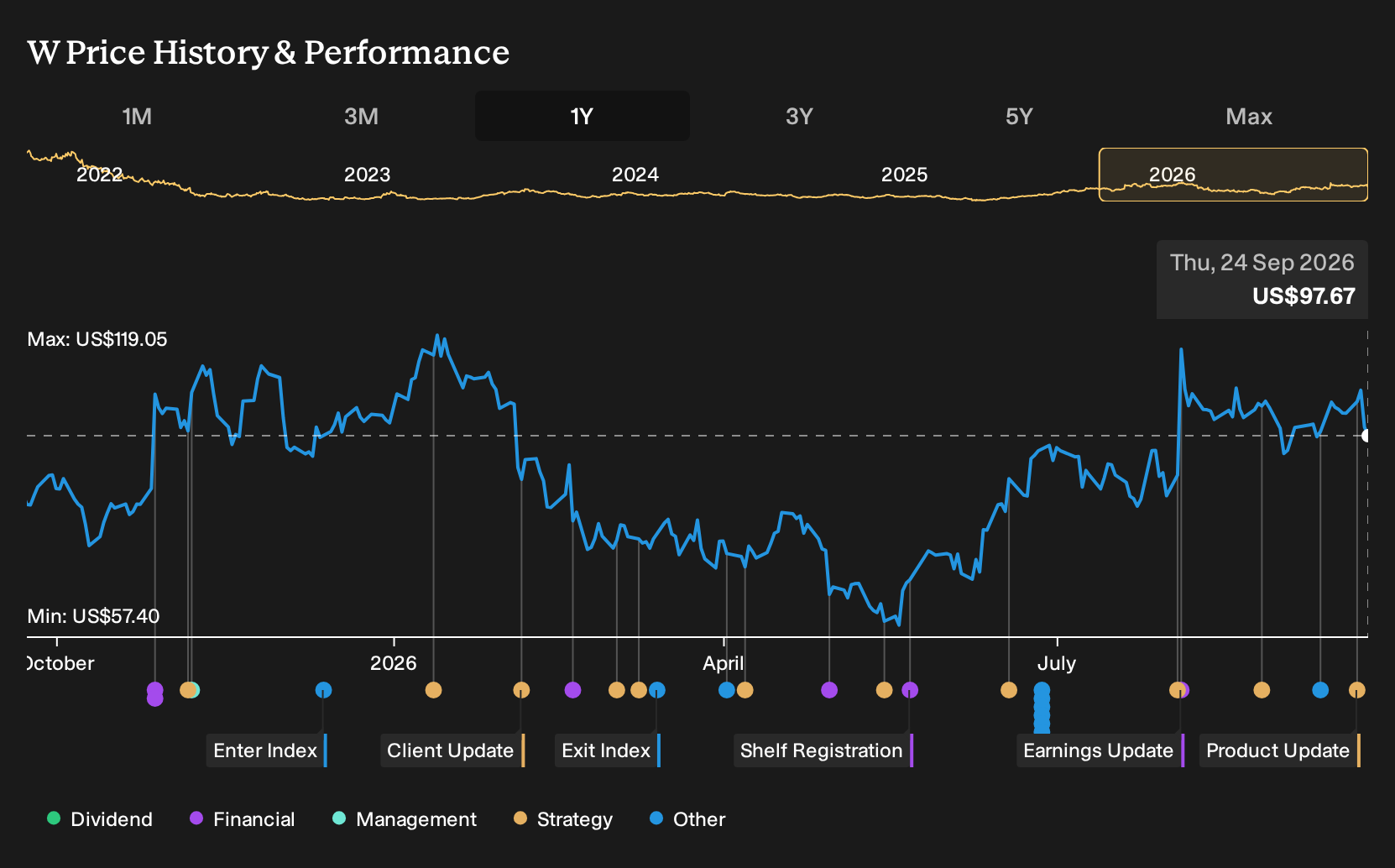
Exploring Other Perspectives
One alternate take on Wayfair leans hard into CastleGate and logistics as a profit engine. The most optimistic analysts were already penciling in about US$17.1b of revenue and roughly US$956.6m of earnings by 2029, before this Wayfair Delivers campaign existed. This launch can be treated as a fresh test of that more aggressive story.
Explore 3 other Wayfair fair value estimates, including one that suggests potential upside of up to 112% from the current price.
Decide For Yourself
Disagree with existing narratives? Extraordinary investment returns rarely come from following the herd, so go with your instincts.
- A great starting point for your Wayfair research is our analysis highlighting 3 key rewards and 3 important warning signs that could impact your investment decision.
- See our latest analysis for Wayfair. The report includes a comprehensive fundamental analysis summarized in a single visual, the Snowflake, making it easy to evaluate Wayfair's overall financial health at a glance.
Looking For More Ideas Beyond Wayfair?
If the Wayfair story has sharpened your thinking about logistics, pricing power and customer loyalty, you can use that same framework to scan the wider market with the Simply Wall St Screener. You can focus on balance sheet strength, income potential or underappreciated quality, then shortlist stocks that fit your own risk tolerance and time horizon.
- If capital preservation matters most to you, start with companies that our models flag as relatively resilient by checking the 31 resilient stocks with low risk scores.
- For investors who care about financial strength and staying power, filter for businesses with robust finances and sound fundamentals using the list of solid balance sheet and fundamentals (23 results).
- If you want to widen your watchlist with underfollowed ideas that still have solid fundamentals, take a look at the 16 high quality undiscovered gems.
This article by Simply Wall St is general in nature. We provide commentary based on historical data and analyst forecasts only using an unbiased methodology and our articles are not intended to be financial advice. It does not constitute a recommendation to buy or sell any stock, and does not take account of your objectives, or your financial situation. We aim to bring you long-term focused analysis driven by fundamental data. Note that our analysis may not factor in the latest price-sensitive company announcements or qualitative material. Simply Wall St has no position in any stocks mentioned.
Have feedback on this article? Concerned about the content? Get in touch with us directly. Alternatively, email editorial-team@simplywallst.com