
How Investors Are Reacting To Dover (DOV) SaaS Packaging Launch
- Markem-Imaje, a Dover subsidiary, recently introduced CoLOS 2D Activate and CoLOS 2D Engage SaaS platforms to help global manufacturers manage GS1 Digital Link QR codes for compliance and consumer engagement ahead of the 2027 Sunrise deadline.
- The combination of new connected-packaging software and analysis pointing to Dover trading below estimated intrinsic value highlights how software, services, and cash generation are increasingly intertwined in the business model.
- This article examines how Dover's long-term investment narrative is influenced by connected-packaging SaaS growth through Markem-Imaje.
Scan beyond Dover and spot other packaging and compliance plays that are potentially primed for similar QR and connected-packaging tailwinds with our curated list of 16 high quality undiscovered gems.
Dover Investment Narrative Recap
To own Dover, you need to believe that a broad industrial portfolio can keep turning steady demand into predictable cash, even as end markets move at different speeds. In the near term, the key swing factor is execution on higher growth areas like clean energy components, data center cooling and automation, which analysts see as supporting future revenue and earnings. The Markem Imaje QR code SaaS launch fits that pattern but does not radically change the short term picture.
The biggest risk still sits in the more cyclical and slower growth parts of Dover, where project pushouts, pricing pressure and mix shifts can dilute margins. Restructuring and footprint consolidation projects also carry real execution risk. Cost overruns or delays could blunt the benefit of portfolio upgrades, especially if demand in refrigeration, LNG or vehicle services softens at the same time.
The CoLOS 2D Activate and CoLOS 2D Engage rollout through Markem Imaje is the announcement that ties most directly to the current story. It pushes Dover further into recurring, software driven connected packaging, which links well with the broader push into higher margin digital and service offerings. For investors, the key question is how meaningful that recurring software and services layer can become compared with hardware heavy segments.
On the catalyst side, this type of SaaS launch complements the capital being put to work in data center cooling, clean energy components and precision fluid handling. It supports the idea of a larger mix of aftermarket, software and service revenue that could make earnings less volatile. On the risk side, success depends on adoption by CPG and FMCG manufacturers ahead of the 2027 GS1 deadline and on Dover avoiding pricing or competitive pressure that could compress returns from these digital investments.
Dover consensus expectations in context
Dover's current analyst narrative assumes revenue grows by 5.1% each year, with earnings moving from $1.1b today to a consensus estimate of $1.5b by 2029, which is an increase of about $0.4b. That forecast ties to a 2029 revenue figure of $9.8b and embeds higher profit margins as the business leans further into software, services and higher value components.
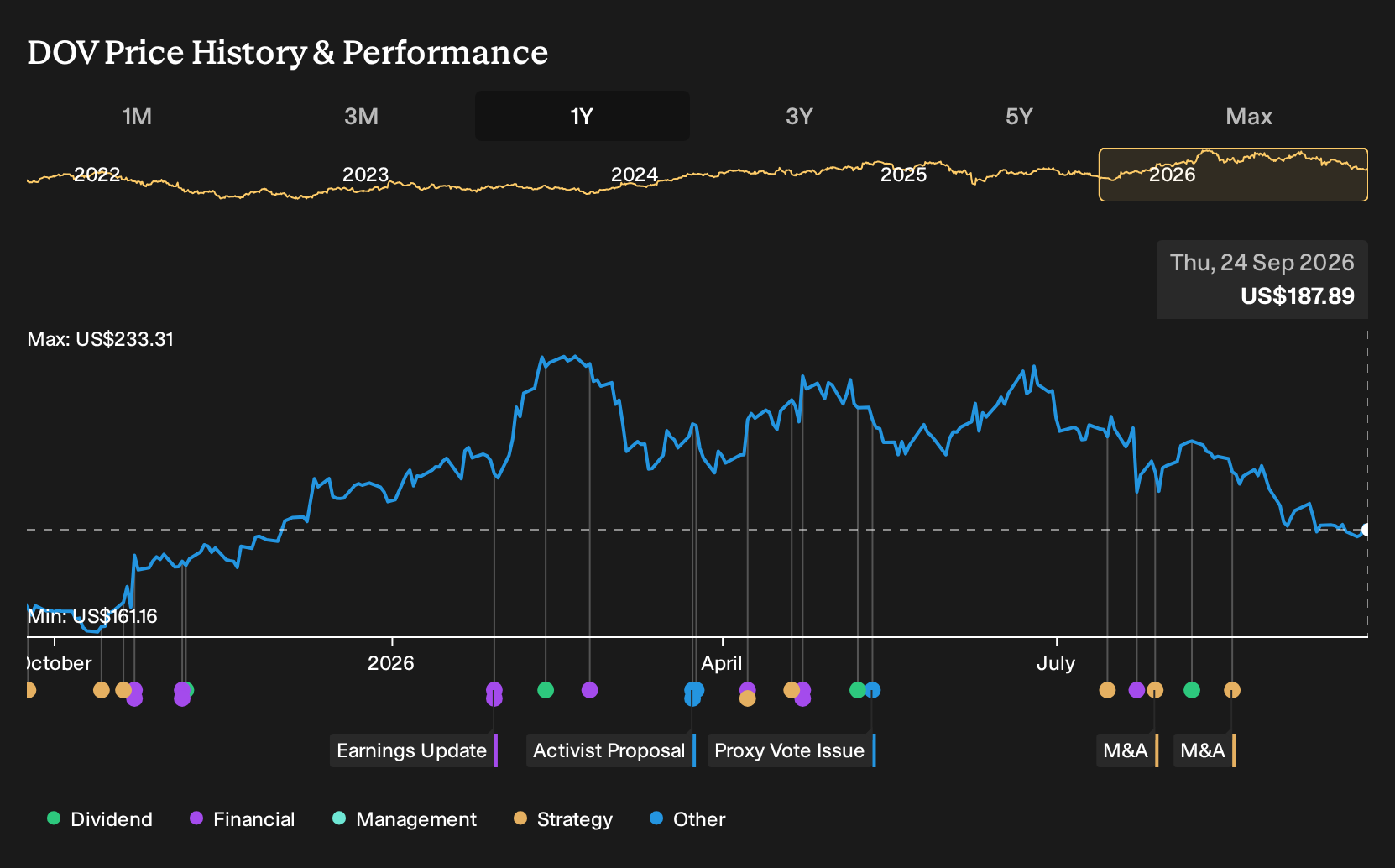
Those same forecasts imply that by 2029 Dover would earn $1.5b on that $9.8b of sales. The consensus view then applies a P/E of 26.0x to those 2029 earnings, compared with 22.5x today and 24.4x for the wider US Machinery peer group in the report, to support a price target of $245.72 against a current share price of $188.97.
The spread between analyst views is wide. Earnings expectations range from $1.4b to $1.9b for 2029 and price targets run from $168.0 to $288.0. That dispersion shows how differently people are weighing the benefits of connected-packaging SaaS, data center exposure and clean energy components against restructuring execution risk and exposure to more cyclical end markets.
For investors thinking about Dover, the key analytical question is whether the mix shift toward recurring revenue, including Markem Imaje's CoLOS 2D platforms, can support that move in earnings from $1.1b to $1.5b without stretching capital intensity or price competitiveness. A separate question is whether a 26.0x P/E on those earnings feels reasonable given the machinery sector reference point and the possibility that industrial sentiment or interest rates in 2029 could differ from today.
Dover's narrative projects $9.8b revenue and $1.5b earnings by 2029. This requires 5.1% yearly revenue growth and an earnings increase of about $0.4b from $1.1b today.
Uncover why Dover's fair value indicates a 31% potential upside to its current price, which could narrow quickly.
Exploring Other Perspectives
Two fair value estimates from the Simply Wall St Community cluster tightly between about $241.55 and $245.72. This contrasts with analysts pointing to connected-packaging SaaS, data center cooling and clean energy projects as possible earnings drivers for Dover. Investor opinions can differ widely, so explore several viewpoints before deciding how this fits your portfolio.
Explore another Dover fair value estimate, including one that suggests it could be worth just $241.55!
Form Your Own Verdict
Disagree with existing narratives? Extraordinary investment returns rarely come from following the herd, so trust your own analysis.
- A great starting point for your Dover research is our analysis highlighting 4 key rewards that could impact your investment decision.
- See our latest analysis for Dover. The report includes a comprehensive fundamental analysis summarized in a single visual, the Snowflake, which makes it easier to evaluate Dover's overall financial health at a glance.
Looking For More Investment Ideas Beyond Dover?
Once you have a view on Dover, it often helps to compare it with other companies that share similar qualities or offer a different balance of risk and return. The Simply Wall St Screener can help you quickly surface sets of stocks that match the kind of profile you are looking for.
- If resilience matters most to you, start with a group of companies that score well on stability using our 30 resilient stocks with low risk scores.
- If balance sheet strength is your anchor, compare Dover with financially robust peers by filtering through the list of solid balance sheet and fundamentals (24 results).
- If you prefer under-the-radar opportunities, widen your watchlist with a curated 8 elite penny stocks with strong financials that already show stronger financials than most in their price range.
This article by Simply Wall St is general in nature. We provide commentary based on historical data and analyst forecasts only using an unbiased methodology and our articles are not intended to be financial advice. It does not constitute a recommendation to buy or sell any stock, and does not take account of your objectives, or your financial situation. We aim to bring you long-term focused analysis driven by fundamental data. Note that our analysis may not factor in the latest price-sensitive company announcements or qualitative material. Simply Wall St has no position in any stocks mentioned.
Have feedback on this article? Concerned about the content? Get in touch with us directly. Alternatively, email editorial-team@simplywallst.com