
National Australia Bank (ASX:NAB), Why Is It Getting Attention Today?
National Australia Bank (ASX:NAB) has completed a ¥15b fixed income offering, issuing callable subordinated fixed to floating rate notes due 2036. This provides investors with another lens on the bank’s funding and capital structure.
Recent events around National Australia Bank include the digital outage affecting online and app services and the rollout of its Community Hub in Cairns branches. Both shape how investors think about operational resilience and customer engagement as the bank raises subordinated funding.
Against that backdrop, the stock’s 1-day share price return of 1.02% and 90-day share price return of 2.75%, alongside a year-to-date share price decline of 9.10%, contrast with a 3-year total shareholder return of 52.55% and 5-year total shareholder return of 80.09%. This combination points to cooling near term momentum within a stronger multi year record.
Compare how National Australia Bank stacks up on funding strength and digital execution against a hand picked set of 7 resilient stocks with low risk scores.
National Australia Bank now trades only fractionally below both intrinsic estimates and analyst targets after a mixed share price run. Is the modest discount a cautious market overreacting to recent hiccups, or a fair read on risk?
Most Popular Narrative: Overvalued
The most followed narrative puts National Australia Bank’s fair value at A$38.38, slightly below the recent close around A$38.54, which leaves only a slim valuation cushion for new buyers.
Ongoing digital transformation, focus on cost management, and productivity initiatives (including Citi integration, streamlined processes, and leveraging AI tools) are expected to structurally reduce the cost-to-income ratio over time, which could support higher net margins and profitability.
See why 72 investors see National Australia Bank as 0% overvalued.
Result: Fair Value of A$38.38 (OVERVALUED)
Still, the National Australia Bank story could shift quickly if digital rivals accelerate customer churn or if higher technology and compliance costs squeeze the profit pool.
Find out about the key risks to this National Australia Bank narrative.
Another View: National Australia Bank Through Earnings Ratios
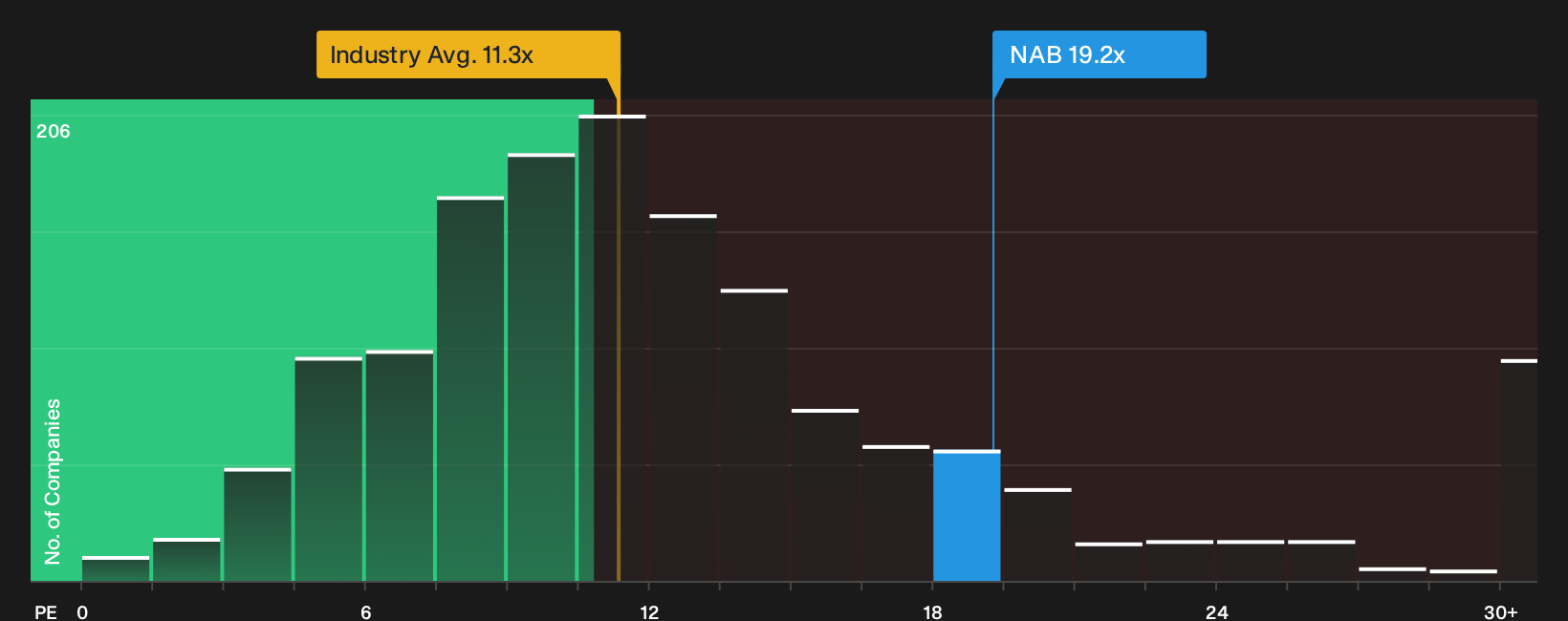
On simple price versus fair value estimates, National Australia Bank screens as only slightly overpriced. Shift the lens to its P/E though and the picture looks different, with the stock at 19.2x compared with 11.3x for global banks and about 17x for peers.
The fair ratio sits at 19.6x, just above where National Australia Bank trades today, which implies only a narrow margin for error if sector sentiment weakens or earnings forecasts change. The question for you is whether paying a premium to industry and peer averages feels justified by the story you believe in.
See what the numbers say about this price — find out in our valuation breakdown.
Next Steps
Mixed messages on National Australia Bank’s valuation and sentiment can be confusing, so move quickly, check the numbers yourself, and decide what feels justified for your goals. To see both the potential upsides and the pressure points in one place, review the 2 key rewards and 2 important warning signs.
Looking for more investment ideas beyond National Australia Bank?
If the National Australia Bank story feels tight on valuation, broaden your watchlist now and give yourself more options before the next shift catches you off guard.
- Target stability first by scanning a list of solid balance sheet and fundamentals (12 results) so you can focus on businesses with stronger financial footing behind their share prices.
- Hunt for pricing gaps with a 6 high quality undervalued stocks that highlights companies where quality and current market expectations appear out of sync.
- Spot early opportunities using a 16 high quality undiscovered gems that surfaces quieter tickers with fundamentals that may not yet be widely followed.
This article by Simply Wall St is general in nature. We provide commentary based on historical data and analyst forecasts only using an unbiased methodology and our articles are not intended to be financial advice. It does not constitute a recommendation to buy or sell any stock, and does not take account of your objectives, or your financial situation. We aim to bring you long-term focused analysis driven by fundamental data. Note that our analysis may not factor in the latest price-sensitive company announcements or qualitative material. Simply Wall St has no position in any stocks mentioned.
Have feedback on this article? Concerned about the content? Get in touch with us directly. Alternatively, email editorial-team@simplywallst.com