
Bruker Stock After A $6 Million UC Berkeley NMR Order
- Bruker announced that the University of California, Berkeley placed a multi system NMR order exceeding US$6 million, centered on an AV NEO-X 800 MHz spectrometer with a cryogenically cooled MAS CryoProbe plus several complementary systems, with delivery planned for 2027 to the Pines Magnetic Resonance Center.
- The UC Berkeley deal underlines demand for Bruker’s high field NMR platforms across solid state, solution state and DNP research. This reinforces the company’s role as a core supplier to large academic centers that often influence broader equipment purchasing trends.
- We will now assess how Bruker’s sizable UC Berkeley high field NMR order could influence the existing investment narrative around research funding.
Scan how academic equipment demand, such as Bruker’s UC Berkeley NMR deal, is rippling across research suppliers by reviewing our curated 16 high quality undiscovered gems in the scientific tools space.
Bruker Investment Narrative Recap
To own Bruker, you need to believe the demand for advanced scientific instruments remains resilient enough for the firm to grow into its cost base and return to consistent profitability. The UC Berkeley NMR order supports that long term thesis around high end research tools, but at a bit over US$6 million it does not materially change the near term picture.
The key short term catalyst still sits in any sign that research and biopharma funding levels are stabilising, especially in the US and China, so that order books and book to bill ratios stop softening. The biggest risk remains continued funding pressure and weak visibility, which would keep Bruker leaning on cost cuts while debt stays less comfortably covered by operating cash flow.
The UC Berkeley win connects most closely to the broader expectation that research spending eventually steadies and supports Bruker’s pipeline of advanced analytical platforms. That order is one concrete example of a well funded institution committing real money to high field NMR, which points to ongoing relevance of the company’s core BioSpin and related offerings.
For catalysts, the more important thread is management’s larger cost reduction program that targets US$100 million to US$120 million of annual savings and at least 300 basis points of margin expansion, mainly by FY26, even if revenue growth stays muted. Execution against that plan, alongside continued placements like the Berkeley package, will shape how quickly the business moves from current losses of US$106.9 million toward the profitability that analysts are modelling over the next few years.
Bruker’s current analysis framework points to forecast revenue of US$4.1b and expected earnings of US$328.4 million by 2029. That profile is based on analysts assuming 5.4% yearly revenue growth and an earnings change of roughly US$364.8 million from today’s earnings loss of US$36.4 million to the forecast 2029 consensus level.
Uncover why Bruker's fair value indicates a 7% potential downside to its current price that leaves little room for error.
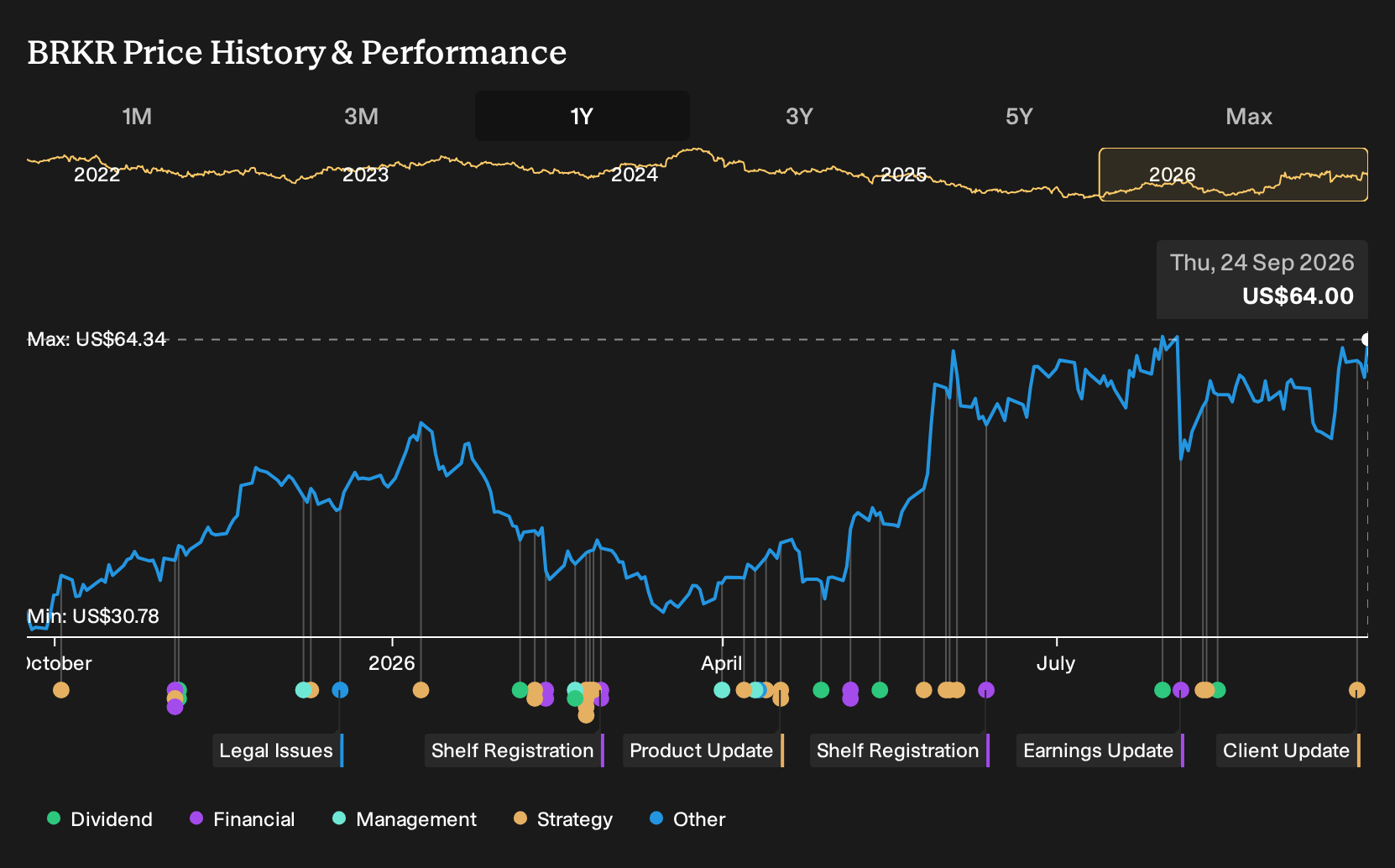
Exploring Other Perspectives
Some of the lowest Bruker forecasts lean hard into funding risk. Those analysts were pencilling in revenue of about US$3.9b and earnings of US$392.5 million by 2029 before this UC Berkeley order, and they still saw a price target near US$42.3. That gap highlights how widely views can differ, so it is worth exploring several angles before deciding what this new contract might mean for you.
Explore 2 other Bruker fair value estimates, including one that suggests as much as 34% downside from the current price.
Decide For Yourself
Don't just follow the ticker. Dig into the data and build a conviction that's truly your own.
- A great starting point for your Bruker research is our analysis highlighting 3 key rewards and 1 important warning sign that could impact your investment decision.
- See our latest analysis for Bruker. The report includes a comprehensive fundamental analysis summarized in a single visual, the Snowflake, making it easy to evaluate Bruker's overall financial health at a glance.
Looking For More Ideas Beyond Bruker?
Once the Bruker story is clear in your mind, it often helps to zoom out and compare it with other potential opportunities using a consistent, data led approach.
- For investors who want a margin of safety backed by fundamentals, scan a curated set of 30 high quality undervalued stocks that combine quality metrics with discounted pricing signals.
- If capital preservation ranks high on your list, focus on stability first by reviewing a 30 resilient stocks with low risk scores that scores well on balance sheet strength and earnings volatility.
- When balance sheet resilience matters as much as headline growth, filter for companies with robust finances using a focused list of solid balance sheet and fundamentals (24 results) that can complement a position in Bruker.
This article by Simply Wall St is general in nature. We provide commentary based on historical data and analyst forecasts only using an unbiased methodology and our articles are not intended to be financial advice. It does not constitute a recommendation to buy or sell any stock, and does not take account of your objectives, or your financial situation. We aim to bring you long-term focused analysis driven by fundamental data. Note that our analysis may not factor in the latest price-sensitive company announcements or qualitative material. Simply Wall St has no position in any stocks mentioned.
Have feedback on this article? Concerned about the content? Get in touch with us directly. Alternatively, email editorial-team@simplywallst.com