
Does New Test Platform Change The Bull Case For Teradyne Stock (TER)?
- Teradyne, GS Microelectronics U.S., Inc., and Teradyne’s India team have recently advanced semiconductor and optical test capacity through a multi-year U.S. test center partnership, a new Iris 100 microLED test platform, and a dedicated Bengaluru office for local manufacturing support.
- The combination of a Teradyne-equipped Silicon Valley evaluation hub, the microLED-focused Iris 100 system, and an on-the-ground India presence points to higher customer engagement intensity across AI, photonics, display, and power device testing.
- The next area of focus is how Teradyne's Iris 100 microLED platform could influence the longer term investment narrative around test automation.
Teradyne Investment Narrative Recap
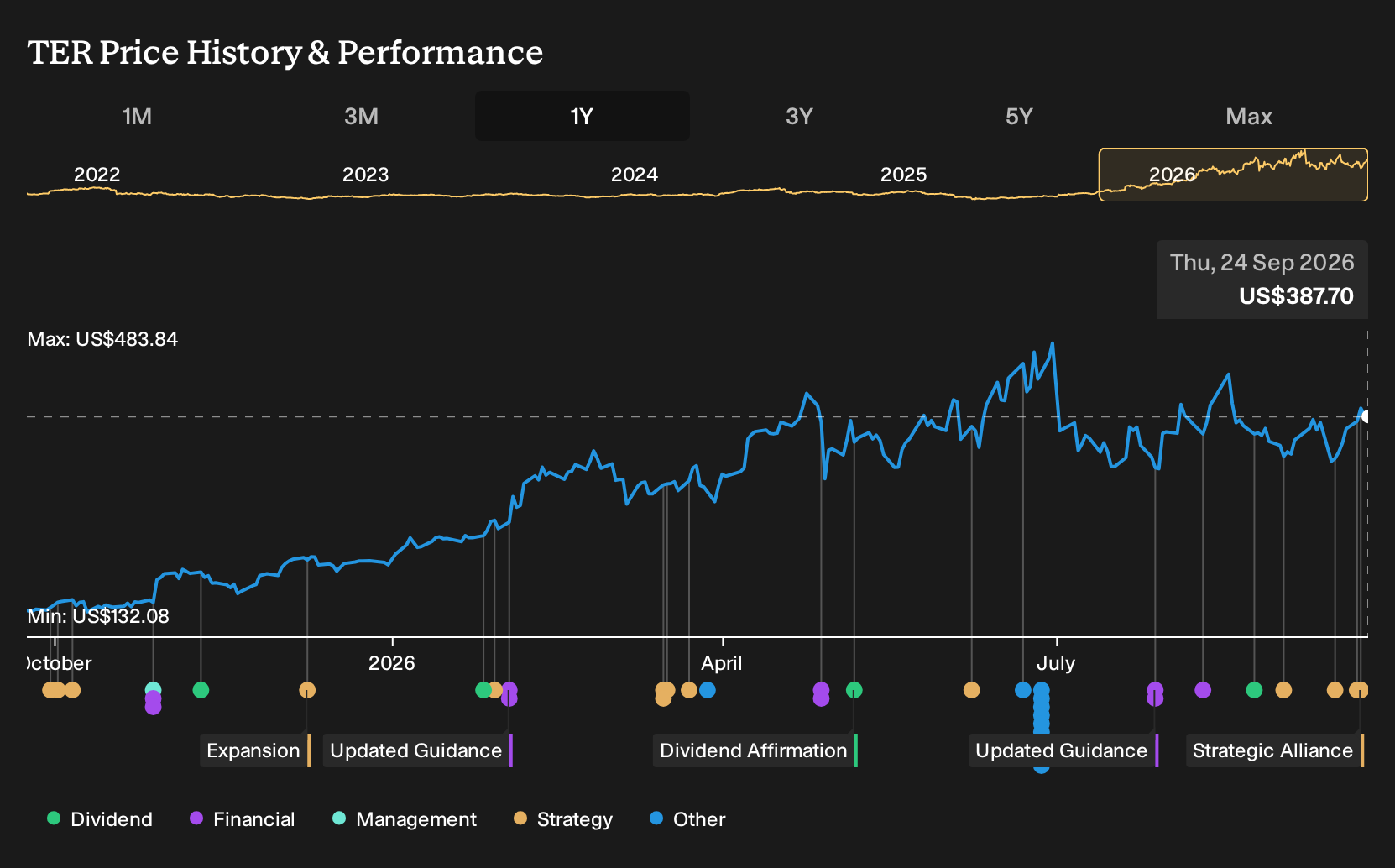
To own Teradyne, you need to believe test automation remains a key way semiconductor and electronics customers manage rising complexity in AI, photonics, and power devices. In the near term, the main operational swing factor is how consistently large chip and electronics makers spend on advanced test capacity. The recent Silicon Valley test center, Iris 100 launch, and India office collectively support that case but do not remove demand cyclicality.
The main risk still sits in uneven orders tied to trade policy, tariffs, and shifting product mix, which can pressure margins and earnings visibility beyond a couple of quarters. Robotics softness and a volatile share price add execution and sentiment risk if end markets pause capex. These announcements may help Teradyne deepen customer ties, but they do not insulate the business from macro or policy shocks.
The Iris 100 optical test platform appears most directly connected to the test capacity and AI infrastructure narrative. It targets microLED manufacturing for AR microdisplays and optical interconnects in AI data centers, both device categories that can require high precision, high throughput characterization. By tying Iris 100 into the established UltraFLEXplus and IG XL ecosystem, Teradyne is aiming to keep customers within a single test workflow for both optical and electrical steps.
For investors focused on catalysts, Iris 100 fits into the same themes analysts already watch, including AI accelerators, silicon photonics, and more complex board and device testing. Execution risk is material. Adoption depends on how quickly microLED and optical interconnect volumes increase and how test budgets are allocated across competing suppliers. If demand proves slower or more price sensitive than expected, the platform could see a longer path before materially influencing Teradyne’s revenue mix.
Teradyne's current analyst narrative points to revenue of US$7.3b and earnings of US$2.2b by 2029. That profile assumes 17.8% yearly revenue growth and an earnings increase of about US$1.0b from US$1.2b today.
Discover why Teradyne's fair value suggests a 14% potential upside to its current price before that gap closes.
Exploring Other Perspectives
One big swing factor the bearish analysts keep circling is operating expense. Before this Teradyne news, the lowest forecasts were built on revenue reaching about US$6.8b and earnings of US$1.9b by 2029, with OpEx near 29% to 30% of sales. That is a far more cautious story. Use it as a prompt to compare different viewpoints and decide which assumptions you find more realistic, especially as these announcements potentially reshape expectations.
Explore 4 other Teradyne fair value estimates, including one that suggests as much as 39% downside from the current price.
Form Your Own Verdict
Disagree with existing narratives? Extraordinary investment returns rarely come from following the herd, so consider going with your own analysis.
- A great starting point for your Teradyne research is our analysis highlighting 2 key rewards and 2 important warning signs that could impact your investment decision.
- See our latest analysis for Teradyne. The report includes a comprehensive fundamental analysis summarized in a single visual, the Snowflake, making it easy to evaluate Teradyne's overall financial health at a glance.
Looking For More Investment Ideas Beyond Teradyne?
If Teradyne has sharpened your interest in test automation, AI hardware, and manufacturing capacity, it can be useful to widen the lens and compare it with other companies that share some of those quality or risk traits. The Simply Wall St Screener can help you filter the wider market down to a focused shortlist that actually matches your approach.
- For readers who care most about quality at a reasonable entry point, consider starting with a curated set of 30 high quality undervalued stocks that combine stronger fundamentals with more modest pricing.
- If capital preservation and balance sheet strength are near the top of your checklist, you might want to review a list of solid balance sheet and fundamentals (24 results) that can handle tougher conditions without leaning too heavily on debt.
- Those looking for quieter, steadier holdings rather than headline driven stories can scan a 30 resilient stocks with low risk scores that screens for lower risk profiles across multiple fundamental checks.
This article by Simply Wall St is general in nature. We provide commentary based on historical data and analyst forecasts only using an unbiased methodology and our articles are not intended to be financial advice. It does not constitute a recommendation to buy or sell any stock, and does not take account of your objectives, or your financial situation. We aim to bring you long-term focused analysis driven by fundamental data. Note that our analysis may not factor in the latest price-sensitive company announcements or qualitative material. Simply Wall St has no position in any stocks mentioned.
Have feedback on this article? Concerned about the content? Get in touch with us directly. Alternatively, email editorial-team@simplywallst.com