
Cable's Line in the Sand: Why 1.32 Could Be the level Buyers Have Been Waiting For
Diverging Central Banks and a Restless Middle East: What Is Driving Cable's Mood
Sentiment on 6B has turned cautious this week as the policy paths of the Federal Reserve and the Bank of England continue to diverge. On September 16, the Fed raised its target range by 25 basis points to 3.75% to 4.00%, its first hike since 2023, in a unanimous 12 to 0 vote under Chair Kevin Warsh. The updated dot plot showed 16 of 18 officials penciling in at least one more hike before year end, reinforcing a hawkish US Dollar bias. A day later, the Bank of England held Bank Rate at 3.75% in a 6 to 3 split, with Catherine Mann, Huw Pill, and Megan Greene again voting for an immediate move to 4%.
UK CPI rose to 3.1% in August, and the BoE now expects inflation to climb toward 3.75% by the fourth quarter and above 4% in early 2027, largely on the back of a protracted Middle East conflict that has kept crude and refined energy prices elevated and volatile. Adding another layer to the policy picture, the same September minutes showed the Committee discussing a more forward-looking plan for the remainder of its quantitative tightening program, noting that the Asset Purchase Facility has already been unwound from a peak of £895 billion in February 2022 to £488 billion this month, with £70 billion of that reduction coming in the past year alone. The Bank's next meeting on November 5 is a forecast round decision and is increasingly viewed as the live meeting for a first hike.
Adding to the mix, flash September PMI data pointed to a loss of momentum in the UK's dominant services sector, tempering hopes that resilient growth alone will force the BoE's hand sooner. On the geopolitical front, the United States and Iran held their first direct contact in months on September 23, with envoys meeting Iran's foreign minister on the sidelines of the UN General Assembly and President Trump calling the talks "very productive." The signal remains fragile, however, since Iran has also set conditions around reopening the Strait of Hormuz and Trump separately warned of further military action if no deal is reached, so markets are treating this as a tentative opening rather than a confirmed de-escalation.
This backdrop, along with a firmer Dollar Index and ten-year Treasury yields above 5%, has kept Cable on the back foot, with the pair trading in the 1.32 to 1.33 area, its softest levels since late June.
What the Market Has Done
- The market has been in a well-defined consolidation range between 1.365 (Daily range 2) and 1.32 (Daily range 3) since May 2025, with slight excursions outside the edges, which were quickly met by the opposing side to return prices quickly back into the range.
- Consistent with this, the market is in balance, with yearly VWAP moving sideways as well.
- Within this range, the latest swing up took two months, from end June to end August, to complete, with rotational price action, consisting of deeper pullbacks, rather than a straight move up.
- Following that swing up, sellers responded at 1.365, and the swing down was faster and smoother, taking only one month, from end August to end September, to complete.
What to Expect in the Coming Weeks
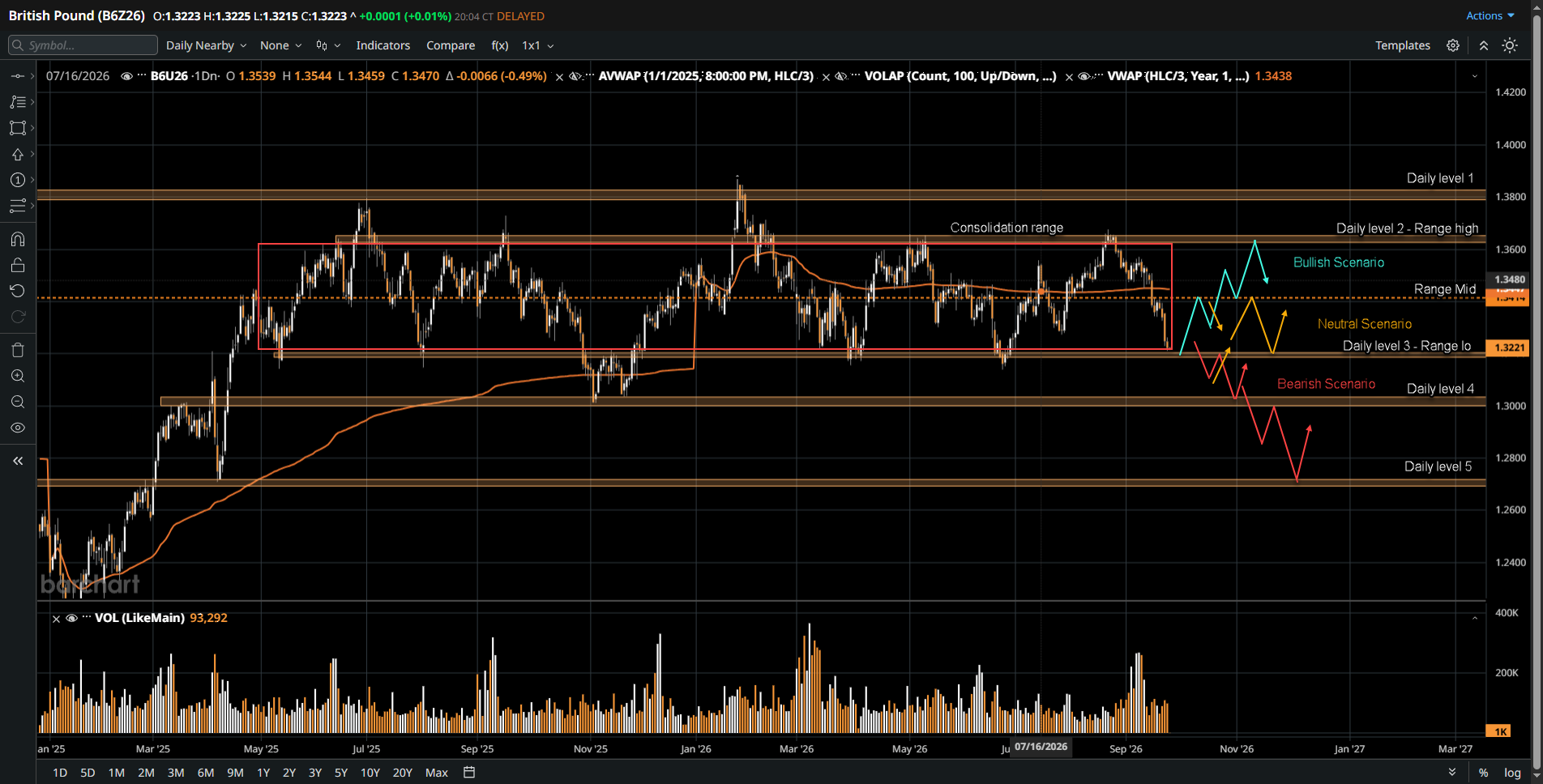
The key level to watch is 1.32 (Daily range 3), which is the consolidation range low.
Bullish Scenario
- If buyers defend the 1.32 area, expect a rotation up back through the range toward 1.365 (Daily range 1), which is the consolidation range high.
- A possible trigger for this scenario is confirmation of a genuine breakthrough in the US Iran talks that began on September 23, building on the first direct contact between the two sides in months; a real de-escalation, rather than the tentative signals seen so far, would ease pressure on energy prices and could soften the Dollar's yield advantage.
Neutral Scenario
- If on the rotation up from 1.32 toward 1.365, sellers hold at the 1.34 area (range mid), which is in the vicinity of the VWAP, expect a possible rotation back down toward 1.32 for a narrower two-way auction between 1.32 and 1.34 to establish value lower.
- A possible supporting condition for this scenario is a data dependent Bank of England that continues to signal a wait and see approach ahead of November 5, keeping both buyers and sellers hesitant to commit.
Bearish Scenario
- If buyers are not able to defend the 1.32 area, expect a move down toward the 1.30 area (Daily level 4). Expect responsive buyers here and prices to reclaim back into the range. However, if buyers are not able to defend the 1.30 area, expect further selloff down to the 1.27 area (Daily level 5).
- A possible trigger for this scenario is a further escalation in the Middle East conflict that drives oil prices sharply higher, reinforcing Dollar demand while squeezing UK growth and complicating the Bank of England's policy calculus.
Conclusion
Cable's price action continues to respect a range that has held for well over a year, and the current test of 1.32 places the market at a genuine decision point rather than a foregone conclusion. Fundamentally, the setup mirrors the technicals. The Federal Reserve has turned hawkish first, the Bank of England is boxed in by an energy driven inflation overshoot it cannot yet act on while also reshaping its quantitative tightening plans, and the tentative US Iran contact this week is a reminder that geopolitical risk can move quickly in either direction. Watch how price behaves around 1.32 over the next few sessions, since the reaction there may say as much about the market's read on diverging central bank paths and a still fragile Middle East backdrop as any single data release between now and the Bank of England's November 5 decision.
We built EdgeClear for traders who treat trading as a business. That means low commissions, zero-friction order routing, and free access to EdgeClear Insights—a cloud-based analytics platform that tracks your P&L, discipline, and execution quality in real time. Build your trading business on a foundation that scales with you. Open an Account today.
Disclaimer:
This article is provided for informational and educational purposes only and does not constitute financial, investment, or trading advice. The analysis presented reflects the author’s market observations and opinions at the time of writing and is not a recommendation to buy or sell any futures contract, security, or financial instrument. Futures trading involves significant risk and is not suitable for all market participants. Losses may exceed initial margin deposits, and market conditions can change rapidly.
Any scenarios, levels, or market expectations discussed are hypothetical in nature and are intended solely to illustrate potential market behavior. They do not represent actual trading results and should not be interpreted as guarantees of future performance. Past performance, market behavior, or historical price action are not indicative of future outcomes.