
Grok Bot Sees User Base Extend 400K. What This Means for SPCX Stock.
Elon Musk-led SpaceX's (SPCX) AI company, SpaceX AI, has achieved a major milestone recently. Its Grok Bot agent now has 418,000 users as of Sept. 14, according to Bloomberg. Denoting a weekly increase of 24%, the news comes in just as Meta Platforms' (META) personal AI agent Muse has stormed to the top position in the App Store and Play Store.
Tweeting about it on X (formerly Twitter), Musk acknowledged the growth and said, “Grok @Bot usage is growing faster than anything we’ve ever seen.”
What Is Grok Bot?
Grok Bot was launched in early beta on August 11, 2026, and is xAI's agentic AI platform. Notably, Grok Bot is the first major “agent with a full computer” product from the company. It started as an internal prototype that spread rapidly for real operational work, then opened to the public in beta. There were no prior public “Grok Bot” versions; this is the debut of the always-on teammate concept with persistent cloud machines and multi-Bot collaboration.
Grok Bot is aimed primarily at professionals, knowledge workers, and teams who do repetitive or multi-step digital work. A Bot can sign into work tools, update a sales record, process an invoice, or file a software bug. It keeps working on a cloud computer after the user closes the app. Users can give different Bots separate jobs, let them pass tasks to each other, and show one Bot a process that it can save for next time. That makes it potentially more useful for recurring work than an assistant that starts fresh with each request.
An example from SpaceXAI gives that pitch some substance. Its procurement Bot reviewed spending across roughly 125 vendors and, according to the company, identified more than $100,000 in direct savings. It found 43 paid software seats with no activity in the previous 90 days, worth $14,220, and a separate $85,662 a year in unused subscriptions.
On price, Grok Bot is not a separate monthly subscription. Cursor includes access in its $20 monthly individual plan and its $40 per user monthly Teams plan. It is also included with SuperGrok at $30 a month and SuperGrok Plus at $100 a month. Included Bot usage resets weekly, while work beyond the allowance can incur additional charges if the user enables that option, according to Cursor’s billing guide. On the other hand, Muse is free within usage limits, with reported paid tiers of $20 and $100 a month. Thus, Muse's free nature and consumer focus are keeping it ahead of Grok Bot.
Overall, assessment of Grok Bot in the future will be based on whether customers keep assigning useful tasks, paid usage grows without runaway computing costs, and enterprise controls make companies comfortable giving Bots more work.
How Was Q2?
SpaceX has achieved notable revenue expansion over recent years, climbing from $10.4 billion in 2023 to $18.7 billion in 2025. The company posted profits of $791 million in 2024 before recording a loss of $4.9 billion the next year.
Operating cash flow strengthened during this span, advancing to $6.8 billion in 2025 from $4.5 billion in 2023. The firm closed 2025 with a solid cash balance of $24.7 billion and minimal short-term debt, which helps address potential liquidity questions.
During the second quarter of 2026, SpaceX generated revenue of $7.8 billion, reflecting a 92% year-over-year increase. Net losses improved to $541 million from a $1 billion loss in the same period a year earlier. The company finished the quarter with $93.5 billion in cash and cash equivalents.
Capital spending has grown substantially over the past three years, rising from $4.4 billion in 2023 to $20.7 billion in 2025. Investments related to artificial intelligence have increased especially quickly, beginning at $463 million in 2023 as the smallest category among space, connectivity, and artificial intelligence before expanding to $12.7 billion in 2025 and becoming the primary focus of capital allocation. This evolution demonstrates how SpaceX, which originally concentrated on space operations and connectivity offerings, is now establishing artificial intelligence as a foundational element for future growth across its businesses. In the second quarter of 2026 alone, artificial intelligence capital expenditures reached $15.8 billion.
Second-quarter 2026 revenue mix shows that connectivity continues to lead with $4.29 billion of the $7.8 billion total. The artificial intelligence segment produced $2.56 billion, a robust contribution from a newer area of the business, while the space segment added $962 million.
From a valuation standpoint, SPCX stock remains significantly elevated relative to peers. For example, the 46.86x price-to-sales ratio is substantially higher than the sector median of 1.14x.
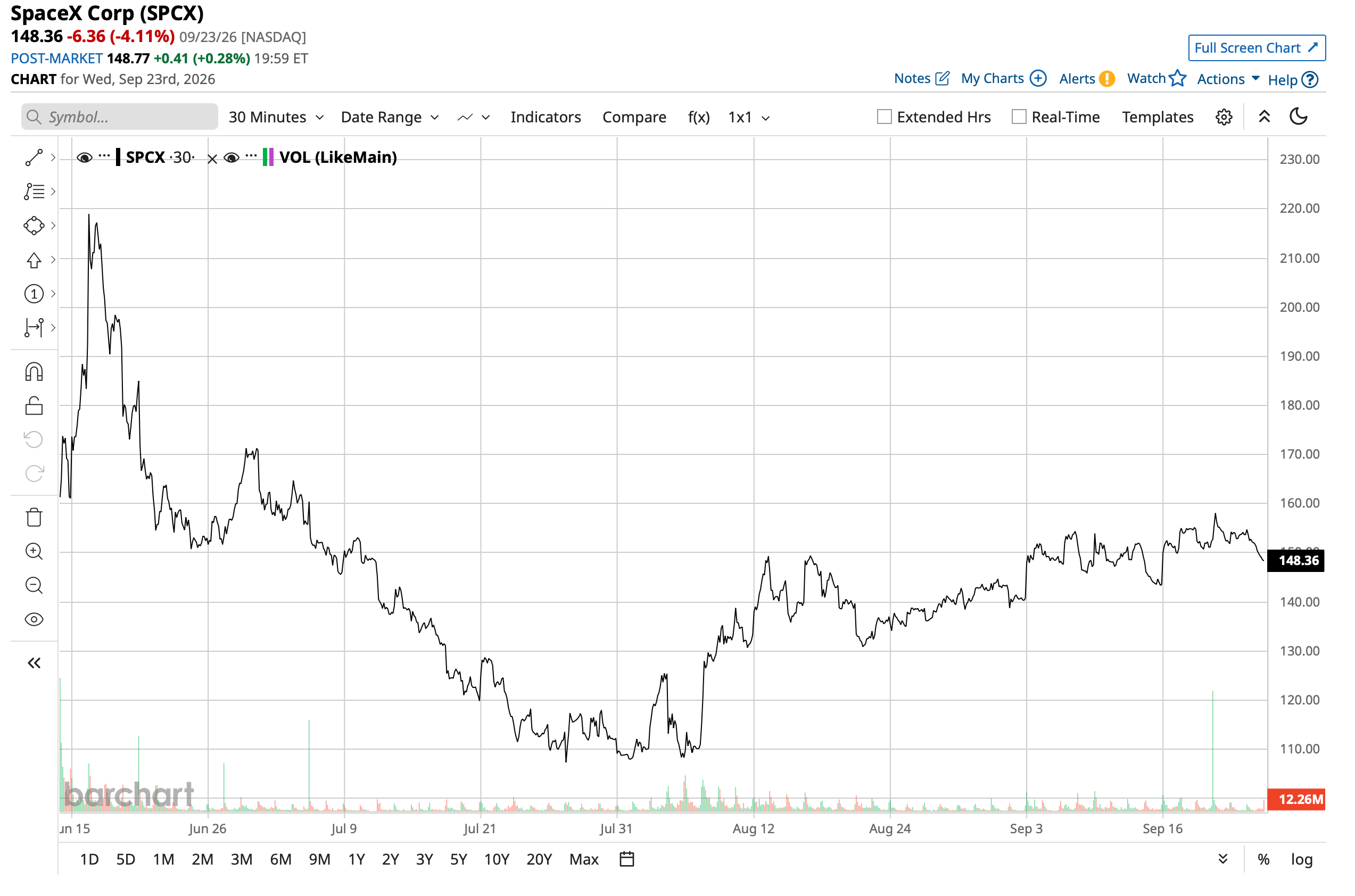
Currently valued at a market cap of just over $2 trillion, SPCX stock is down 7.8% since its IPO.
Analyst Opinion On SPCX Stock
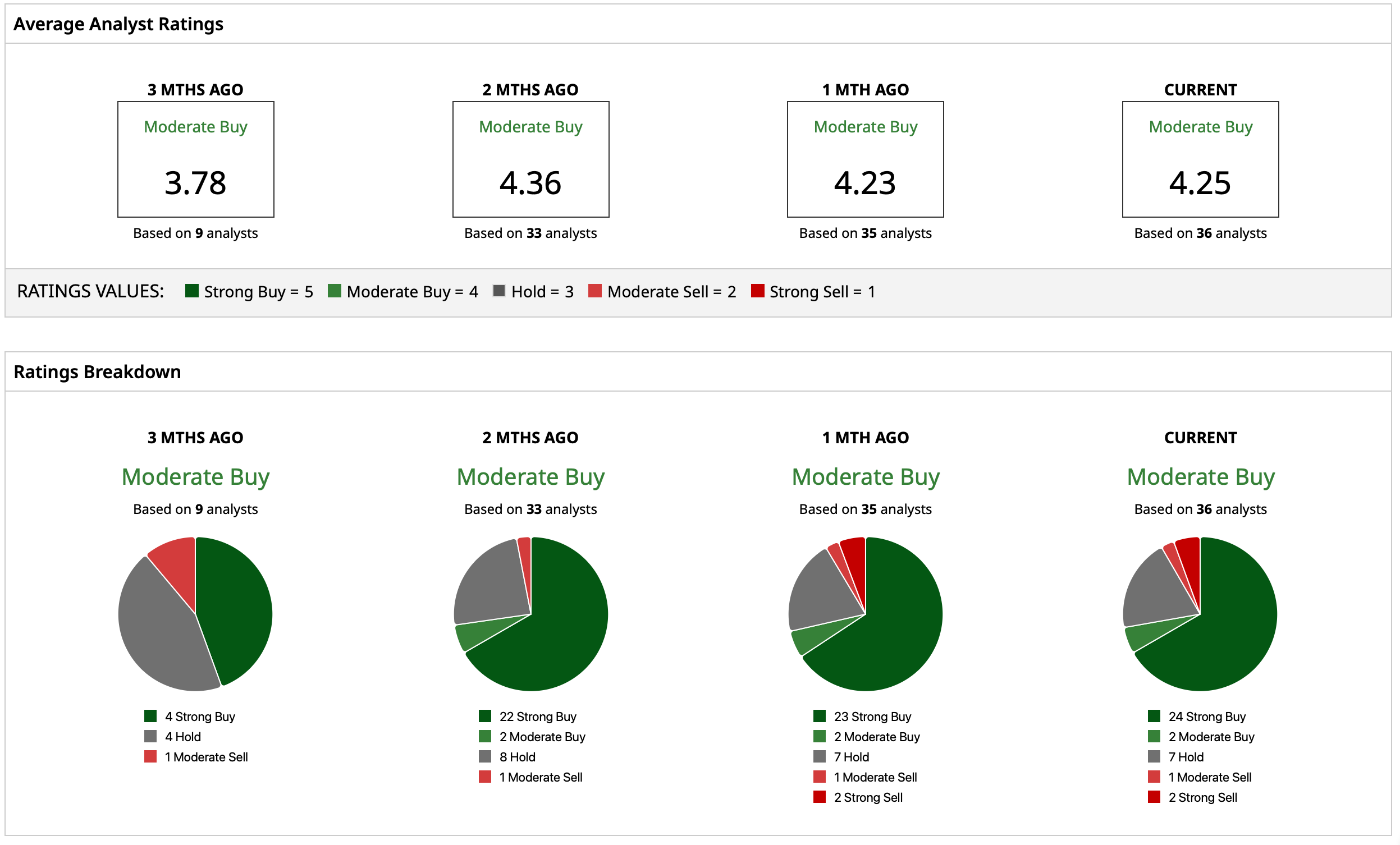
Analysts have assigned an overall rating of “Moderate Buy” for SPCX stock. Out of 36 analysts covering SpaceX stock, 24 have a “Strong Buy” rating, two have a “Moderate Buy” rating, seven have a “Hold” rating, one has a “Moderate Sell” rating, and two have a “Strong Sell” rating. The mean target price of $220.03 indicates potential upside of about 48.3% from current levels.
On the date of publication, Pathikrit Bose did not have (either directly or indirectly) positions in any of the securities mentioned in this article. All information and data in this article is solely for informational purposes. For more information please view the Barchart Disclosure Policy here.