
Can Wheat Rise to a New All-Time High?
Wheat is the primary ingredient in bread that feeds the world. Wheat grows worldwide in North America, Europe, South America, Asia, and Australia. Governments’ main job is to protect and feed their citizens; when they cannot satisfy basic needs, governments have historically lost power. Therefore, meeting wheat demand is critical, making the grain a highly political agricultural commodity. While oil powers the world, wheat feeds it.
On August 18, 2026, I asked how high wheat prices will rise in a Barchart article, concluding with the following:
Markets reflect the economic and geopolitical landscapes. Crude oil powers the world, and wheat, the primary ingredient in bread, feeds the world. Oil and wheat are highly political commodities that are in the crosshairs of wars in the Middle East and Ukraine/Russia. If the conflict around the Black Sea escalates, wheat prices could move significantly higher, as $7.20 per bushel stands as a line in the sand for the agricultural commodity.
Nearby CBOT wheat futures were trading at $6.7375 per bushel on August 17, and the price subsequently rose to nearly $8, the highest price since February 2023. CBOT soft red winter wheat futures are highly liquid and a benchmark for global wheat prices.
CBOT wheat futures continue to rise
CBOT soft red winter wheat futures have made higher lows and higher highs throughout 2026.
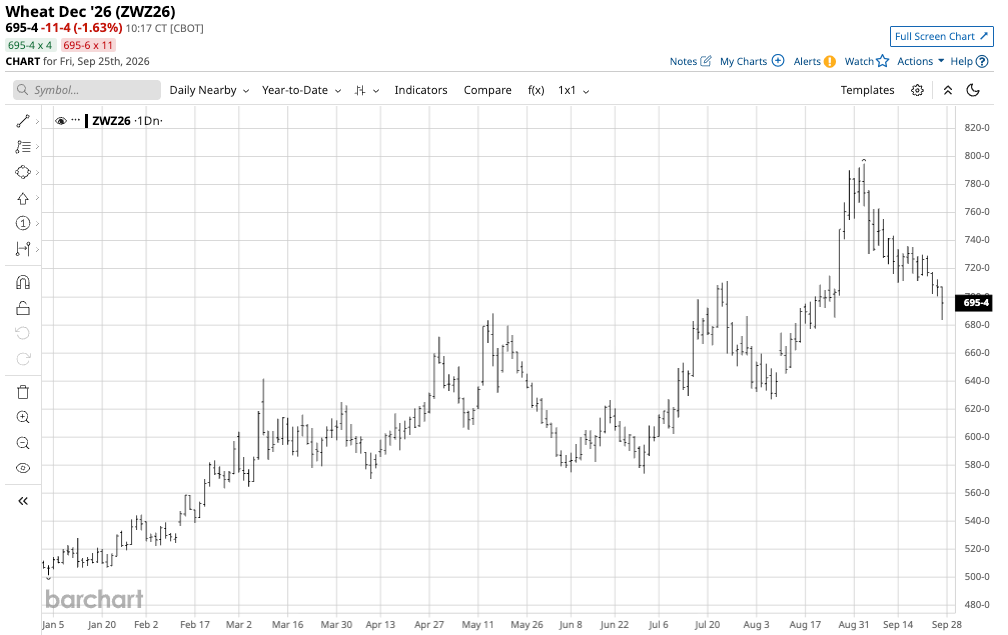
The daily continuous CBOT wheat futures chart shows that after closing 2025 at $5.07 per bushel, they rose 56.8%, reaching $7.95 per bushel on September 2, 2026.
CBOT wheat futures have pulled back to just below $7.00 per bushel; the bullish trend’s next support level is at the $6.50 level.
Geopolitical events have pushed wheat prices higher: Ukraine and Russia
Wheat production and logistics have pushed prices higher. While China and India led the world in wheat production in 2025, with 140.1 and 110 million metric tons, Russia and Ukraine combined for 111.83 million tons, putting the Russian and Ukrainian output second only to China. Meanwhile, Canada led the world in wheat exports in 2025, with 16.9% of total wheat shipped abroad. Australia was the second-largest exporter at 13.5%, while Russia and Ukraine combined for 14.8%, eclipsing Australia’s position in the wheat export market.
The ongoing and escalating war between Russia and Ukraine has disrupted production and critical logistical routes through the Black Sea ports and the Kerch Straight, a 25-mile waterway that connects the Black Sea and the Sea of Azov, and separates the Kerch Peninsula of Crimea from the Taman Peninsula of Russia.
The Kerch Strait is a critical logistical route for maritime traffic and a chokepoint. Russian border authorities halted all vessel passage through the Kerch Strait, which is closed to commercial shipping.
The bottom line is that the war in the region has impacted wheat production and logistics. As the world’s combined second-leading wheat exporters, Russia and Ukraine have seen the war between them cause supply fears and lift prices.
The Middle East conflict has added to supply concerns
Adding to supply fears caused by the ongoing war between Russia and Ukraine is the Middle East conflict between the United States and Iran. The Strait of Hormuz is a focal point for the crude oil market, but its closure has also impacted global fertilizer supplies. Moreover, while there are strategic petroleum stockpiles, there are few, if any, fertilizer stockpiles, which is affecting agricultural production, and wheat is no exception. The fertilizer issue has increased production costs and caused output issues. Therefore, the Middle East conflict adds insult to injury with the ongoing war in Ukraine.
Levels to watch in CBOT wheat futures as it moves toward the 2022 record high caused by a geopolitical event and a coming super El Niño
The long-term quarterly chart of CBOT soft red winter wheat futures shows the critical technical support and resistance levels to watch over the coming weeks and months.
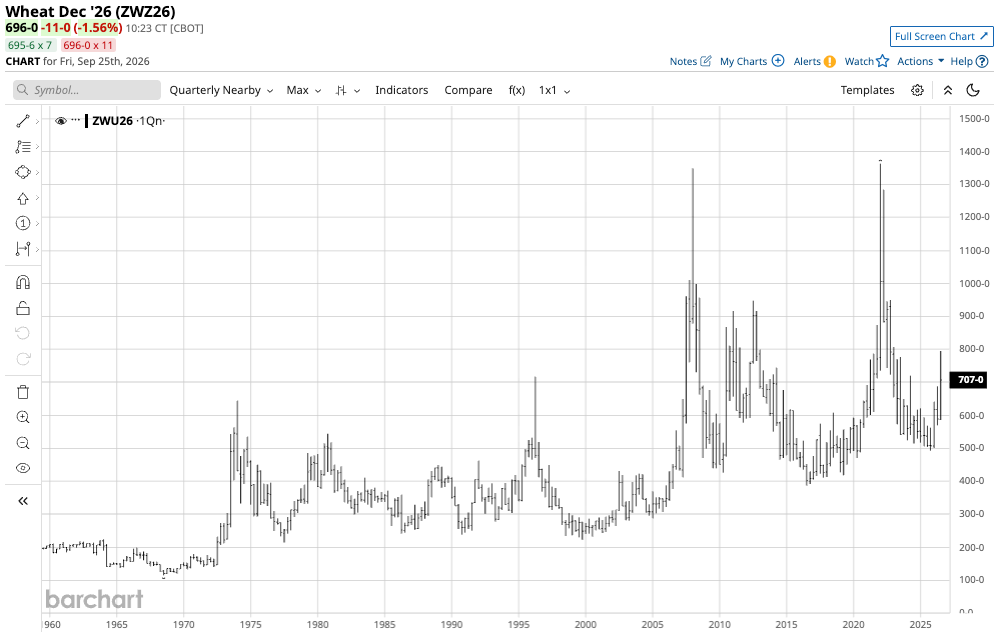
The chart shows the next upside technical targets above $7.95 are the Q1 2023 high of $8.0750, the Q4 2022 high of $9.4975, and the Q1 2022 all-time high of $13.6350 per bushel. The current technical support level is at the Q1 2025 high of $6.2175 per bushel.
Aside from the wars in Ukraine and the Middle East, the rising potential for a super El Niño weather pattern in 2027 could affect worldwide crops, as weather is always the critical factor for annual crops and the path of least resistance for agricultural commodity prices.
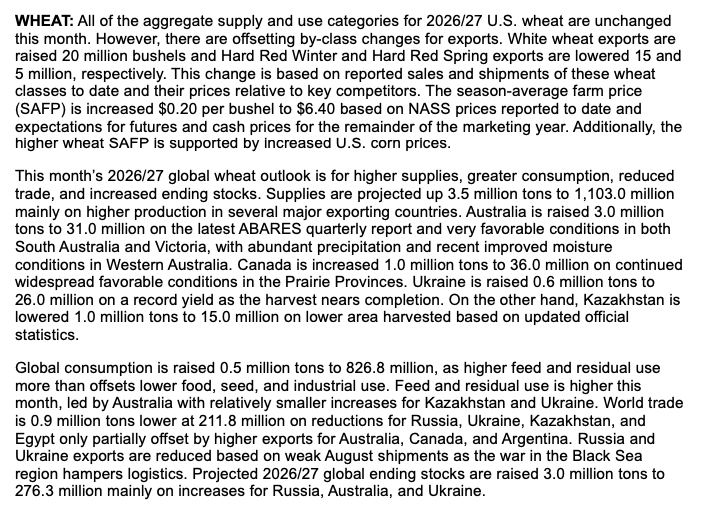
While the USDA raised the season-average far price by 20 cents to $6.40 per bushel, the September WASDE said the 2026/2027 global ending stocks increased from the previous month.
The WEAT ETF tracks CBOT wheat futures
The most direct route to CBOT wheat exposure is the futures and futures options. At $7.00 per bushel, each 5,000-bushel contract is worth $35,000. The futures are leveraged instruments that require specialized trading accounts. The CBOT’s original margin requirement for wheat is $2,255 per contract or 6.44% of the contract value. If equity moves below $2,050, the exchange requires maintenance margin payments. Wheat price volatility determines margin levels. As volatility rises, margin requirements increase.
The Teucrium Wheat ETF (WEAT) lets market participants gain wheat exposure without the leverage or account requirements of the futures market. At $25.38 per share, WEAT had $304.283 million in assets under management. WEAT trades an average of nearly 680,000 shares per day and charges a 0.62% management fee. WEAT owns a portfolio of three actively traded CBOT wheat futures contracts, excluding the nearby contract to minimize roll risks. Since the nearby contract attracts the most speculative activity, it tends to experience the highest price volatility. Therefore, WEAT often underperforms nearby CBOT wheat futures on the upside and outperforms the futures during price declines.
The most recent rally in nearby CBOT wheat futures took them 26.8% higher, from $6.2675 on August 6 to $7.9500 per bushel on September 2.
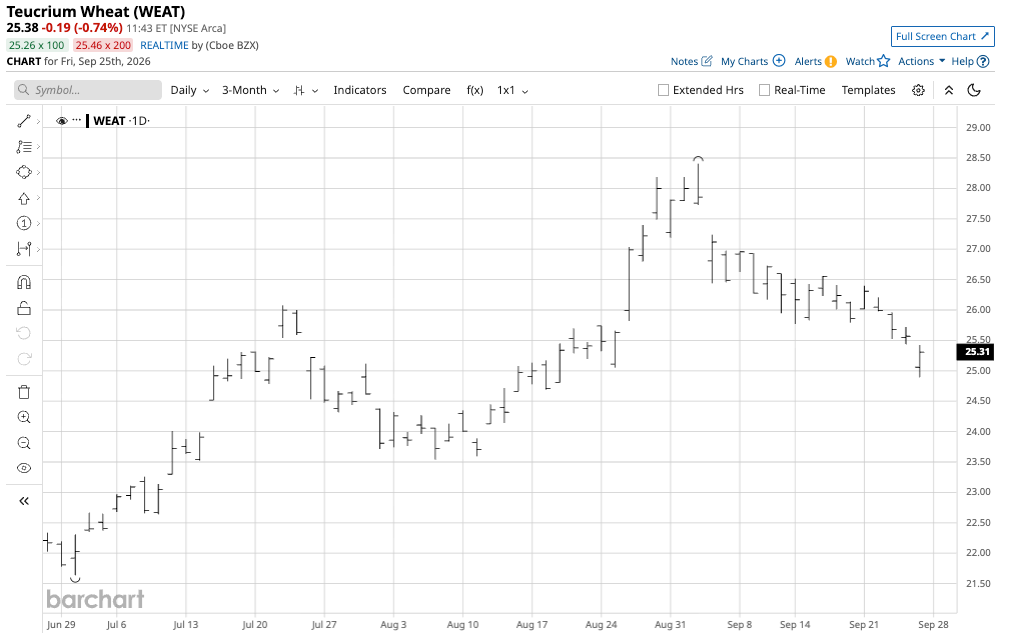
Over the same period, the WEAT ETF rose 20.7% from $23.54 to $28.41 per share, slightly underperforming the nearby futures. The correction took the CBOT wheat futures 14% lower, from $7.95 on September 2 to $6.8350 on September 25. Over the same period the WEAT ETF fell 12.4% from $28.41 to $24.89 per share, slightly outperforming the nearby futures.
If the wars in Ukraine and the Middle East continue to escalate and a super El Niño impacts crops, a perfect bullish storm could push CBOT wheat prices toward a test of the 2022 all-time high.
On the date of publication, Andrew Hecht did not have (either directly or indirectly) positions in any of the securities mentioned in this article. All information and data in this article is solely for informational purposes. For more information please view the Barchart Disclosure Policy here.